


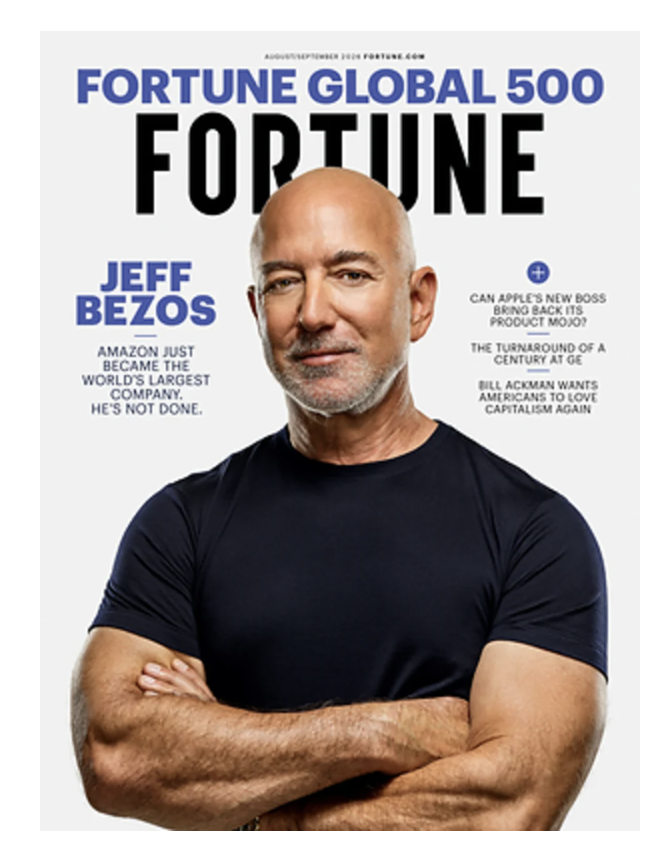
Historically, Amazon has defined its corporate trajectory by its willingness to build massive, self-sustaining ecosystems that the rest of the business world initially doubted but ultimately came to rely upon. In an illuminating mid-2026 interview with Fortune, Amazon’s founder and Executive Chair, Jeff Bezos, mapped out what he believes will be the company’s next great, generational foundation: custom silicon. For decades, the global business community understood Amazon through three primary, seemingly indestructible pillars—its ubiquitous e-commerce Marketplace, its sticky and customer-centric Prime subscription program, and the paradigm-shifting cloud infrastructure of Amazon Web Services (AWS). Yet, as the world stands on the precipice of an artificial intelligence revolution demanding unfathomable quantities of raw processing power, Bezos sees a fourth pillar rising directly from the cleanrooms of semiconductor fabrication plants. This vision is not merely a reactionary play to survive the AI gold rush, but a profound declaration that Amazon intends to own the physical substrate upon which the future of global computing will be written. By designing its own microchips, Amazon is positioning itself to bypass traditional hardware bottlenecks, establishing a direct pipeline of specialized, cost-effective computing power that could fundamentally alter the economics of technology. This strategic pivot marks a transition from a company that merely orchestrates digital operations to one that physically manufactures the brainpower of the next century, transforming raw sand into the silicon engine of global commerce.
The journey to this state of silicon independence did not happen overnight; it is the culmination of a quiet, decade-long gamble that showcases the company’s unique brand of patient capital and long-term thinking. Back in 2015, long before “generative AI” became a fixture of public discourse, Amazon made a stealthy and highly strategic acquisition of Annapurna Labs, an Israeli chip design startup that many industry observers overlooked at the time. While competitors were content to purchase off-the-shelf processing units from established silicon giants, the brilliant engineers at Annapurna, working out of Tel Aviv and Haifa, were quietly empowered to construct custom architecture tailored specifically for the hyper-scale workloads of Amazon’s growing data centers. This massive, coordinated effort eventually bore fruit in the form of Graviton, Nitro, and eventually, the company’s highly specialized AI-focused processors: Trainium and Inferentia. Trainium was designed from the ground up to handle the incredibly taxing phase of training massive, multi-billion-parameter large language models, while Inferentia was optimized to run those models efficiently once they were deployed in the real world. By controlling the entire stack from the physical transistor to the cloud-accessible user interface, Amazon bypassed the crippling supply-chain bottlenecks and exorbitant markups that have plagued the rest of the technology sector during the modern chip scarcity. The human element of this story lies in the sheer audacity of these engineers who took on the established silicon monopoly, working diligently in the shadows for over ten years to build a hardware architecture capable of going toe-to-toe with the most advanced processors on Earth.
Today, the real-world implications of this multi-billon-dollar silicon gamble are manifesting in massive public partnerships and staggering financial returns that are turning the heads of Wall Street analysts. The custom silicon division has quietly built an annual run rate exceeding $20 billion, driven by the intense demand for Trainium, Graviton, and Nitro chips among developers who are desperate for affordable alternatives to the dominant, and highly expensive, GPUs produced by Nvidia. AI pioneers like Anthropic are already deep in the trenches, utilizing Trainium to train and execute their cutting-edge Claude models directly within the AWS ecosystem, with researchers from both companies collaborating late into the night to optimize their code. Even OpenAI, a firm historically linked to rival infrastructure, has signed a monumental commitment to consume approximately two gigawatts of Trainium computing capacity, a rollout schedule that is set to ramp up dramatically into 2027. To put two gigawatts into perspective, that is enough electrical power to run a major metropolitan city, reallocated entirely to the training of artificial networks on Amazon’s proprietary hardware. This indicates a profound shift in the technological landscape, proving that Amazon’s custom silicon is no longer just a defensive hedge to lower their own internal operational expenses, but is actively transforming into an essential, highly profitable, and universally sought-after public utility. For developers and research institutions worldwide, this represents a crucial democratizing force, dropping the astronomical costs of AI experimentation and giving human creators a realistic, scalable, and affordable canvas upon which to build the next generation of digital applications.
At the helm of this epic physical expansion is Amazon CEO Andy Jassy, who has adopted a fearless and unapologetically aggressive stance toward capital investment in an era of rapid technological disruption. Under Jassy’s leadership, Amazon has charted an unprecedented course, signaling plans to deploy a staggering $200 billion in capital expenditures in 2026 alone. This eye-popping financial commitment represents one of the largest capital campaigns in corporate history, targeting what Jassy describes as “seminal opportunities” across artificial intelligence, microchips, robotics, and the Kuiper low-Earth-orbit satellite constellation. Rather than viewing this monumental expenditure as a high-stakes gamble, Jassy frames it as a necessary, foundational blueprint to ensure Amazon remains the bedrock of global infrastructure for the next fifty years. To make these systems work on a planetary scale, Amazon isn’t just buying chips; they are building entire ecosystems from scratch, which includes constructing highly efficient data centers, securing massive clean energy feeds to power them, and developing sophisticated cooling networks to keep the machinery running. This is a story of incredible human mobilization, bringing together construction workers, power engineers, physicists, and software developers to erect the modern temples of the digital age. Jassy’s unwavering focus on this underlying physical infrastructure reflects a deep understanding of technological cycles: while software applications can change overnight, the group that owns the physical infrastructure, power grids, and silicon cores will always remain the ultimate gatekeeper of progress.
One of the most intriguing and potentially disruptive aspects of Amazon’s mature silicon strategy is the possibility of stretching these custom chips far beneath the digital borders of AWS’s cloud farms. In his recent annual letter to shareholders, Jassy tantalized the market by suggesting that it is “quite possible” Amazon will eventually sell entire prefabricated server racks of its internally developed Trainium and Inferentia chips directly to third-party entities. This move would represent a spectacular shift in the company’s business model, transforming Amazon from a pure cloud tenant and digital service provider into a physical manufacturing titan that equips private corporate data centers the world over. This ambition perfectly aligns with the famous business philosophy Bezos outlined in his 2014 letter to shareholders, where he detailed the four sacred characteristics of what he termed a “dreamy” business: it must be deeply loved by customers, possess the capability to scale to an immense size, deliver exceptionally high returns on invested capital, and show the durability to survive and thrive for decades. By putting high-performance, cost-effective silicon directly into the hands of enterprises, governments, and scientific institutions, Amazon creates a product ecosystem that is incredibly sticky and virtually impossible to migrate away from. It reshapes our understanding of corporate boundaries, transforming a company that began as a humble online bookseller into a modern industrial forge, cranking out the heavy machinery of the digital epoch to ensure that global civilization runs on Amazon’s physical architecture.
As Amazon prepares to report its Q2 2026 earnings, the success of this silicon-driven metamorphosis is already reflected in the highest echelons of global business rankings. In a historic milestone, Amazon has claimed the coveted No. 1 spot on the Fortune Global 500 list for the first time, officially ending Walmart’s impressive twelve-year reign as the world’s largest company by revenue after surpassing an astronomical $700 billion in annual sales. Industry analysts and economists now project that Amazon is on a clear and inevitable trajectory to become the first trillion-dollar company by revenue in human history. This monumental achievement underlines a spectacular, poetic evolution: the physical logistics network that once excelled in delivering packages to doorsteps in cardboard boxes has successfully evolved into a hyper-sophisticated digital and hardware empire that delivers the actual processing power behind human thought. By treating custom silicon as its fourth permanent pillar alongside Marketplace, Prime, and AWS, Amazon is sending an unmistakable message to the markets and its competitors alike. They are not merely surviving the rapid currents of the AI revolution; they are building the hard, physical foundation upon which the next century of human and machine intelligence will operate, ensuring that the legacy of Amazon is etched not just in the annals of retail history, but directly into the very silicon that powers the modern mind.