


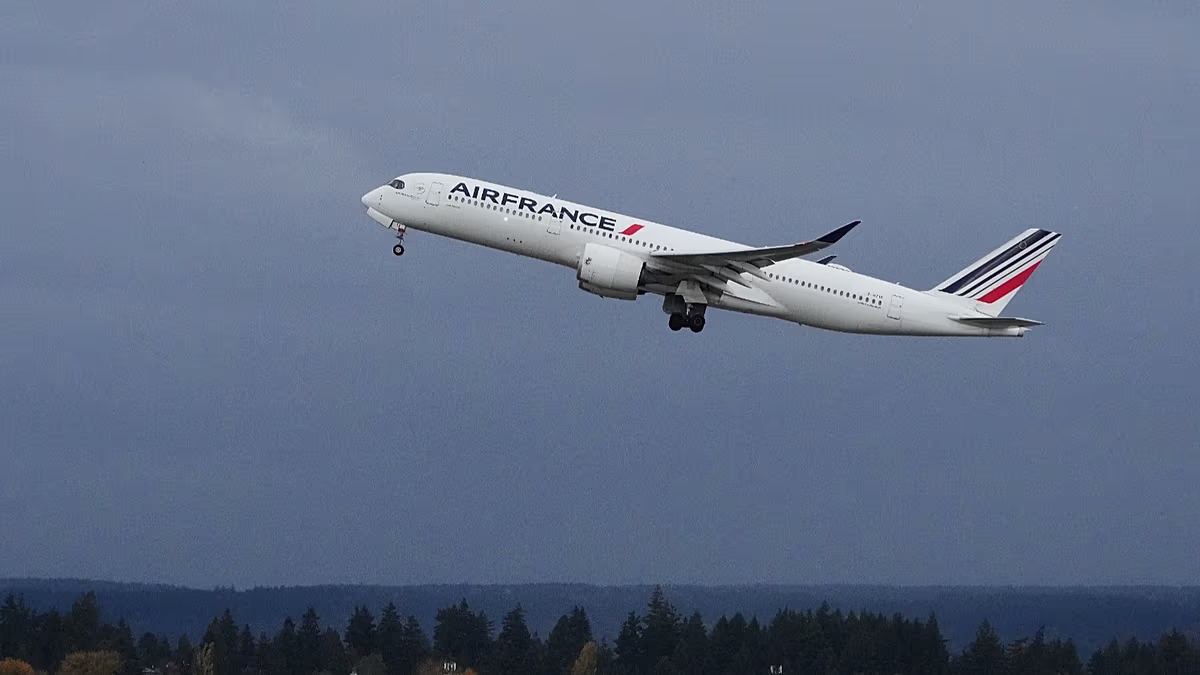
For anyone who has ever stood in a bustling airport terminal, watching the departure board flicker from a hopeful green to a stark, ominous red, the reality of global travel disruptions is deeply personal. It is not merely a matter of canceled tickets or delayed itineraries; it is the sudden shattering of carefully laid plans—missed family reunions, postponed business ventures, and the creeping anxiety of being stranded far from home. This unsettling human reality took center stage on July 20, 2026, when Air France announced the immediate suspension of its flights to Riyadh, Dubai, and Beirut. Grappling with a highly volatile security situation in the Middle East, the French flag carrier made the difficult decision to prioritize human lives over commercial operations. By halting services to Riyadh until July 24, Dubai until July 27, and extending the suspension of flights to the beleaguered Lebanese capital of Beirut until August 2, the airline sent a clear signal that the skies above these historically vibrant crossroads of the world are currently too unpredictable to navigate. Air France emphasized that its teams are monitoring the geopolitical landscape in real-time, acknowledging that the safety of passengers and crew is a non-negotiable priority in a region where the ground reality changes by the hour.
This cautious retreat by Air France is not an isolated incident of corporate anxiety, but rather part of a highly coordinated, industry-wide defensive maneuver guided by international safety regulators. On July 14, 2026, the European Union Aviation Safety Agency (EASA) issued a Conflict Zone Information Bulletin advising commercial carriers to entirely avoid the airspaces of Qatar, Bahrain, Kuwait, and the United Arab Emirates, as well as the sensitive maritime skies of the Gulf of Oman. This sweeping directive, active through at least late July, essentially redrew the aviation map of the world. Confronted with the grim prospect of guiding multi-million-dollar aircraft filled with hundreds of innocent travelers through potential crossfires, many of the world’s major airlines chose to abandon short-term, week-by-week scheduling altogether. Instead, they took the dramatic step of pushing their resumption dates back to late October 2026. This realignment deliberately coincides with the launch of the global aviation industry’s northern winter timetable, reflecting a sober, long-term industry consensus that the current geopolitical friction is not a passing summer storm, but a deeply rooted crisis that requires systemic operational adjustments.
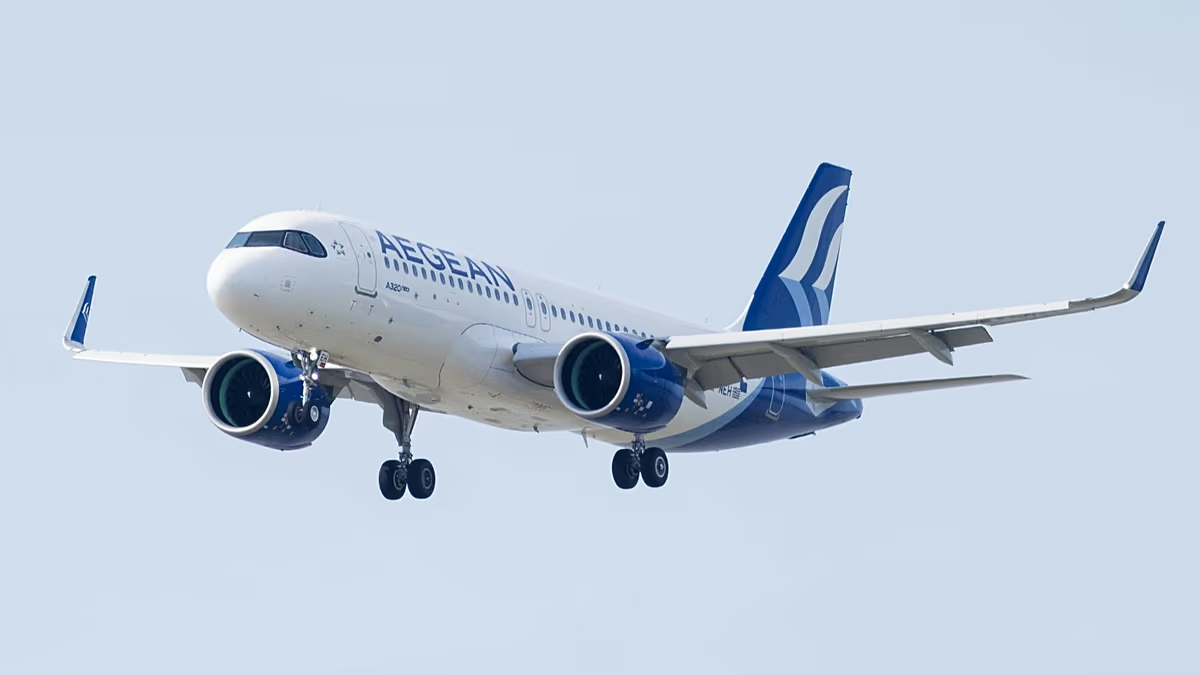
Among the European carriers restructuring their networks, the Dutch carrier KLM has taken some of the most drastic steps to shield its passengers and crews from risk. Recognizing the physical and psychological toll that flying near conflict zones inflicts on travelers, KLM has completely redrawn its flight paths, bypassing the airspaces of Iran, Iraq, Israel, and several neighboring Gulf states. This major geographic detour has inevitably resulted in longer travel times and logistical headaches, but the airline has remained firm in its commitment to safety, suspending all passenger services to Dubai and the Saudi Arabian hubs of Dammam and Riyadh until August 23, while bracing for ongoing disruptions on its Beirut routes through mid-August. Further south, Greece’s Aegean Airlines has mirrored this abundance of caution, canceling its Dubai services until the end of August and delaying flights to the historically sensitive Iraqi cities of Erbil and Baghdad until at least September 30. Meanwhile, Latvia’s flag carrier, airBaltic, has decided to pull out of Dubai entirely until the autumn transition in late October, demonstrating that even carriers situated in the quiet corners of Northern Europe cannot escape the global ripples of Middle Eastern instability.
The impact of these cancellations is felt just as acutely in the Asia-Pacific region, where transit giants that historically bridge the East and the West have had to radically alter their operations. Singapore Airlines, renowned for its global connectivity, initially hoped for a speedy recovery but has now extended its suspension of flights to Dubai all the way to late October, a decision mirrored by its low-cost subsidiary, Scoot, which halted its services to Jeddah through early August. For countries like the Philippines, the human cost of these suspended routes is incredibly personal; millions of overseas Filipino workers rely on these air corridors to travel between their homes and their jobs in the Gulf. While Philippine Airlines managed to bring some relief by resuming its Manila-to-Doha route in July, the carrier’s vital service connecting Manila to Dubai remains grounded until October 2, leaving thousands of migrant workers and their families in a state of stressful limbo. Hong Kong’s Cathay Pacific has faced a similar struggle, pushing back its highly anticipated return to Dubai and Riyadh to late October, reminding us of how heavily the global economy relies on the seamless, uninterrupted movement of people across hemispheres.
Across the Atlantic, North American and British carriers are also navigating these turbulent diplomatic and physical skies with a mixture of pragmatism and caution. British Airways has delayed its return to some of the Middle East’s most economically vital locations, keeping flights to Dubai, Tel Aviv, Bahrain, and Amman grounded until late October, though it holds onto a fragile hope of restoring flights to Doha and Riyadh by early August. Air Canada has adopted an even more conservative stance, keeping its passenger services to both Dubai and Tel Aviv completely suspended until October 24, highlighting the reality that even airlines based thousands of miles away must respect the boundaries of global conflict. These decisions are not made lightly; every canceled flight represents lost revenue, disrupted supply chains, and stranded individuals. Yet, the unified front presented by these Western carriers underscores a profound truth: in the modern era of aviation, no market share or financial projection is worth jeopardizing the physical safety of a single passenger or flight attendant.
This protective philosophy is perhaps most visibly embodied by the massive Lufthansa Group, which operates as a critical lifeline of connectivity across Central Europe and the wider world. Utilizing its vast network, the group—which includes SWISS and Brussels Airlines—has systematically dismantled its standard Middle Eastern routing to create a protective buffer for its operations. Brussels Airlines has ground its Tel Aviv services to a halt until late October, while SWISS has cautiously pushed its resumption of flights to the Israeli hub into August, while both airlines keep their Dubai routes empty until at least mid-September. On a broader scale, the Lufthansa Group has enacted blanket suspensions across a dozen major regional destinations, including Abu Dhabi, Amman, Beirut, Dammam, Erbil, Muscat, Riyadh, and Tehran, with no plans to return before the winter timetable begins on October 24. While these empty runways and quiet skies paint a somber picture of our fractured world, they also reflect a deep, enduring respect for human life. As travelers wait out the storm, these decisions remind us that while geopolitical boundaries may shift and conflicts may rage, the ultimate triumph of the global aviation community lies in its quiet, unwavering commitment to bringing every passenger back down to earth safely.