


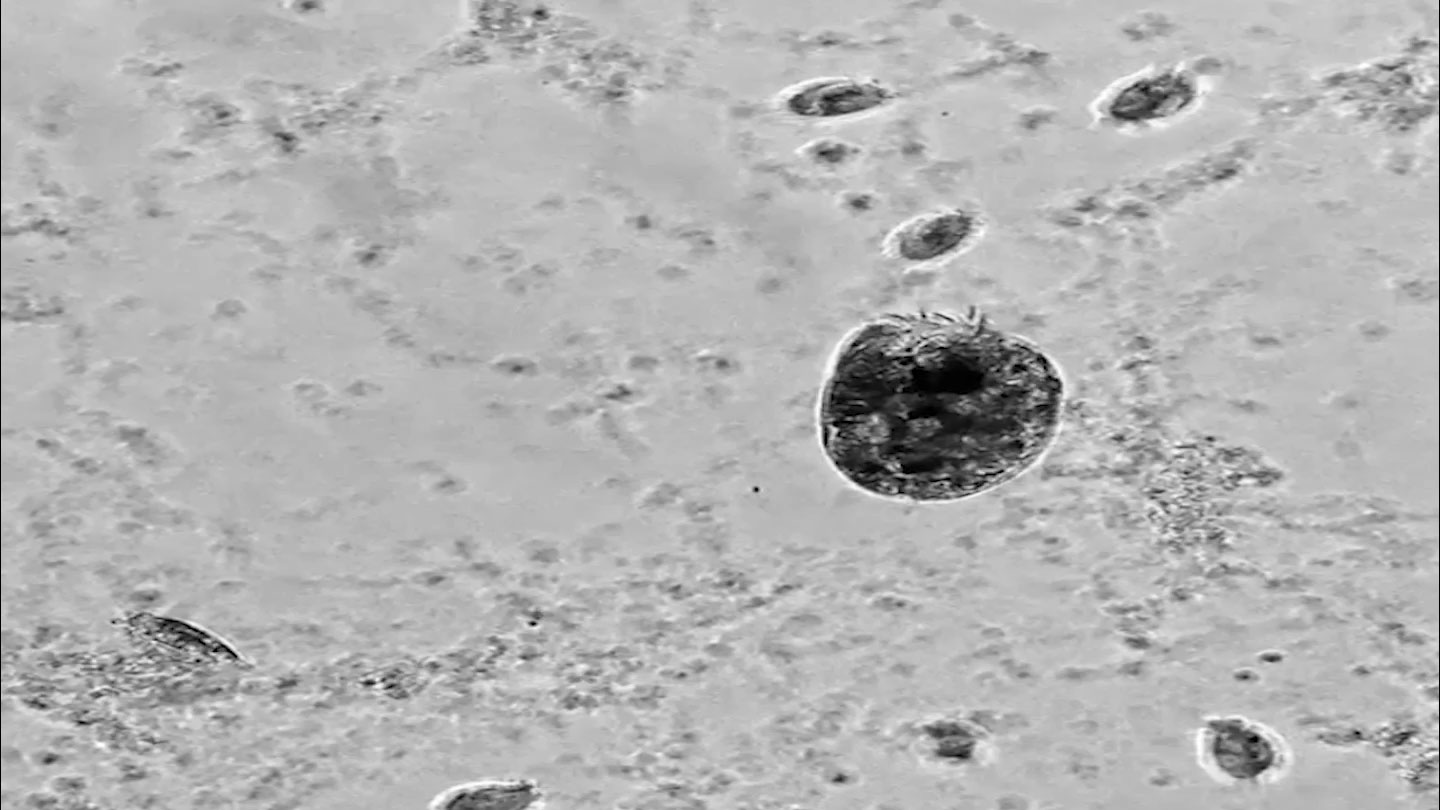
Science often looks for the extraordinary in the far-flung, pristine corners of our planet, yet some of the most revolutionary biological discoveries are made in the dirtiest, most mundane places imaginable. Such was the case when cell biologist Ben Larson, working at the Rensselaer Polytechnic Institute in Troy, New York, decided to examine a layer of dark, organic gunk scraped from an ordinary aquarium filter during a trip to the tropical island of Curaçao. Amid the discarded waste and microscopic debris, Larson noticed a bustling micro-community dominated by a previously undescribed single-celled organism. Now officially classified as Euplotes gigatrox, this newly discovered protist immediately captivated researchers with its startling, dynamic lifestyle. Far from being a passive resident of the muck, this microscopic entity proved to be a master of adaptation, capable of undergoing a dramatic physical transformation that mimics one of pop culture’s most famous monsters: the Incredible Hulk. This discovery highlights the magnificent complexity lurking within overlooked niches, serving as a vivid reminder that natural marvels do not require deep-sea submersibles or pristine wilderness to be found—sometimes, all they require is a curious mind willing to look closely at the slime inside a household fish tank.
To understand the magnitude of this microscopic drama, one must first meet Euplotes gigatrox in its everyday, tranquil state. Under the microscope, this single-celled protist looks less like a typical amorphous amoeba and more like a leggy, sci-fi insect scurrying across a slide. It belongs to a diverse group of single-celled organisms known as ciliates, which are characterized by the presence of hundreds of tiny, hair-like projections called cilia. In Euplotes gigatrox, these cilia are bundled together to form stiff, leg-like structures that the creature uses to crawl over surfaces, as well as finer structures used to generate currents in the surrounding water. During its normal phase, the tiny creature spends its time peacefully grazing on bacteria and other minute microbial organisms, acting as a vital cleanup crew for its environment. It reproduces in a straightforward, predictable manner, dividing right down the middle once every twenty-four hours to create genetically identical clones of itself. In this standard state, it is an efficient, quiet organism perfectly adapted to a life of microscopic routine, playing its minor role in the aquatic ecosystem without drawing any undue attention to itself.
However, this peaceful coexistence is completely shattered when their environment undergoes a sudden shift, particularly when food becomes overwhelmingly abundant. In a fascinating twist of nature, a plentiful supply of resources acts as a catalyst for a stark Jekyll-and-Hyde transformation, triggering a select portion of the population to undergo a massive growth spurt. This transformation unfolds in distinct, highly coordinated stages that resemble a real-life horror film on a microscopic scale. Initially, a single cell begins to change shape, developing an enormously enlarged mouth, known as an oral depression, while simultaneously racing around its environment with frantic, almost desperate speed. In this transitional, semi-transformed state, the would-be giant is initially clumsy and incapable of easily capturing its typical prey. Yet, the moment this frantic hunter manages to run over and jam one of its smaller, genetically identical siblings or cousins into its expanding maw, the genetic floodgates swing open. The ingestion of its own kin sparks a rapid, total reorganization of the cell’s entire skeletal structure, causing it to swell into a “supergiant” cannibalistic monster more than twice its original dimensions.
The emergence of the supergiant Euplotes gigatrox brings about not only a shocking physical divergence but also a complete overhaul of the organism’s behavior and movement patterns. While normal-sized cells are highly agile, routinely spiraling and swimming through the open water to find new grazing grounds, the lumbering giants lose this three-dimensional mobility entirely. Instead of swimming, these microscopic Hulks restrict themselves to a flat plane, walking in slow, repetitive, and deliberate circles across the substrate. Their feeding strategy shifts from passive filter-feeding to active, predatory harvesting. Equipped with a massive, cavernous mouth cavity located directly behind a prominent fringe of waving cilia, the giant version hunts by running headlong into its smaller, unsuspecting relatives. Upon making contact, the giant simply uses its momentum to drive the smaller cells into its cavernous oral depression. This stark contrast in behavior between two genetically identical phases of the same species demonstrates how physical scaling can entirely rewrite an organism’s ecological niche, turning a gentle, swimming grazer into a grounded, circling predator.
Despite the terrifying efficiency of this giant form, the transformation is not permanent, and the organism possesses an equally remarkable exit strategy to return to its original shape and peaceful demeanor. The giants accomplish this de-escalation by utilizing an asymmetric cellular division process that essentially allows them to shrink back down to size while rapidly populating their environment. Instead of dividing symmetrically to create two massive giants, the colossal cell begins to bud off normal-sized offspring in quick succession. Through this lopsided division, a single supergiant can generate up to nine standard, non-cannibalistic offspring within a short twenty-four-hour window, and as many as sixteen offspring over the course of five days. This is a blistering rate of reproduction compared to the single daily division of a normal-sized cell. With each successive division, the giant parent cell loses a significant portion of its bulk, systematically resizing itself until the original giant is completely gone, replaced by a crowd of normal-sized, swimming cells that resume their peaceful grazing on bacteria as if the monstrous episode had never occurred.
Underneath this dramatic biological theater lies a complex genetic network that has left scientists thoroughly astounded. By analyzing the genetic activity of these cells during their dramatic transitions, Larson and his colleagues discovered that up to 42 percent of the organism’s entire genome is actively involved in guiding the shift from standard size to supergiant and back again. Such a massive genetic investment indicates that this shape-shifting capability is not a random glitch, but a highly sophisticated, evolutionary adaptation designed to navigate fluctuating environmental conditions. Studying how a single-celled protist coordinates such complex structural and behavioral changes offers researchers a rare window into the early chapters of evolutionary history, potentially explaining how simple, solitary cells first developed the complex genetic tools required to build multicellular life. By looking closely at the tiny “Hulk” of Curaçao, science is gaining a deeper appreciation for the fluid, creative boundaries of life, showing us that even the simplest single-celled organisms contain a universe of genetic ingenuity that mirrors our own complex biological systems.