


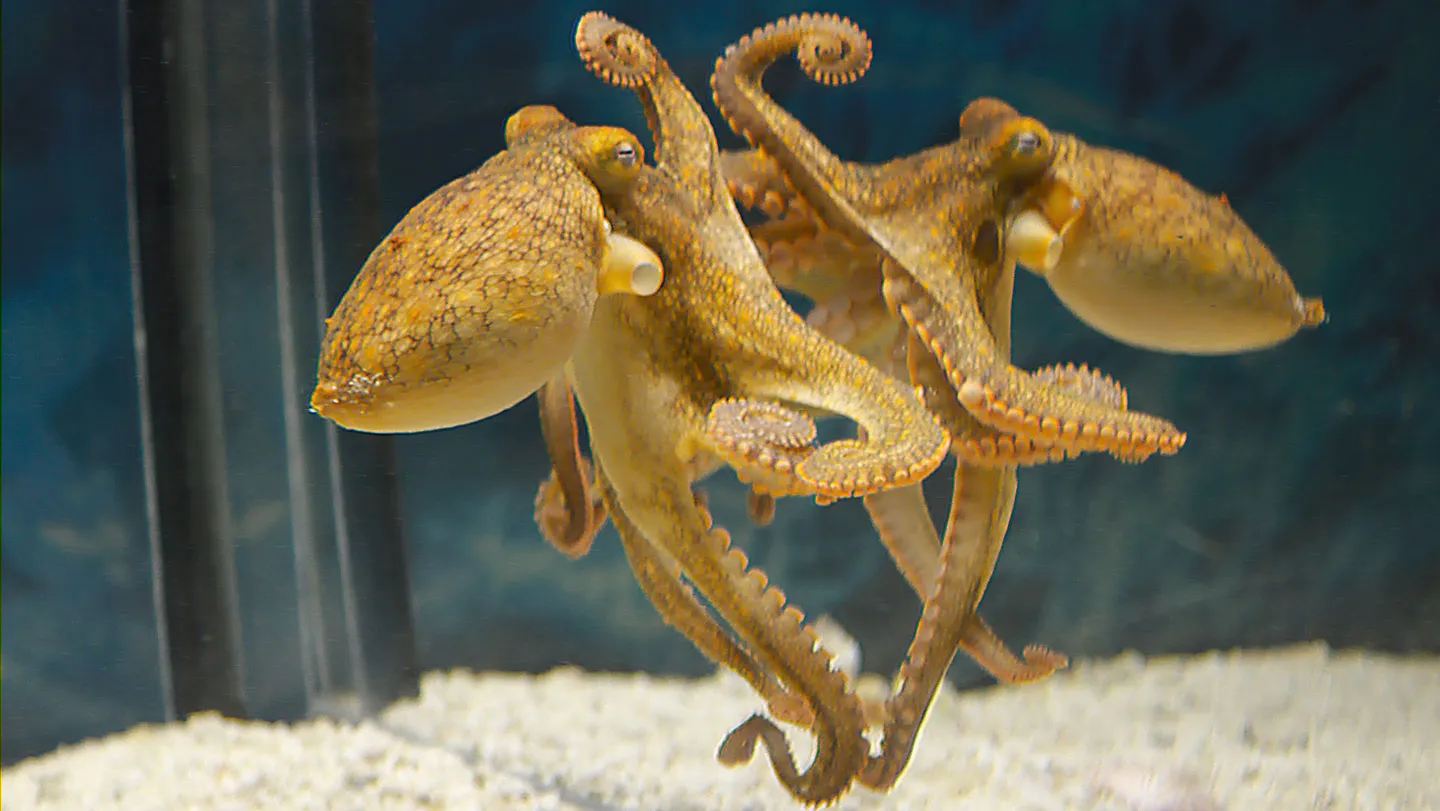
For humans, a mirror is a mundane, ubiquitous feature of daily life that we easily take for granted, yet it actually represents a highly sophisticated cognitive milestone. We are not born with an innate, instinctual understanding of reflective surfaces; rather, as infants, we must spend months observing, playing, and learning how a silvered sheet of glass translates three-dimensional space into a reversed, two-dimensional projection. If this concept is tricky for a highly cooperative, terrestrial mammal equipped with a massive visual cortex, it stands to reason that it represents an astronomical hurdle for a creature whose evolutionary lineage diverged from ours over five hundred million years ago. Enter the octopus: a soft-bodied, multi-brained mastermind of the deep ocean whose high intelligence has long fascinated and baffled scientists. On June 3, researchers publishing in the journal Current Biology revealed that the California two-spot octopus (Octopus bimaculoides) is fully capable of learning how to decipher and utilize mirrors to navigate their surroundings. This groundbreaking discovery, led by neuroscientist Mary Kieseler and her dedicated team at the University of Fribourg in Switzerland, proves that the capacity to transform abstract, reflected visual information into complex, real-world physical action is not a privilege reserved solely for backboned, warm-blooded animals, but is also well within the grasp of the ocean’s most enigmatic invertebrates. By showing that these highly adaptive tide-pool dwellers can treat a reflection not as a rival or a meaningless illusion, but as a roadmap for survival, the study bridges a massive psychological gap between us and one of the most alien minds on Earth.
The spark of this scientific inquiry began with a classic psychological benchmark: the mirror self-recognition (MSR) test, first developed in the 1970s to determine whether an animal possesses a conscious sense of self. To pass, an animal must look into a mirror, recognize its reflection, and use it to investigate a mark placed on its own body that it cannot see directly. While a few elite species—like chimpanzees, bottlenose dolphins, Asian elephants, and Eurasian magpies—have passed this test, administering it to an octopus is a logistical nightmare. These creatures are entirely soft-bodied, constantly change their skin texture and color for camouflage, and live underwater where traditional paints or markers simply wash away. Furthermore, if a researcher does manage to attach a physical tag or sticker to an octopus, the animal’s highly sensitive, suction-cupped arms will instantly locate and rip the foreign object away, making it impossible to tell if they are reacting to their reflection or simply grooming by touch. Recognizing these immense structural and physiological hurdles, Kieseler and her colleagues decided to step back and tackle a more fundamental question first: before we ask if an octopus can recognize its own face, we must first determine if it can understand how a mirror works and use it as a functional tool to do something they are already exceptional at—hunting prey.
To test this, the researchers gathered three wild-caught California two-spot octopuses, placing them in specialized tanks designed to gently introduce them to the strange properties of reflective glass. The team began with a careful habituation phase, installing a mirror that covered exactly half of each animal’s tank. The octopuses were given complete freedom to hide away from the mirror behind a protective partition, or to venture out and investigate the mysterious “other” octopus looking back at them. Crucially, the researchers waited until the animals were completely comfortable eating their meals in front of the mirror, ensuring they no longer viewed their reflections as a threat or an active rival. Once this peaceful baseline was established, the true test of their intellect began. The scientists hid a glass jar containing a live, delicious crab behind an opaque white barrier inside the tank. The barrier completely blocked the octopus’s forward line of sight, meaning the only way it could find the crab was by looking at its reflection in the mirror on the opposite wall. Initially, the octopuses behaved exactly as one would expect of an untrained animal: they saw the reflection, swam directly toward the glass mirror, bumped their sensitive mantles against it, and then turned back to crawl around the barrier to find their prey. However, after only ten to twelve trials, each of the three octopuses had a breakthrough; they stopped visiting the glass altogether and began navigating direct paths to the hidden jar on their very first attempt, showing they had mapped the reflection to the physical space behind them.
While these initial results were incredibly exciting, the rigorous standards of scientific inquiry demanded a deeper look. Octopuses are famous for their extraordinary sensory capabilities; their skin is studded with millions of chemical receptors and suckers that can pick up microscopic water currents, vibrations, and scents. The researchers had to prove beyond a shadow of a doubt that the octopuses were navigating purely by visual cues, rather than sniffing out the prey or feeling the vibrations of the crab’s tiny legs echoing through the water. To isolate the sense of sight, Kieseler’s team constructed a highly clever, high-tech secondary experiment using digital technology. They placed each octopus inside a small, white, three-sided enclosure that sat within the main tank, completely blocking their view of the outside world except for a mirror running along the front. Behind this enclosure, entirely out of the octopus’s direct sight, the researchers set up a high-definition computer screen displaying videos of a moving crab. Because the screen was hidden, the digital crab was only visible as a light reflection in the front mirror, appearing to crawl toward either the left or the right side of the rear wall. To earn a real food reward, the animal had to look at this virtual reflection, compute the correct direction, exit its three-sided plastic box, and navigate to the corresponding side.
Working with wild marine life always brings unexpected human challenges, and this study was no exception. Kieseler and her team discovered that motivating the octopuses to cooperate required endless patience, as their willingness to participate depended entirely on their individual moods and levels of hunger. On many days, the octopuses simply had no interest in playing along with the high-tech visual games; if they were not hungry enough, they would just ignore the mirrors entirely, settle into a comfortable corner of the tank, and fall asleep, or sit in silent contemplation. Because of these distinct personalities and relaxed routines, each octopus would only complete about one successful trial per day, stretching the research over a painstaking period. Yet, when the animals did choose to participate, their cognitive performance was spectacular. The octopuses successfully completed the virtual crab navigation puzzle on about 73 percent of their runs. Most importantly, in 59 percent of those correct trials, the octopuses did not foolishly lunge at the mirror projection expecting to capture a prize; instead, they immediately used their highly flexible bodies to climb right over the side walls of their plastic chamber, heading straight for the true location of the stimulus.
This remarkable behavior provides definitive proof that the octopuses understood how the mirror represented physical space, rather than simply reacting to a moving image. As Trevor Wardill, an independent neurobiologist at the University of Minnesota who was not involved in the project, pointed out, this shows that octopuses possess the advanced mental flexibility to adapt their navigation strategies in complex habitats using whatever visual tools are available to them. This study represents a massive step forward in our understanding of convergent evolution—the idea that completely different species can independently develop identical cognitive abilities to solve the same environmental problems. Now that we know octopuses can master the tricky spatial geometry of mirrors, scientists are highly optimistic about what comes next. By proving that these marine invertebrates can use reflections to guide their physical actions, this research has successfully paved the way for future scientists to bring the mirror self-recognition test back into the tank. Ultimately, this work brings us one step closer to understanding whether these ancient, beautiful, and deeply intelligent creatures of the deep can look upon their own reflections and feel a spark of self-awareness.