


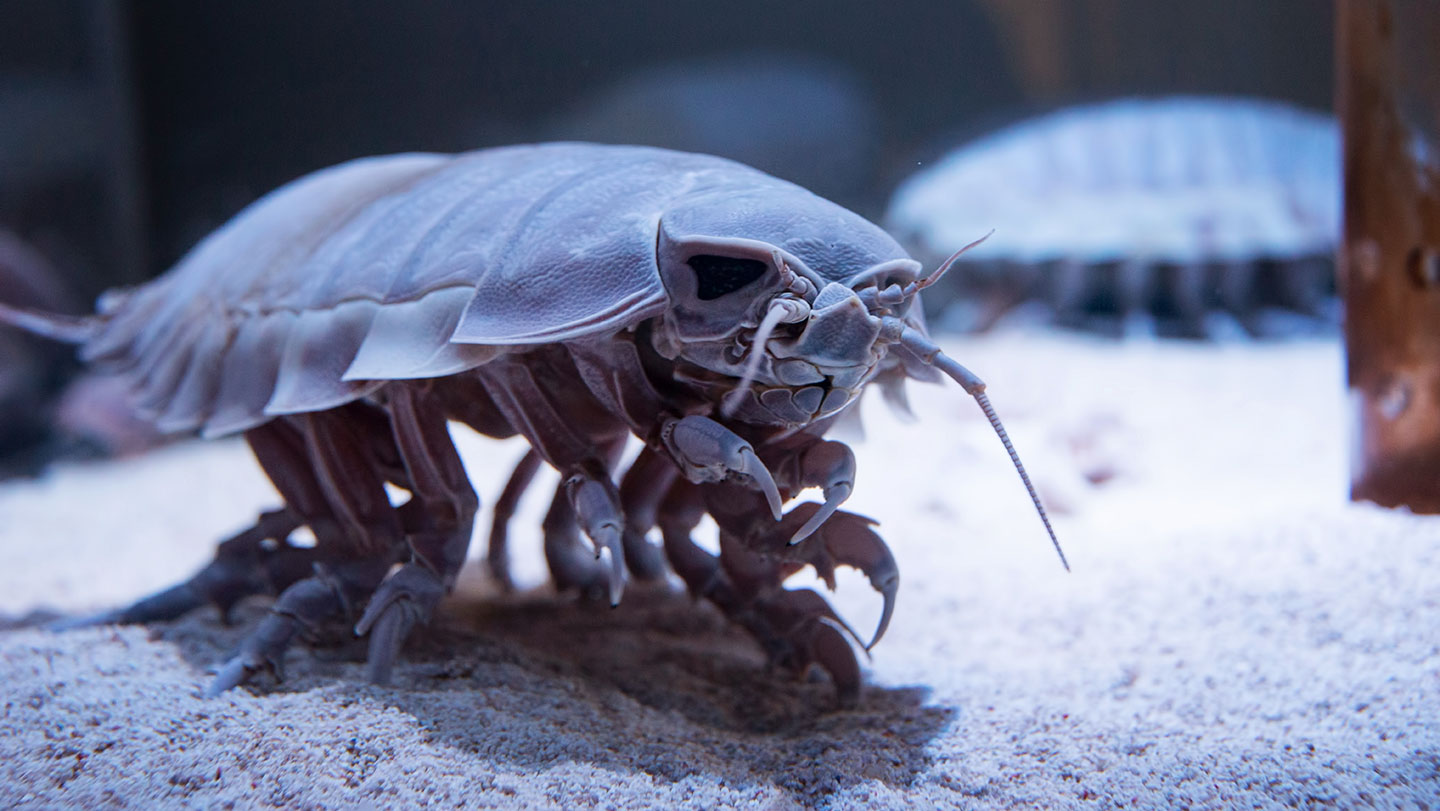
Deep below the sunlit surface of our planet’s oceans lies a realm of perpetual twilight shifting into absolute, freezing blackness. At a depth of one kilometer or more, where the crushing weight of the water column exerts immense pressure and temperatures hover just above freezing, the seafloor resembles a barren, abyssal desert. Yet, in this seemingly uninhabitable wasteland, strange and resilient lifeforms have carved out a highly successful existence. Among the most remarkable of these deep-sea residents are giant ocean isopods, specifically of the genus Bathynomus. These creatures are, quite literally, the football-sized cousins of the common, harmless garden woodlice, pillbugs, or “roly-polies” that children find scurrying under damp logs in their backyards. While their terrestrial relatives rarely grow larger than a pencil eraser, these deep-sea behemoths can reach nearly half a meter in length. Cloaked in heavily armored, pale, segmented exoskeletons and sporting pairs of large, compound eyes, they slowly clamber along the muddy seabed like prehistoric tanks. For decades, marine biologists have been captivated by their strange lifestyle, notably their astonishing metabolic patience. In an environment where food is incredibly scarce, falling only occasionally from the surface in the form of “marine snow” or the rare, decaying carcass of a whale, these animals have developed a survival strategy based on extreme, almost unfathomable cellular discipline. They can wander the ocean floor for months or even years without encountering a single scrap of food, yet they somehow remain perfectly healthy, waiting patiently for their next meal while continuing to grow to massive proportions.
To understand the sheer resilience of these colossal crustaceans, one must look at the historical records of their survival in captivity, which have baffled animal physiologists for years. Some captive giant isopods, kept in meticulously controlled cold-water aquariums, have been documented going more than five years without consuming a single bite of food. This represents one of the longest recorded periods of self-inflicted starvation in the entire animal kingdom, challenging our fundamental understanding of biological fuel, digestion, and energy consumption. Under normal physiological circumstances, an animal of that size would quickly exhaust its glycogen, fat, and muscle reserves, leading to cellular collapse, organ failure, and inevitable death. For years, scientists wondered what internal magic allowed Bathynomus to remain alive, active, and physiologically stable during these multi-year fasts. The phenomenon of deep-sea gigantism is itself an evolutionary puzzle; generally, biologically hostile and nutrient-poor environments favor smaller organisms that require less energy to sustain themselves. Yet, these isopods defy that expectation, growing into giants. Evolutionary biologists have hypothesized that their large size is actually an adaptation to the cold and the extreme scarcity of food, allowing them to store more energy reserves and travel further across the barren ocean floor. However, the precise internal mechanics—specifically, how they manage their cellular energy budget on a microscopic level—remained deeply shrouded in mystery until a team of researchers decided to probe their genetic code.
To unravel this deep-sea mystery, a dedicated group of marine biologists at the Chinese Academy of Sciences in Qingdao embarked on an ambitious scientific mission. Using a specialized deep-sea submersible vehicle, the researchers searched the depths near China’s Hainan Island and successfully captured several healthy specimens of a specific giant isopod species known as Bathynomus jamesi. Lead researcher Jianbo Yuan and his colleagues were determined to uncover the secrets behind how these creatures thrive in the barren, cold dark. The team carried out a rigorous comparative analysis, contrasting the giant B. jamesi with a smaller, closely related isopod species harvested from a depth of 300 meters, as well as an even smaller cousin that populates the shoreline. Their investigation was twofold, examining both the physical anatomy and the complete genetic instructions, or genomes, of the animals. What they discovered inside the giant isopods was absolutely staggering. Yuan noted that the results were far more surprising than anyone on the team had previously imagined. Anatomically, they found that the giant deep-sea species possessed an incredibly massive stomach, which expanded to occupy up to two-thirds of their entire body cavity. This was far larger than the stomachs of their shallower and shoreline relatives. This bizarre anatomy strongly suggests a “feast-or-famine” lifestyle: the giants may eat rarely, but when they do stumble upon a meal, they gorge themselves to the absolute limit, packing their cavernous bellies with fish, fallen carrion, and whatever slow-moving organisms they can manage to catch.
While a giant stomach explains how these creatures store massive amounts of food when it is available, it does not explain how they make those meals last for years at a time. The answer to that riddle lay hidden deep within the isopods’ DNA. Published on June 5 in the prestigious scientific journal Cell, the team’s genetic analysis revealed an extraordinary evolutionary quirk: long ago, an ancestor of the giant isopods stole a crucial metabolic gene from a bacterium. Through a rare process known as horizontal gene transfer, where genetic material moves between entirely different species rather than being passed down from parent to offspring, the ancestral isopod integrated this bacterial gene into its own genome. Over 16 million years ago, this borrowed gene, known as ND1, became a permanent fixture of the isopod’s genetic blueprint. Over evolutionary time, the deep-sea giant duplicated this gene, retaining multiple copies within its DNA. This ancient biochemical heist gave the creatures a powerful new tool to manipulate their own metabolism. In bacteria, similar genes play roles in managing cellular respiration and energy production, and when integrated into the animal’s biology, ND1 functioned like a low-power switch. By altering how mitochondria—the powerhouses of the cell—process nutrients, the stolen gene effectively throttled the creature’s energy consumption, allowing it to enter a state of metabolic suspended animation during prolonged periods of starvation.
To prove that this stolen bacterial gene was indeed the secret behind the isopods’ legendary starvation resistance, Jianbo Yuan’s research team designed a sophisticated laboratory experiment. They used genetic engineering to introduce the deep-sea isopod’s version of the ND1 gene into laboratory fish. Under normal household temperatures, the transgenic fish behaved and metabolized food just like their unaltered peers. However, when the researchers subjected the fish to near-freezing conditions, the magic of the ND1 gene was unlocked. The genetically modified fish demonstrated an incredible 37 percent increase in their survival rate during long periods without food compared to the control group. Crucially, this survival benefit was completely dependent on the cold; at warmer temperatures, the gene did not provide the same protective effect. This temperature-dependent mechanism perfectly aligns with the freezing environment of the deep-sea floor, where the water is constantly chilled to just a few degrees above freezing. The icy cold of the deep ocean acts as a biochemical catalyst, triggering the stolen ND1 gene to put a microscopic drag on cellular energy consumption. This elegant genetic adaptation enables the giant isopods to fuel their surprisingly massive bodies and maintain essential bodily functions on a mere fraction of the calories that a shallow-water creature would require, ensuring they can survive the long, silent intervals between scarce deep-sea banquets.
This remarkable discovery not only solves a long-standing mystery of marine biology but also expands our fundamental understanding of how complex life on Earth evolves. Historically, classical evolutionary theory maintained that animals adapt to their environments almost exclusively through the slow, gradual modification of their own ancestral genes. However, this study provides a striking, real-world example of “gene domestication,” demonstrating that animals can acquire completely new, highly functional biological tools directly from the microbes around them. Yang Li, an evolutionary biologist from the University of Michigan who was not involved in the project, expressed great excitement over the findings. He points out that the giant isopods offer a profound proof of concept: complex biological traits can be acquired horizontally across kingdoms, bypassing traditional inheritance. This realization prompts exciting new questions about the deep-sea biome and the evolution of extreme survival. If giant isopods survived by domesticating bacterial genes, it is highly likely that other mysterious denizens of the deep ocean—from bizarre deep-sea fish to ghostly giant squids—possess their own set of stolen genetic gear. The abyss, once thought of as a simple evolutionary dead end, is instead revealed to be a dynamic arena of genetic sharing and incredible metabolic engineering. As we continue to deploy submersibles into the deepest trenches of our oceans, studies like this remind us of the endless, hidden wonders of nature, showing how a microscopic bacterium, 16 million years ago, forever changed the fate of a family of giant, deep-sea roly-polies clambering across the cold, silent seafloor.