


For over a century and a half, a quiet mystery lay sleeping in the archives of paleontology, preserved in fragments of stone that seemed to defy definition. Discovered in 1870 within the ancient, river-carved sediment of the St Maughans geologic formation in England, these fossilized remains looked more like a puzzle with missing pieces than a creature that once walked the Earth. For decades, researchers who looked upon the petrified parts of Praearcturus gigas could only guess at what kind of animal they belonged to. Some proposed it was an ancient, oversized woodlouse crawling through the damp undergrowth of a young world; others argued it was a massive, armored, millipede-like creature that wound its way through primeval landscapes. There were even long-held theories that it was some strange variety of prehistoric lobster or crustacean, lost to time. Though whispers in the 1980s suggested it might have been a scorpion, the evidence remained frustratingly out of reach, leaving this giant of the ancient world an unresolved cold case in the history of evolutionary biology.
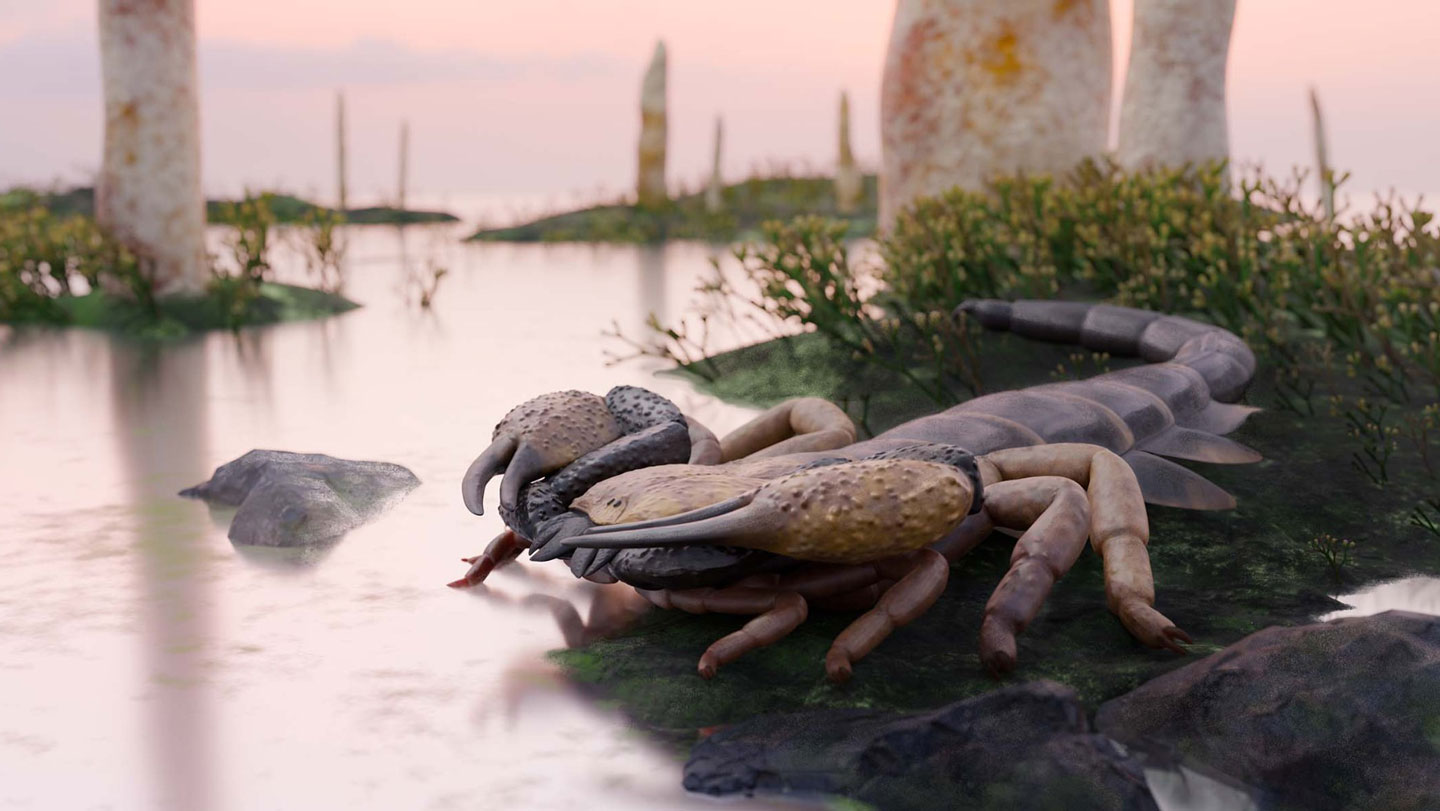
The breakthrough finally came when a team led by paleobiologist Richard Howard from the Natural History Museum in London decided to re-examine the enigmatic fossil using modern forensic techniques. Rather than relying on simple visual inspection, Howard and his colleagues utilized high-resolution photography and meticulous scientific illustration to map out every fine ridge, joint, and contour of the specimen. Their focus turned specifically toward the fossil’s massive, 15-centimeter pincer, which, on its own, was larger than almost any scorpion alive today. By detailing the mechanical structure of this weapon, they noticed a telling detail: the movable claw of P. gigas faced directly away from its fixed claw. This specific anatomy is a hallmark of defensive and predatory scorpions, distinct from lobsters and other crustaceans whose claws pinch inward toward one another. Furthermore, the researchers detected faint, specialized ridges along the creature’s pedipalps—the long appendages that house the pincers. In modern scorpions, these textured ridges are rubbed against the body to create a sharp, defensive hissing sound, a behavior known as stridulation used to ward off curious predators.
Yet, identifying P. gigas required more than just recognizing these physical traits; it required a key evolutionary link that scientists did not possess until very recently. The final proof emerged when Howard’s team compared their anatomical reconstructions with Eramoscorpius brucensis, an incredibly well-preserved, 430-million-year-old scorpion species that was only discovered in 2015. Before this discovery, scientists lacked a clear reference point for the primitive skeletal structures of early arachnids. Most modern scorpions possess a small, pentagonal chest plate, or sternum, which looks very different from the broad, ancient structures found in the fossil record. However, both P. gigas and E. brucensis shared a highly distinct, elongated, almost triangular sternum with a deep, characteristic groove running directly down the middle. Because E. brucensis had remained hidden of the geological record for so long, previous generations of scientists simply did not have the comparative data necessary to crack the identity of P. gigas. This historical overlap not only confirmed its identity but crowned the one-meter-long monster as arguably the largest scorpion ever known to have lived.
This discovery significantly alters our understanding of evolutionary timelines, revealing that scorpions achieved massive physical scale far earlier than previously believed. Traditionally, the era of giant creepy-crawlies has been associated with the Carboniferous period, which began roughly 300 million years ago. During that time, atmospheric oxygen levels soared, fueling the rise of eagle-sized dragonflies and Volkswagen-sized millipedes that dominated dense, swampy forests. However, the one-meter-tall Praearcturus gigas roamed the Earth approximately 415 million years ago, during the Early Devonian period—at least 55 million years before the Carboniferous giants took their first breath. This means that while other groups of land-dwelling invertebrates were still agonizingly small and primitive, ancestral scorpions had already unlocked the biological mechanisms of gigantism. They managed to grow to terrifying proportions in a world that was still very much in its infancy, establishing a reign of giant arachnids long before the rest of the animal kingdom followed suit.
To picture the life of Praearcturus gigas is to imagine an Earth that would feel completely alien to us today. During the Early Devonian, the dry land was a quiet, sparse, and newly greening frontier, devoid of the familiar songs of birds, the buzzing of modern insects, or the heavy footsteps of dinosaurs. Since there were no terrestrial vertebrates like early reptiles, amphibians, or mammals to compete with, this colossal scorpion would have stood unchallenged at the absolute top of the food chain. It was likely one of the very first true apex predators to walk upon the land, stepping heavily across primitive mosses and early vascular plants. However, because the terrestrial ecosystem was still so young, it did not yet support a massive biomass of prey. To satisfy the immense caloric demands of its meter-long body, P. gigas could not rely solely on the tiny, primitive land creatures crawling near the shoreline; it had to be a versatile hunter capable of straddling two entirely different worlds.
In order to survive, this ancient giant likely divided its time between the barren land and the rushing waterways of the Devonian landscape. The sedimentary rocks in which the fossils were found were deposited by ancient river systems, indicating that P. gigas lived in or near freshwater environments. Howard and his team hypothesize that when food on land was scarce, this giant arachnid would slip beneath the ripples of rivers and estuaries, using its size to hunt heavily armored fish and even competing sea scorpions. Interestingly, the fossil features peculiar, flap-like structures on its underside, highly reminiscent of the specialized appendages modern lobsters use to paddle through water, suggesting it may have been an adept swimmer. While scientists still require more fossil evidence to confirm exactly how these prehistoric flaps functioned, the picture of Praearcturus gigas that emerges is nothing short of awe-inspiring: a transitional titan that could stalk the riverbanks, hiss loudly in the darkness to keep rival predators at bay, and submerge into the depths to claim its crown as the ruler of land and water alike.