



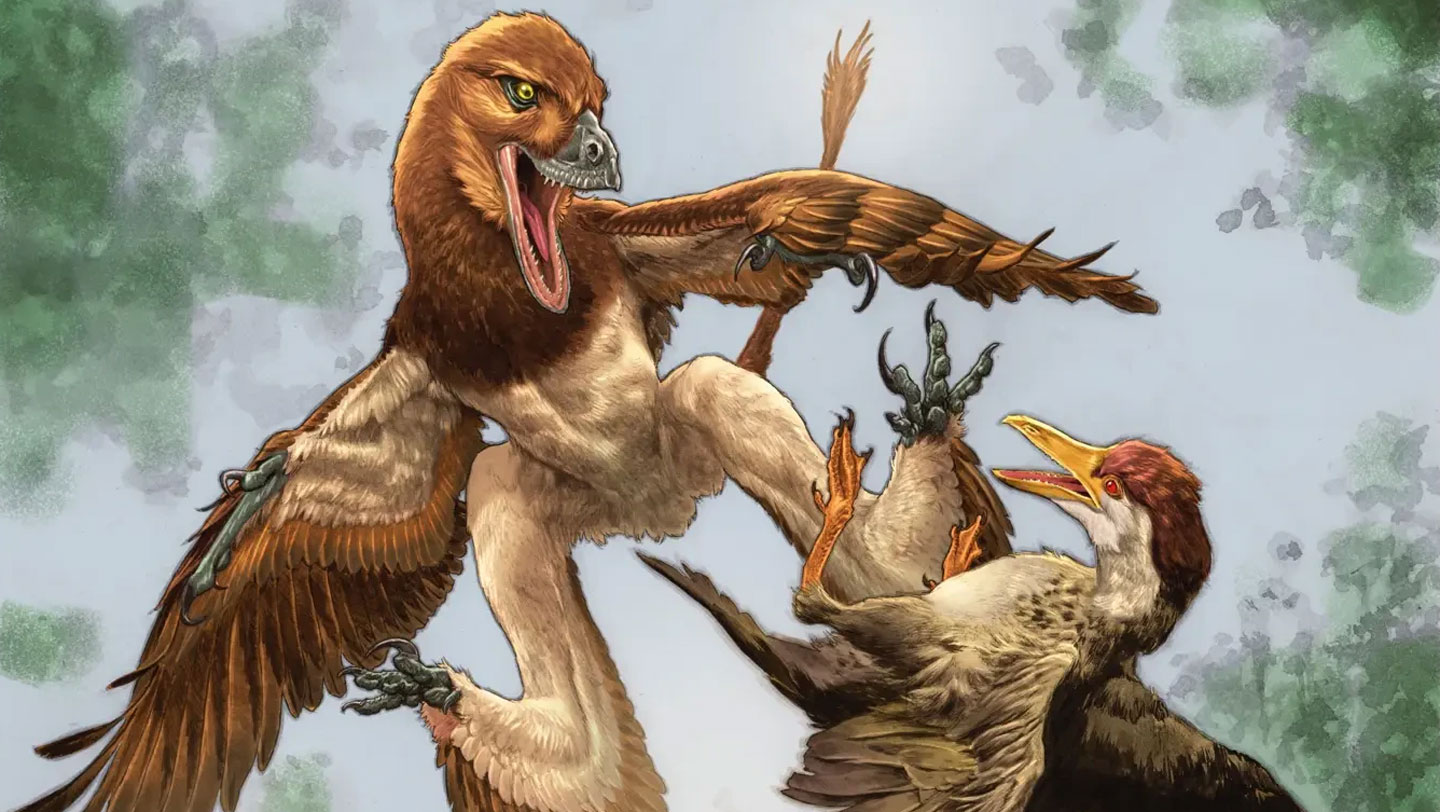
Imagine standing in what is now northwestern China some one hundred and twenty million years ago, a realm far removed from the arid, windswept deserts of Gansu Province today. Instead, you would find yourself completely immersed in a subtropical paradise of lush conifer forests, sprawling shallow lakes, and active volcanoes that periodically dusted the prehistoric landscape in rich, life preserving ash. Amidst the hum of primitive insects and the gentle splashing of early aquatic birds like Gansus, a sudden shadow sweeps silently beneath the forest canopy. This was the hunting ground of Jian changmaensis, a newly described gliding dinosaur that has recently sent shockwaves through the global paleontological community. Unlike the massive, lumbering beasts that dominate popular imagination, this sleek, feathered predator was a true master of the airwaves, engineered for stealth and sudden, violent aerial ambushes. Sporting a stunning array of primitive aerodynamic feathers on both its forelimbs and hindlimbs, this remarkably adapted creature represents a terrifying evolutionary experiment in flight. As it perched high in the ancient ginkgo trees, its keen eyes scanned the shores below, waiting for the perfect moment to launch into the misty morning air. With a single, powerful leap, Jian changmaensis would spread its four feathered wings, angling its long, stiffened tail to adjust its trajectory as it plummeted toward unsuspecting early birds. The skies of the Early Cretaceous were not a peaceful sanctuary for the ancestors of modern birds; instead, they were a battlefield where this newly discovered aerial terror reigned supreme, using its gravity assisted speed to swoop down on its avian cousins with lethal precision. By reconstructing this ancient environment, scientists have revealed not just a new species, but a dramatic chapter in the history of life on Earth, where the boundary between dinosaur and bird was beautifully, and sometimes bloodily, blurred for millions of years.
The story of uncovering Jian changmaensis is as much a human triumph of patience and dedication as it is a groundbreaking scientific breakthrough. For years, international teams of paleontologists have braved the harsh, unforgiving weather of the Changma Basin, meticulously scraping away layers of fine grained shale that once formed the muddy bottoms of Cretaceous lakes. It was during one of these grueling excavations that researchers stumbled upon a spectacularly preserved fossil, its delicate bones outlined by the dark, carbonized halos of ancient feathers. To the naked human eye, these fossils look like delicate charcoal sketches pressed into stone, but to the trained eyes of scientists, they are a priceless treasure trove of anatomical data. Excavating such fragile specimens requires an almost meditative level of precision, using tiny dental picks and fine brushes under the scorching sun and freezing desert winds to ensure not a single feather barbule is lost to time. When the team analyzed the unique pelvic structure, the fused clavicles, and the distinct curvature of the foot claws of this specimen, they realized they were looking at a completely new genus and species. This fossil did not just represent another dead animal; it was a physical bridge connecting the ground dwelling theropod raptors to the highly specialized aerial flyers of the Mesozoic. The discovery breathed new life into the silent desert, connecting the researchers directly to a split second moment one hundred and twenty million years ago when this creature died, sank to the lake bed, and began its long journey to the present day. Through their exhausting work, these scientists have given a voice to a silent predator, allowing us to visualize the complex mechanics of its ancient existence and appreciate the sheer diversity of life that once flourished in a region now defined by silence and dry earth.
To fully comprehend how Jian changmaensis dominated the Mesozoic skies, we must look closely at its fascinating and highly sophisticated aerial biomechanics, which challenge outdated notions of dinosaurian clumsy movement. Biomechanical testing and computer simulations of its skeleton suggest that while this dinosaur lacked the massive, specialized breastbone muscles required for continuous, powered flapping flight like modern eagles, it was an incredibly efficient glider. Its body plan resembled a biological biplane, utilizing asymmetrical feathers on both its arms and legs to generate substantial lift as it sailed through the air. The long, stiff tail, tipped with a decorative and aerodynamically active fan of feathers, served as a crucial rudder, allowing the creature to execute sharp, banking turns amidst the dense branches of prehistoric forests. Imagine the sheer physical control required for Jian changmaensis to launch from a high branch, immediately orienting its body into a stable glide, and adjusting its limb posture to control its descent speed. This was not a passive fall, but a controlled, active navigation of the aerial environment. By analyzing the fossil’s shoulder girdle, scientists have determined that its range of motion allowed it to adjust the angle of its wing feathers on the fly, mimicking the flaps of modern aircraft to prevent stalling. When closing in on its prey, it could pull its hind limbs forward, using its leg feathers as airbrakes to slow down just enough to deploy its sharp, curved claws for a strike. These revelations show that flight was not a sudden evolutionary breakthrough, but a gradual, creative process of trial and error. This delicate balance of physics and biology paints a humanized picture of an animal that, despite lacking the evolutionary refinements of modern birds, managed to conquer the air through sheer anatomical ingenuity and behavioral adaptability, carving out a highly successful niche in the ancient canopy.
The ecological implications of Jian changmaensis’s existence reveal a brutal and fascinating evolutionary arms race played out in the ancient skies. During the Early Cretaceous, the ancestors of modern birds were undergoing a massive radiation, filling the air with diverse shapes and academic sizes, but they were not alone up there. For these early avian species, Jian changmaensis represented a constant, terrifying threat that kept them on the razor edge of survival. Because these early birds were still developing their own flight capabilities, often limited to short bursts of powered flight and clumsy landings, they were incredibly vulnerable to a stealthy, silent glider that could swoop down from above without warning. Paleontologists theorize that Jian changmaensis utilized its highly developed binocular vision to spot the subtle movements of birds nesting or feeding in the forest undergrowth. Once a target was acquired, the dinosaur would launch its attack, gliding silently through the trees to bypass the birds’ natural defenses before they could gather enough speed to escape. This predatory pressure likely acted as a powerful evolutionary driver, forcing early birds to develop stronger flight muscles, more agile aerial maneuvers, and better sensory systems just to keep one step ahead of their glided tormentors. By studying the stomach contents of closely related dromaeopterygids, which occasionally contain the half digested bones of primitive birds, scientists have reconstructed a vivid, terrifying picture of these ancient hunts. It is a stark reminder that the history of flight is not just a story of passive adaptation to the physical environment, but also a story of intense predator-prey relationships, where the need to eat and the desperation to avoid being eaten shaped the very genetics of the animals we see gliding through our modern skies.
Beyond its role as an ancient predator, Jian changmaensis forces a radical rethinking of the entire evolutionary tree of flight, throwing a wrench into simplistic, linear narratives of biological progress. For decades, the scientific debate over the origin of flight was divided into two rigid camps: the “ground up” theory, which argued that cursorial runners developed wings to leap higher, and the “trees down” theory, which posited that tree dwellers glided down to earth. This newly discovered dinosaur suggests that nature did not follow a single, tidy path; rather, the Cretaceous was a wild evolutionary laboratory of diverse experiments. Jian changmaensis represents a unique branch on this tree, proving that gliding and feathered aerodynamics evolved independently across multiple dinosaurian lineages, overlapping and competing with the ancestors of true birds. It shows us that feathers were not originally designed for flight, but were multi purpose tools used for insulation, display, and eventually, aerodynamic control, which different species utilized in remarkably diverse ways. By filling this crucial evolutionary gap, the discovery highlights the chaotic, non-linear reality of life’s history on our planet, where transitional forms coexisted and pushed each other to ecological extremes. It teaches us that nature is not an architect with a singular blueprint, but an opportunistic tinkerer, constantly repurposing existing structures to meet shifting ecological demands. Every feather on this dinosaur’s body was a testament to this creative chaos, illustrating how subtle changes over millions of years can culminate in radical behavioral shifts. When we look at a modern pigeon, eagle, or hummingbird, we are looking at the survivors of this ancient, cutthroat competition, whose ancestors survived the terrifying glides of animals like Jian changmaensis. Understanding this connection humanizes the science of paleontology, transforming dry bones into a living, organic tapestry of evolutionary trial, error, adaptation, and survival that connects the deep past directly to our modern world.
Today, the windswept hills of northwestern China are silent, save for the occasional howling gale carrying dust across the empty plains of Gansu Province. It is difficult to reconcile this stark, arid, and beautiful landscape with the vibrant, moisture rich paradise where Jian changmaensis once glided through the canopy in pursuit of its prey. Yet, preserved deep beneath the desert sands, the fossilized remnants of this extraordinary dinosaur remain, waiting to be discovered by curious human minds. This striking contrast serves as a poignant reminder of the impermanence of ecological epochs and the profound changes our planet has undergone over millions of years. The discovery of Jian changmaensis does more than just add a new name to a scientific catalog; it sparks our collective imagination, bridging the immense chasm of time that separates us from the Mesozoic Era. It invites us to look up at the birds in our backyards with a renewed sense of wonder, recognizing them not just as modern creatures, but as the resilient survivors of an ancient aerial war. Through the dedicated efforts of paleontologists who piece together these stone puzzles under the blazing sun, we are granted a fleeting, precious glimpse into a world we will never walk, yet one that shaped the very ecosystem we inhabit today. Each fossil we discover is a message in a bottle from a lost world, urging us to cherish the fragile beauty of life on Earth and to appreciate the grand evolutionary dance that made our own existence possible. In the end, the story of Jian changmaensis is a testament to the power of human curiosity and our innate desire to understand our origins. As we continue to dig, brush away the dust of prehistory, and discover new wonders hidden in the earth, we are reminded that our story is intimately connected to theirs, bound together by the shared history of a restless, ever changing planet.