


Tragedy and Silence: Inside the Desperate Search for Survivors after Venezuela’s Devastating Double Earthquake
1. A Diaspora United in Grief: The Digital Search for the Missing
The devastating double earthquake that struck Venezuela on Wednesday has triggered an unprecedented humanitarian crisis, transforming social media platforms into chaotic, digital missing-persons bureaus for a sprawling global diaspora. From Miami to Dallas and across South America, millions of Venezuelan emigrants—who left their homeland during years of economic collapse—spent sleepless nights refreshing feeds, uploading faded family photographs, and pleading for any scrap of information about relatives suddenly silenced by the disaster. The double seismic shockwaves, which ripped through Caracas and its vulnerable coastal suburbs, severed already fragile communications lines, leaving families abroad in an agonizing informational vacuum. As hours stretched into days, the digital landscape became a heartbreaking tapestry of generational loss, featuring portraits of toddlers, grandmothers, and siblings overlayed with desperate pleas for local intervention. While some expatriates received bittersweet confirmation that their loved ones had survived the initial tremors but lay injured in unidentified medical facilities, many others were met with grim confirmations of death, and thousands more remained unaccounted for beneath the concrete weight of collapsed apartment blocks. The crisis highlights not only the severe physical impact of the natural disaster but also the emotional torment of a divided nation, where those who escaped past hardships must watch from afar as their remaining family members face yet another catastrophic ordeal.
2. The Ghosts of Los Corales: Survival and Legacy of Past Disasters
For Okarina Castaño, a bank employee living in Miami, Florida, the psychological toll of the catastrophe arrived via a crackling, early-morning phone call on Thursday from her brother, Carlos Castaño. Carlos, who resided in Los Corales—a coastal sector east of the Caracas airport that bore the brunt of the seismic energy—spoke with the breathless, trembling voice of a man who had miraculously cheated death. “I’m alive, we’re alive; we just got out of the rubble, we made it,” she recalled him saying, before his voice faltered with the devastating caveat: “But I think my mother-in-law didn’t.” Carlos had spent the entire night trapped in a dark pocket of debris, listening to the shifting concrete above him while breathing in pulverized dust. Although his wife, Eliana Palacios, forty, and their twelve-year-old daughter, Danna, managed to escape the collapse with various physical injuries, they were quickly separated in the ensuing chaos, leaving Carlos to frantically search under-resourced local hospitals while suffering from severe physical trauma and shock. The nightmare was compounded by a cruel sense of historical repetition: the Castaño family had survived the catastrophic 1999 Vargas tragedy, a series of mudslides and landslides in the very same coastal region that claimed tens of thousands of lives and permanently altered the landscape. This fresh disaster reopened deep, decades-old psychological wounds, illustrating how previous environmental traumas intensify the horror of current emergencies for survivors who find themselves digging out of the same earth that once buried their childhoods.
3. Crushed Under Concrete: The Structural Crisis in Macuto
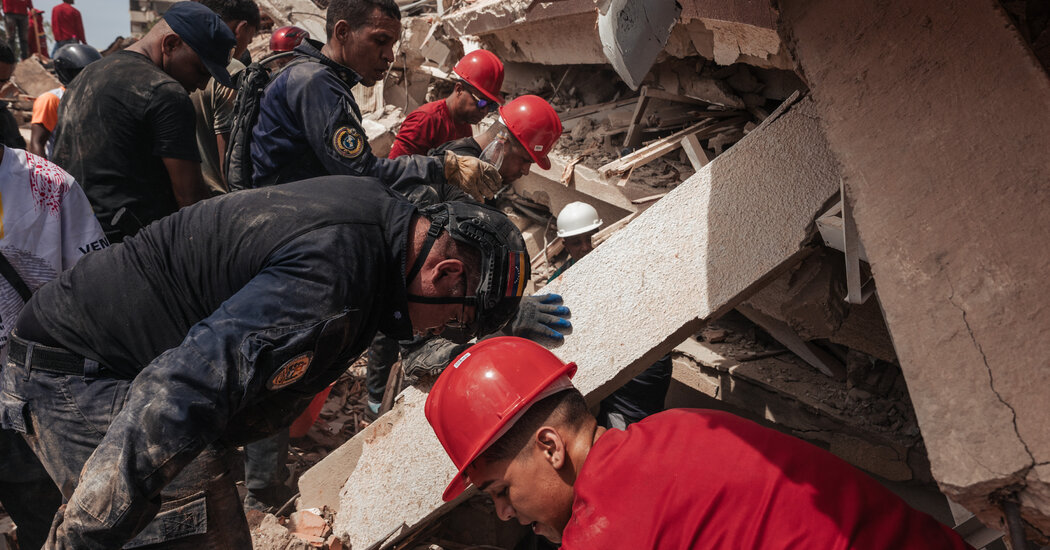
A few miles down the damaged coastline, in the seaside community of Macuto, the structural failure of multi-story residential buildings created vertical tombs, leaving families like that of Brigeanner Soto pleading for heavy industrial machinery. Writing from her home near Dallas, Texas, Soto described her desperate attempt to gather reliable news about her eighteen-year-old sister, Gabriela Orfao, who resided with other siblings in Punta Brisas, a prominent fourteen-story apartment building located roughly twelve miles east of the main international airport. Through sporadic, low-fidelity audio notes sent by neighbors when local cellular signals temporarily surged, Soto learned that while her sister Camila had been pulled from the wreckage and rushed to a hospital for emergency hip surgery, Gabriela remained trapped deep within the lower levels of the collapsed high-rise. “Gabriela was too far underneath, and they needed heavy machinery to reach her,” Soto explained, her voice heavy with the realization that the community simply lacked the technological resources to save those still breathing beneath the concrete slabs. In the absence of an immediate, organized state rescue response, civilian survivors and neighbors were forced to utilize their bare hands, shovels, and car jacks to sift through tons of unstable debris, risking their own lives to reach those crying out from the darkness. This grassroots mobilization highlights a stark reality: in modern Venezuela, the boundaries between professional emergency response and civilian survival have completely dissolved, leaving ordinary citizens to shoulder the burden of disaster recovery.
4. A Hallowed Infrastructure: The Severe Limits of Civic Defense
The systemic hollowed-out state of Venezuela’s municipal emergency infrastructure has left local populations feeling abandoned, forcing them to pin their hopes on international rescue teams that have yet to arrive. In a tense telephone interview from within the country, local resident Angie Reyes shared her agonizing search for her colleague, forty-three-year-old Daniel Vivas, who lived on the sixth floor of an apartment block in the heavily damaged port city of La Guaira. Reyes had not heard from Vivas since before the earth began to shake, and her fears were compounded by the knowledge that local civil defense forces are severely underfunded, lacking basic diagnostic tools like thermal imaging cameras, acoustic listening devices, and heavy cranes. “We know the country’s rescue services have very limited capacity,” Reyes said, expressing a widespread anxiety that the critical window for saving lives would close before effective help could reach the coast. This acute shortage of rescue personnel and equipment is the direct result of years of economic stagnation and institutional decay, which have left public hospitals without basic medical supplies and fire departments without operational vehicles. Consequently, communities find themselves in a state of suspended animation, balanced between the urgent need to act and the paralyzing realization that they are entirely dependent on foreign humanitarian assistance to manage a tragedy of this magnitude.
5. Silent Ruins in Caracas: Diminishing Hope in El Paraíso
Within the capital city of Caracas, the urban landscape presented a similarly grim tableau of destruction, particularly in middle-class neighborhoods like El Paraíso, where older concrete structures proved highly vulnerable to the seismic forces. Outside the dusty, fractured remnants of a six-story residential building, Vladimir Navas stood in silence, searching the heap of shattered brick and twisted rebar for any sign of his elderly in-laws, eighty-six-year-old Freddy Carrero and eighty-two-year-old Eliana Hernández. Navas estimated that the couple had been in their apartment watching a World Cup football match when the building collapsed, a routine afternoon activity transformed in an instant into a claustrophobic cage. Although a few municipal workers operating borrowed heavy machinery had begun lifting massive chunks of flooring from the site by Thursday afternoon, the discovery of deceased domestic pets and the complete lack of structural void spaces suggested a grim outcome for the at least seven residents missing at the location. “There’s no possibility that they got out,” Navas remarked quietly, his eyes fixed on the motionless debris while Caracas Fire Department Colonel Henry Ascanio supervised the search. “You can’t hear anything. If anyone is alive in there, it’s a miracle,” Navas added, reflecting the numbing resignation of family members who must watch their loved ones’ homes turned into permanent monuments of grief.
6. A Fractured Nation’s Path Forward: Resilience Amid Reconstruction
As the dust settles over the devastated valleys of northern Venezuela, the long-term path to recovery appears fraught with geopolitical, economic, and logistical obstacles that will test the resilience of the nation. The physical reconstruction of damaged cities like La Guaira and Macuto will require billions of dollars in capital investment—heavy machinery, architectural reassessments, structural retrofitting, and comprehensive medical rehabilitation—which the national government is ill-prepared to provide independently. This disaster further complicates the delicate relationship between Venezuela and the international community, as diplomatic barriers must be navigated to allow specialized foreign search-and-rescue teams, field hospitals, and financial aid to cross the borders without political grandstanding. For the millions of Venezuelans living abroad, this tragedy has permanently altered their relationship with their homeland, transforming their financial remittances from sustaining lifelines into emergency survival funds. Ultimately, the true legacy of Wednesday’s double earthquake will not just be measured by the seismic readings or the volume of fallen concrete, but by the endurance of human connection that spans across oceans and continents, keeping hope alive in the quiet spaces beneath the stone.