


For as long as humans have walked the Earth, our relationship with survival has been defined by our mastery of fire. From the flickering embers of ancient campfires that kept the predators of the dark at bay, to the roaring, carbon-spewing fossil fuel plants that powered our industrial revolutions, we have constantly sought more efficient, powerful ways to illuminate our lives and drive our machinery. Today, however, our traditional fires are catching up with us, wrapping our planet in a suffocating blanket of greenhouse gases and forcing us to look toward the ultimate cosmic source of light and warmth: the stars. It is this existential challenge that drives the dreamers, physicists, and engineers at General Fusion, a pioneering company born in British Columbia back in 2002. For over two decades, this passionate team of scientists has dedicated their lives to solving one of modern physics’ most frustrating and tantalizing puzzles: capturing the very process that powers the sun and recreating it safely inside a terrestrial machine. Nuclear fusion—the fusing of light hydrogen isotopes under unimaginable heat and pressure to release vast amounts of clean, safe, and virtually limitless energy—is often dismissed by critics as a perpetual mirage, a miracle technology that is perpetually thirty years away. Yet, representing more than just a scientific goal, this endeavor has become a deeply personal quest for hundreds of researchers who believe that domesticating star-fire is the single most important legacy they can leave to future generations. Guided by this relentless optimism and a stubborn refusal to accept defeat, General Fusion has transitioned from a small, audacious startup into a leading global contender in the ultimate clean energy sweepstakes. They are fighting not just against the laws of plasma thermodynamics, but against the ticking clock of climate change, pushing forward with the profound conviction that we can build a future where clean energy is as abundant as the air we breathe, liberating humanity from its reliance on fossil fuels once and for all.
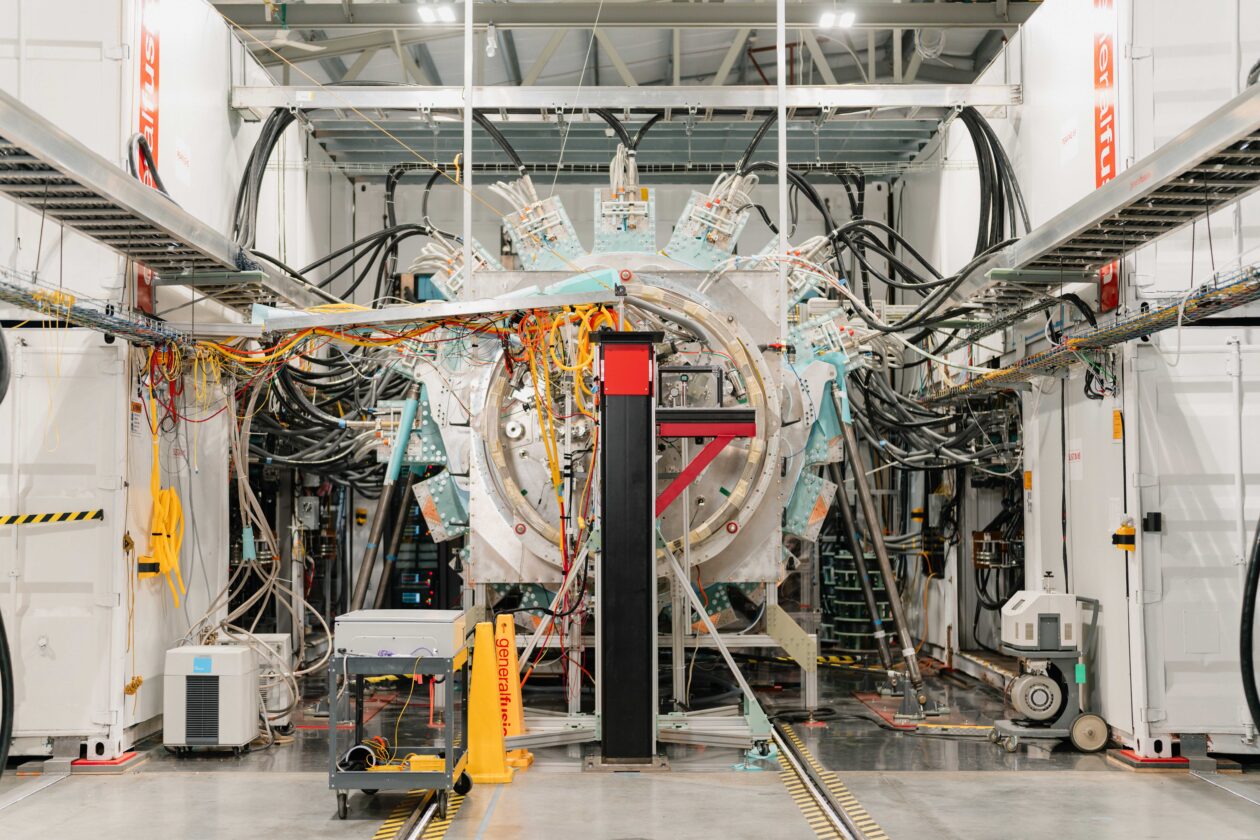
At the absolute heart of General Fusion’s current scientific campaign is a remarkable piece of engineering known as the Lawson Machine 26, or LM26. Named in honor of the British physicist John D. Lawson, who established the fundamental criteria for achieving net energy gain in fusion, this demonstration device is a visual testament to human ingenuity—a majestic, chaotic tangle of polished steel, thick cabling, diagnostics, and high-voltage capacitors that currently stands as a half-scale model of a future commercial reactor. Unlike the massive, multibillion-dollar magnetic confinement tokamaks favored by international government consortiums, General Fusion utilizes a proprietary, highly practical approach called Magnetized Target Fusion. In this elegant, rugged process, a warm cloud of magnetized hydrogen gas is injected into a chamber where liquid metal is rapidly compressed by a system of synchronized, high-tech pistons, squeezing the plasma until it reaches the unfathomable conditions required for its atomic nuclei to fuse and release energy. Recently, the laboratory in Canada erupted in hard-earned celebration as LM26 crossed a historic threshold, achieving a plasma temperature of approximately 8.4 million degrees Celsius. To put that into perspective, this is a temperature hotter than the core of many stars, conjured out of thin air by a team of human beings working in a suburban research park. For the engineers who monitor these tests from control rooms, such breakthroughs are not merely abstract data points on a computer screen; they are the culmination of sleepless nights, complex calibrations, and the overwhelming joy of seeing theoretical physics manifest as physical reality. Every fraction of a degree gained is a hard-fought victory against the chaotic nature of plasma, which constantly seeks to escape its electromagnetic cages, and each successful test run brings humanity one step closer to proving that a controlled, miniature star can indeed be safely packaged, sustained, and harvested to power our collective future.
While achieving stellar temperatures in a controlled laboratory environment is a monumental scientific feat, translating those laboratory triumphs into practical, everyday grid power requires an entirely different kind of courage—one that bridges the gap between pure research and civil infrastructure. Recognizing this immense challenge, General Fusion recently took a massive, visionary leap forward by establishing a pioneering partnership with Renexia, a prominent energy infrastructure developer based in Italy. This collaborative agreement creates a strategic, milestone-based framework specifically designed to scout viable industrial locations, secure necessary development funding, and navigate the complex, often daunting web of European environmental regulations to deploy a commercial-scale fusion machine on Italian soil. Targeted for deployment around the year 2035, this initiative represents a profound cultural shift, translating the abstract promise of fusion into a localized, down-to-earth conversation about community development, national grid stability, and sustainable economic infrastructure. Imagine the historical weight of constructing a fusion plant amid the sun-drenched, ancient landscapes of Italy, a country celebrated for its historical architectural wonders, now planting the seeds for the ultimate clean energy revolution of the twenty-first century. For the local engineers, city planners, and community members who will be involved, this partnership is not just a commercial or industrial transaction; it is a shared vision of a clean, post-carbon society where regional economies are revitalized by safe, high-paying technology jobs and where the seasonal vulnerability of the grid is permanently cured. It serves as a vital reminder that solving the global climate crisis is not a task that can be accomplished in regional isolation, but rather a global cooperative tapestry that requires combining Canadian mechanical ingenuity with European infrastructural expertise to rebuild our relationship with the natural environment.
Yet, the road to the stars is paved with relentless financial peril, and the narrative of General Fusion is as much a story of corporate survival, grit, and strategic adaptation as it is of scientific brilliance. Deep-tech innovation is incredibly expensive, and over its twenty-four-year lifespan, the company has raised upward of $400 million through a delicate, hard-won mix of private venture capital, strategic industry partners, and crucial government grants to keep its lights on. However, the path has been far from smooth, marked by painful, deeply human setbacks that have tested the resolve of everyone involved. Just last year, facing a tightening global economy, geopolitical instability, and rising interest rates, the company had to make the heart-wrenching decision to pause its ambitious plans for a massive demonstration facility in the United Kingdom, focusing instead on the leaner, more immediate LM26 project in a bid to prove their core physics first. This strategic retreat resulted in painful layoffs, leaving remaining employees to shoulder a heavier burden of work while their chief executive officer made public, highly vulnerable pleas for new rounds of investment to stave off financial stagnation and complete their work. Now, a massive financial turning point looms on the immediate horizon with a proposed $1 billion Special Purpose Acquisition Company (SPAC) merger with Spring Valley Acquisition Corp. III. With a highly anticipated shareholder meeting scheduled for July 6, the entire future of the company sits on a knife’s edge; if shareholders and security holders approve the merger, it will unlock the massive capital reserves required to bridge the gap between their current laboratory success and the industrial-scale plants they wish to build. For the founders who started with a mere sketch on a napkin and the workers who have poured decades of their lives into this company, this upcoming financial vote represents a dramatic, hyper-stressful crossroads where economic pragmatism must successfully align with scientific ambition to keep their shared dream alive.
General Fusion does not operate in a vacuum, but rather as a leading contender in an intense, friendly yet fierce global space race involving roughly fifty commercial fusion startups worldwide. Every single one of these companies is chasing the elusive, historic state of “scientific breakeven”—the long-sought holy grail of modern physical science where a machine generates more usable thermal energy from a fusion reaction than the immense power required to initiate and control it in the first place. The sheer volume of investment flowing into this sector highlights a growing, anxious realization among corporate leaders, governments, and tech giants that traditional renewables like wind and solar, while incredibly crucial, may not be enough on their own to satisfy the astronomical energy demands of our AI-driven, data-centered future. In this high-stakes environment, companies are resorting to increasingly creative, and sometimes highly unusual, financial strategies to secure their survival and speed up their timelines. For instance, California-based TAE Technologies, one of General Fusion’s fiercest competitors, recently made headlines by pursuing a staggering $6 billion merger with Trump Media & Technology Group, the publicly traded parent company of the social network Truth Social, with the goal of selecting a site and building a utility-scale plant this year. While such headline-grabbing financial maneuvers may raise eyebrows among traditional scientific purists and political commentators alike, they underscore the absolute desperation and raw determination defining this industry today. For these rival teams of innovators, securing capital is not about corporate greed or vanity; it is about keeping their research laboratories running for just one more year, buying enough time for their brilliant minds to solve the daunting mechanical, electromagnetic, and thermodynamic challenges that stand between humanity and a clean, safe, and truly unlimited energy source.
As we look toward the promised horizon of 2035, the journey of General Fusion and its global peers invites us to meditate deeply on the nature of human legacy and our shared responsibility to the future. To commit to a technology that may not see widespread commercial success for another decade—and whose ultimate triumphs might only be fully enjoyed by our children and grandchildren—is a radical act of faith in a modern world that is so often obsessed with instant gratification and short-term quarterly returns. It requires us to cultivate a generational perspective, a way of thinking akin to the medieval masons who laid the heavy foundation stones of grand cathedrals knowing they would never live to see the spires touch the heavens. By taking the lessons learned from the Lawson Machine 26, combining them with the financial scaffolding of the upcoming SPAC merger, and deploying them on the ground through partnerships like the one with Renexia in Italy, these pioneering innovators are actively constructing the foundations of our future civilization. The struggle, the financial volatility, the layoffs, and the triumphant, multi-million-degree temperature milestones are all interconnected chapters in a grander, deeply inspiring human epic of perseverance. We are, after all, a species born of stardust, composed of the very elements forged in the hearts of ancient stellar furnaces billions of years ago, and there is a beautiful, poetic symmetry in our efforts to build miniature stars of our own right here on Earth. Ultimately, our journey into the heart of the atomic nucleus is not merely an engineering challenge or a corporate race; it is a profound testament to our enduring curiosity, our capacity for resilience, and our refusal to let the darkness of a changing climate dim the brilliant, limitless potential of our future.