


The Sovereign Squeeze: Iraq’s New Prime Minister Ali al-Zaidi Navigates a Perilous Geopolitical Tug of War
1. The Financial Noose and Baghdad’s New Bureaucracy
U.S. FEDERAL RESERVE BAGHDAD COFFERS IRANIAN INFLUENCE[Holds Iraq’s Oil Dollars] —-> [Withheld Cash Shipments] —-> [Militia Crackdown Demand]
When Prime Minister Ali al-Zaidi assumed office in late April, he did not inherit a functioning government so much as a geopolitical fault line destabilized by decades of foreign intervention. The political newcomer, a wealthy businessman with no prior experience in international statecraft, was thrust into the premiership just as the Trump administration applied a devastating financial chokehold to the Iraqi state. In a dramatic escalation of long-standing U.S. foreign policy in the Middle East, Washington abruptly suspended shipments of physical U.S. dollars—earned from Iraq’s own oil sales and held in the Federal Reserve Bank of New York—while simultaneously freezing critical funding dedicated to the country’s national security services. This aggressive leverage was designed to deliver an unmistakable ultimatum to Baghdad: immediately disarm the powerful Iran-backed militias operating within its borders, sever the financial pipelines linking Iraq to Tehran, and prove that the sovereign state could govern without the tacit approval of Iranian proxy forces. For al-Zaidi, this abrupt curtailment of liquid cash threatened to trigger a domestic banking collapse and leave state salaries unpaid, transforming a chronic systemic issue into an immediate crisis of political survival. Iraq has spent the post-Saddam Hussein era caught in a relentless, zero-sum tug of war between its two primary, yet deeply antagonistic, allies—the United States and Iran—a volatile dynamic that has repeatedly transformed local cities and desert outposts into proxy battlefields.
2. The Illusion of Command: Shifting Weapons in the Shadows
      STATE SECTOR                            SHADOW SECTOR
========================                ========================
[ National Security Army ] [ Kataib Hezbollah ]
| |
(Formal Command Structure) (Asymmetric Warfare, IRGC)
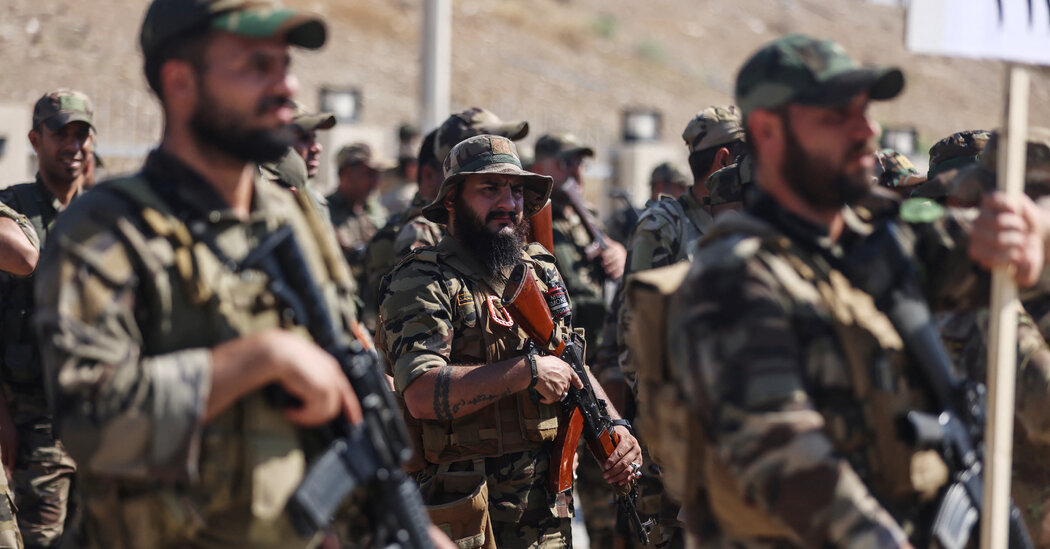
In a direct bid to satisfy Washington’s demands and stave off financial ruin, Prime Minister Ali al-Zaidi issued a sweeping executive decree ordering all independent armed groups to immediately submit to the direct authority of the national security administration. However, this administrative maneuver was quickly met with fierce resistance from the country’s most powerful paramilitary networks, exposing the profound limitations of Baghdad’s centralized authority. Chief among these defiant factions is Kataib Hezbollah, an elite, heavily armed group that has routinely launched rocket and drone attacks against U.S. military installations and diplomatic facilities, while also being implicated in high-profile kidnappings, including the abduction of an American journalist in Baghdad earlier this year. Recognizing that al-Zaidi’s directive stopped far short of demanding the outright disbandment of these groups—as the Trump administration had repeatedly insisted—regional security analysts quickly dismissed the decree as a superficial rebranding effort rather than a genuine disarmament campaign. Renad Mansour, a leading Iraq analyst at the London-based research institute Chatham House, observed that the prime minister’s order served as little more than a political veneer designed to temporarily appease Western critics while leaving the underlying militia infrastructure completely intact. “This is more of a veneer of going after the militias,” Mansour explained, highlighting the systemic challenge that has bedeviled successive administrations in Baghdad, “because the devil is in the details, and once you get to the details, it is still far from an ideal state where there is a clear and clean chain of command.”
3. The Shadow of 2003 and the Institutionalization of the PMF
2003 U.S. INVASION 2014 ISIS INVASION STATE RECOGNITION[Fall of Sunni Hegemony] —> [Creation of the PMF] —> [Sovereign Armed Force Status]
To understand the immense challenge facing Prime Minister al-Zaidi, one must trace the deep sectarian transformations that reshaped Iraq following the 2003 U.S.-led invasion, which permanently shattered the decades-long rule of the Sunni Muslim minority and swept the Shiite majority into the halls of power. Over the ensuing two decades, successive Shiite-dominated administrations in Baghdad naturally forged deeper economic, religious, and political alliances with their Shiite-majority neighbor, Iran, creating a porous border through which Tehran could project its strategic influence. This partnership reached a critical juncture in 2014 when the swift, brutal advance of the Sunni extremist group Islamic State (ISIS) threatened to dismantle the Iraqi state entirely, prompting the formation of the Popular Mobilization Forces (PMF), an umbrella coalition of mostly Shiite militias assembled to defend the capital. Funded by the state budget but heavily armed, trained, and guided by Iran’s Islamic Revolutionary Guard Corps (IRGC), many of these militias became indispensable combat forces on the ground, eventually securing legal status as an official branch of the Iraqi national security forces. Yet, despite being formally integrated into the state apparatus on paper, elite factions within the PMF, such as Kataib Hezbollah, have consistently operated as autonomous political and military entities, maintaining their own intelligence services, financial empires, and allegiances to regional commanders rather than acknowledging the supreme authority of the prime minister.
4. A Fractured Front: The Calculated Compliance of Muqtada al-Sadr
                     [ IRAQI STATE AUTHORITY ]
                                |
        +-----------------------+-----------------------+
        |                                               |
 [ SUBMISSION ]                                  [ REJECTION ]
Sadr’s Peace Brigades Guardians of the Blood
(Nationalist Political Survival) (Demands Complete U.S. Exit)
The domestic fallout from Prime Minister al-Zaidi’s security decree has highlighted deep divisions within Iraq’s Shiite political landscape, revealing that some factions see political advantage in cooperation, while others view compliance as treason. Muqtada al-Sadr, the highly influential and fiercely nationalistic cleric who controls a massive political bloc in parliament, quickly announced that he would fully integrate his powerful Peace Brigades militia into the official military command structure, positioning himself as a defender of civil order. Sadr framed this decision as a vital step to safeguard national stability and protect the public interest during a period of acute national danger, a move that simultaneously enhanced his domestic legitimacy while putting political pressure on his pro-Iran rivals. Conversely, hardline factions like the Guardians of the Blood Brigade—a militant group with a history of claiming responsibility for lethal asymmetric attacks against U.S. personnel—completely rejected the government’s authority, framing the disarmament decree as an act of capitulation to American foreign policy. In an official statement, the group asserted that any legitimate reform of the militia system must be preceded by tangible, irreversible steps to guarantee Iraq’s absolute sovereignty and independence from foreign interference, effectively declaring that they would not lay down their weapons while American troops remained on Iraqi soil.
5. The Collapse of Neutrality in the Crucible of Regional War
REGIONAL STABILITY FEBRUARY AIR STRIKES MILITIA ACTIVATION[Post-Oct 7 Neutrality] —> [U.S./Israeli Strikes] —> [IRGC Activates Proxy Front]
This severe domestic security crisis comes at a time when Iraq is striving to preserve a rare period of relative economic growth and infrastructure development, made possible by years of internal stability. Until recently, Baghdad had successfully insulated itself from the broader regional conflicts triggered by the October 7, 2023, Hamas-led attack on Israel and the subsequent war in Gaza, allowing the country to rebuild its economy and attract foreign investment. While other Iran-backed groups in Lebanon, Yemen, and Syria quickly mobilized to launch attacks against Israeli and Western targets, Iraq’s mainstream armed militias initially remained on the sidelines, reluctant to jeopardize their political standing and economic gains within the Iraqi state. That fragile equilibrium collapsed in late February following the outbreak of direct conflict between regional powers and Iran, a development that forced the IRGC to activate its proxy networks across the Middle East. According to Chatham House’s Renad Mansour, the IRGC moved quickly to coordinate counterattacks against U.S. and Israeli targets, stripping Baghdad of its ability to remain neutral. This escalation quickly manifested in a series of retaliatory strikes by local militias against U.S. interests, including a dramatic rocket attack on the heavily fortified U.S. Embassy in Baghdad, launched in response to an allied airstrike that had killed three militia members at a local headquarters.
6. The Merchant-Prime Minister and the High Stakes of Washington’s Gambits
TRUMP PRESSURE AL-ZAIDI APPOINTION THE CHATHAM HOUSE VERDICT[Vetoed pro-Iran Maliki] —> [Technocrat Wealthy Partner] —> [Stuck between US Cash & Iran Guns]
The appointment of Ali al-Zaidi as prime minister in late April was itself the byproduct of high-stakes political maneuvering by the Trump administration, which had spent months threatening to completely withdraw political and economic support if pro-Tehran figures were brought into government. Washington had previously threatened to cut ties if veteran Shiite politician Nuri Kamal al-Maliki—a former prime minister whose once-strong relationship with the United States collapsed during his eight-year tenure as he aligned more closely with Tehran—was allowed to return to office. By successfully blocking al-Maliki and clearing the way for al-Zaidi, a pragmatist with deep business ties but no established political base, the United States hoped to secure a partner willing to challenge the entrenched influence of Iran-backed paramilitaries. Yet, as demonstrated by the joint statement released after al-Zaidi’s high-pressure June 15 meeting with U.S. diplomat Tom Barrack, which pledged the complete disarming and dismantling of all armed groups operating outside state control, the expectations placed on the new prime minister may exceed his political capabilities. Without the physical security apparatus to enforce such orders, and with the national economy dependent on the continued flow of U.S. dollars, al-Zaidi remains trapped in a dangerous position where trying to disarm these battle-tested militias could trigger a civil war, while failing to do so could lead to economic isolation by the United States.
Key Takeaways: The Geopolitical Dilemma of Prime Minister Ali al-Zaidi
| Strategic Vector | Key Challenges & Constraints | Expected Outcomes & Risks |
|---|---|---|
| U.S. Economic Pressure | • Temporary suspension of Federal Reserve dollar shipments. • Freezing of security assistance funding. • Demands for complete disarmament of militias. |
• Vulnerability to domestic banking collapse. • Absolute dependence on Washington’s financial clearance. • Risk of severe public unrest if state salaries cannot be paid. |
| Iranian Proxy Resistance | • Kataib Hezbollah’s rejection of state integrate decrees. • High-profile asymmetric warfare & kidnappings. • IRGC-driven regional activation against Israel/U.S. |
• Creation of an unpoliceable “state within a state.” • Vulnerability to retaliatory Allied airstrikes. • Inability to protect key diplomatic installations. |
| Domestic Political Splits | • Muqtada al-Sadr’s tactical integration of the Peace Brigades. • Radical factions demanding complete U.S. withdrawal. • Lack of independent political base for al-Zaidi. |
• Deepening polarization within the Shiite majority. • Fractured response to national security crises. • High risk of parliamentary gridlock or cabinet collapse. |