


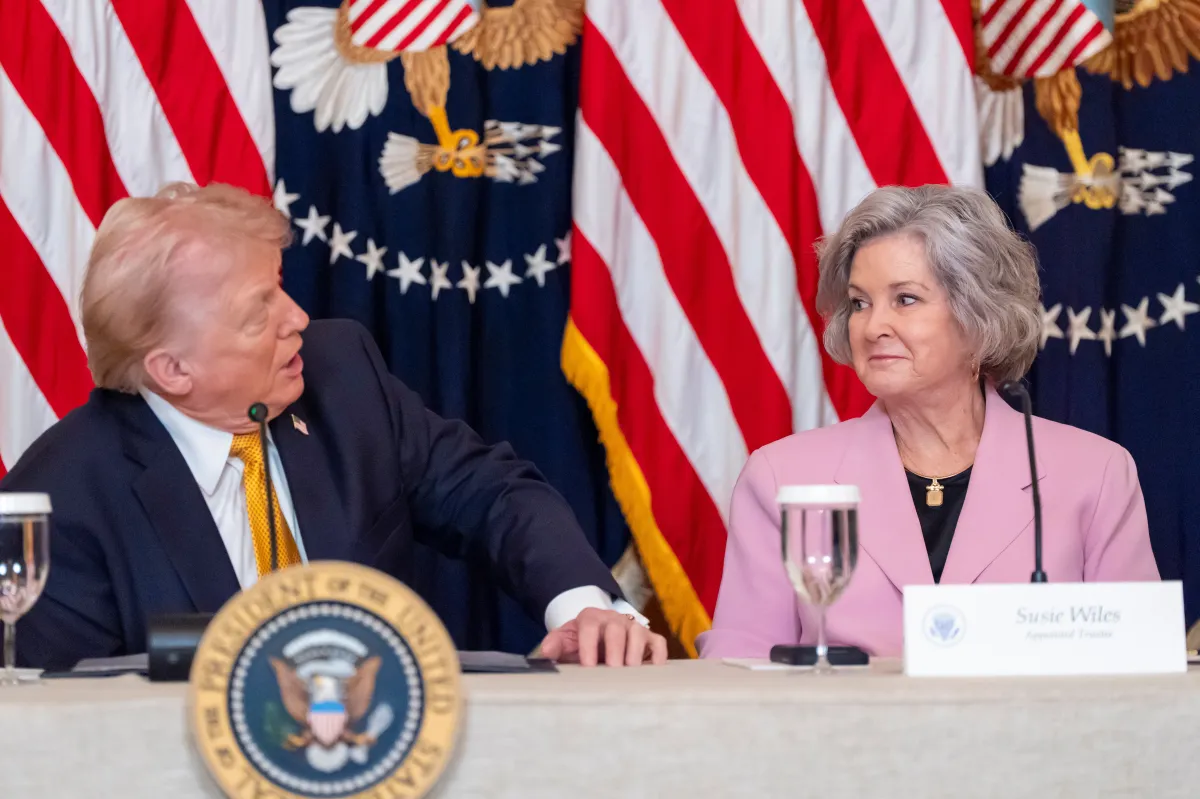
On the hot seat of Washington’s most demanding, unelected office, Susie Wiles has quietly achieved what once seemed impossible: survival. Safely navigating her way to her current milestone in Donald Trump’s second administration, Wiles has outlasted every single one of her first-term predecessors, signaling a major paradigm shift in a White House once synonymous with administrative volatility. For context, John Kelly, a retired four-star Marine general who attempted to bring military discipline to Trump’s initial term, previously held the record for longevity, serving from July 2017 to January 2019 before exiting amid palpable, public tension. In stark contrast, Wiles, who took the reins on Inauguration Day in 2025, has fostered a markedly different atmosphere, transforming the West Wing from a high-pressure cooker characterized by public feuds and sudden ousters into a more organized, disciplined operation. Political observers and historians alike are fascinated by her endurance; the simple fact that Wiles has managed to remain at the helm of an administration led by a president notorious for discarding senior staff is a historical anomaly. During his first term, Trump burned through four chiefs of staff as if they were contestants on a reality show, struggling constantly to find an adviser who could both satisfy his demanding nature and maintain organizational integrity. By enduring the grueling day-to-day demands of this high-stakes environment longer than the rest, Wiles has consolidated her status as the ultimate survivor, humanizing a role that historically breaks even the most seasoned Washington veterans. Her steady hand suggests that the executive branch under Trump’s second term is operating with a level of strategic maturity and personal trust that was profoundly absent during his chaotic first four years in office. This quiet stability is not just a personal victory for Wiles; it is a fundamental shift in how the modern presidency operates under a notoriously unconventional leader.
To truly appreciate the magnitude of Wiles’ achievement, one must examine the extraordinary turbulence that defined Trump’s first administration, where the chief of staff’s office was essentially a revolving door. Behind that door, Reince Priebus, John Kelly, Mick Mulvaney, and Mark Meadows all took turns trying to impose order on a president who actively resisted institutional boundaries, leading to a historic 92 percent turnover rate among senior advisers by the end of his first term. According to data compiled by the Brookings Institution, this staggering rate set a modern record for staff instability, painting a portrait of a government in perpetual, exhausting transition. Today, the landscape is strikingly different under Wiles’ watchful eye; through the entirety of 2025, not a single member of Trump’s Cabinet departed—a dramatic departure from the constant personnel shakeups of the past. Senior staff turnover during the same period dropped to 29 percent, compared to the 35 percent experienced during the first year of Trump’s first term, proving that Wiles’ management style has successfully stanched the bleeding of administrative talent. Granted, Trump has recently faced a few Cabinet departures, and a 29 percent turnover remains elevated when compared to the calmer waters of previous administrations—such as Joe Biden’s first year at 8 percent, Barack Obama’s at 9 percent, or George W. Bush’s remarkably low 6 percent. Yet, within the unique context of Trump’s orbit, Wiles’ ability to keep the ship steady represents an extraordinary organizational feat, illustrating how a highly experienced manager can domesticate one of the most volatile political environments in modern American history. By lowering the temperature in the West Wing, she has allowed policy professionals to focus on governance rather than survival.
Wiles’ path to becoming the indispensable anchor of the modern West Wing was paved by years of disciplined political warfare and a deep understanding of Florida’s complex political landscape. Before stepping into the federal spotlight, she established herself as a brilliant strategist by orchestrating Ron DeSantis’s successful 2018 gubernatorial bid and subsequently navigating Trump’s own triumphant 2024 presidential campaign back to the White House. Her long-standing relationship with Trump, dating back to 2016, gave her an intimate understanding of his shifting moods, political instincts, and personal ticks, enabling her to enter the chief of staff office with a rare commodity: absolute, unshakeable trust. Upon taking office, she immediately set about neutralizing the toxic, factional warfare that had plagued the first term, tightening control over who had access to the Oval Office and limiting the “drama” that feeds media frenzies. Instead of attempting to box Trump in or lecture him on presidential decorum—a fatal mistake that alienated and ultimately doomed John Kelly—Wiles adopted a remarkably pragmatic, humanistic approach that political analysts describe as letting Trump be himself, before quietly stepping in to manage the fallout. Rather than trying to change the president, she accepted him as he was, structuring his advisory circle with loyalists who share his worldview, which effectively neutralized the internal rebellions that had crippled previous chiefs. This masterful combination of tactical flexibility and iron-clad discipline has allowed her to build a protective shield around the presidency while commanding the deep respect of those working beneath her in the West Wing. She has proved that managing Trump requires not a warden, but a whisperer who understands the art of quiet containment.
The ultimate proof of Wiles’ untouchable status within Trump’s inner circle came during a moment that would have instantly spelled professional doom for any other White House staffer in modern history. An explosive interview with Vanity Fair was published in which she was quoted making remarkably candid, raw remarks, including comparing the president’s complex temperament to “an alcoholic’s personality” and offering sharp criticism of other high-profile administration officials. In any ordinary presidency—and certainly during Trump’s highly sensitive first term—such public insubordination would have resulted in an immediate, public firing and a flurry of angry social media posts. Instead, the political universe watched in astonishment as the administration rallied around her, with Press Secretary Karoline Leavitt declaring Wiles to be President Trump’s “greatest and most loyal adviser” and crediting her with the highly successful rollout of the administration’s policy agenda. This extraordinary defense speaks volumes about the depth of Trump’s reliance on her and demonstrates that he views her not as an easily replaceable employee, but as an indispensable partner in his governing enterprise. James Pfiffner of George Mason University noted that this episode highlights just how much Trump trusts Wiles, recognizing that her honesty, strategy, and political instincts are vital to his survival. By standing by her when she was most vulnerable, Trump showed that Wiles has achieved a level of security that transcends traditional political boundaries, making her perhaps the most powerful and secure chief of staff the country has seen in decades. It revealed a human side to their political partnership, grounded in mutual dependence and a shared history of battles won against all odds.
While Wiles has cemented her place as a legendary “Trump survivor,” political scientists like Andrew Rudalevige point out that her tenure, though record-breaking for this specific president, is still relatively brief when viewed through the wider lens of American political history. For comparison, Andrew Card served as Chief of Staff to George W. Bush for over five years, guiding the nation through the immense trauma of 9/11 and the execution of two foreign wars with steady, undisturbed continuity. Nonetheless, the stability Wiles provides has arrived at a critical juncture as the nation marches toward the highly consequential 2026 midterm elections, where the survival of the Republican legislative agenda hangs in the balance. Historically, high staff turnover in the White House severely hampers a president’s policy goals by disrupting coordination across federal agencies, stalling legislative negotiations, and signaling weakness to voters and political opponents alike. By remaining firmly at the helm, Wiles offers the administration a crucial strategic anchor, sparing the president from the grueling, distracting task of onboarding a new chief during a high-stakes campaign season. Given her extensive background as a battle-tested campaign manager, Wiles is uniquely positioned to advise Trump on which candidates to endorse, what policy messages to emphasize, and how to allocate precious resources to maintain legislative majorities. Political observers note that her long-standing credibility and organizational capability have earned her the trust of congressional Republicans, ensuring that the White House and Capitol Hill can present a unified front to a highly polarized American electorate. Her presence guarantees that the administration’s political apparatus remains focused on winning elections rather than fighting internal turf wars.
Ultimately, Susie Wiles’ historic tenure is a testament to the power of quiet diplomacy, realistic expectations, and masterclass political maneuvering in an era of unprecedented national division. By refusing to engage in public vanity battles or push back directly against a notoriously headstrong president, she has managed to carve out a unique space of authority, showing that true power in Washington often belongs to those who speak softly but act decisively. Her ability to survive the internal storms of the West Wing while keeping the focus on the administration’s broader goals has redefined what it means to be a successful modern chief of staff. Whether her steady presence will endure through the midterms and beyond remains to be seen, but she has already succeeded in proving that even ‘the hardest unelected job in Washington’ can be tamed with the right balance of loyalty and strategic wisdom. For now, Wiles has achieved what none of her predecessors could, transforming the narrative of the Trump presidency from one of constant crisis management to one of disciplined execution. As the administration faces the challenges of a dividing nation and upcoming electoral battles, her quiet presence behind the scenes will continue to act as the stabilizing rudder, proving that a leader’s survival is often the ultimate measure of their success. In a city driven by ego and loud declarations, Susie Wiles has shown that silence, strategy, and steady loyalty are the most potent tools of all.