



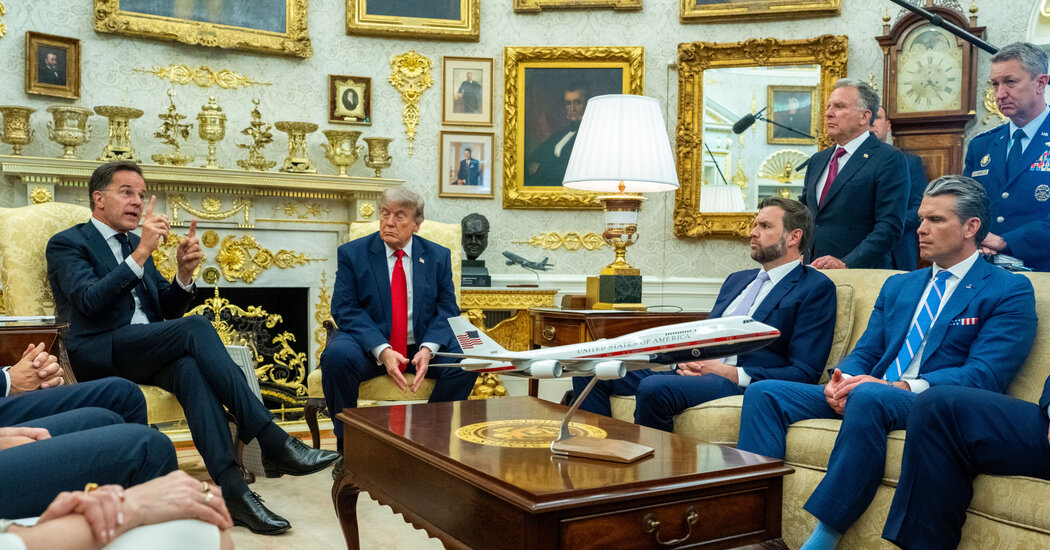
On a chilly Wednesday afternoon inside the historic, gold-draped confines of the Oval Office, a masterclass in personalized diplomacy was quietly unfolding. President Donald J. Trump, seated behind the Resolute Desk, had begun descending into a familiar, rhythmic litany of grievances, venting his long-standing frustrations about America’s North Atlantic Treaty Organization (NATO) allies. To the president, these foreign nations were perennial freeloaders, reaping the security benefits of American military might while offering little of their own treasure in return. But as the atmosphere in the room grew increasingly tense, the newly minted NATO Secretary General, Mark Rutte, did not cower or retreat into defensive, bureaucratic posture. Instead, the former Dutch Prime Minister, who has earned a quiet reputation across European capitals as the preeminent “Trump whisperer,” stepped forward with an unexpected set of visual tools. Carrying large, colorful presentation charts, Rutte transformed the solemn office of the presidency into a makeshift classroom, ready to shift the narrative by appealing directly to Trump’s deep-seated desire for personal validation, transactional victories, and measurable success.
Moving around the room with the practiced ease of an energetic political science professor, Rutte set up his poster boards in front of an audience that included a watchful Pete Hegseth, the newly nominated American Defense Secretary. With a theatrical flourish, the Secretary General pointed to a dramatic upward curve representing European and Canadian defense investments. Rutte did not frame this financial surge as a natural reaction to global instability or the ongoing threat of a belligerent Russia, though he acknowledged those realities. Instead, he branded the massive economic spike with a title carefully designed to capture the president’s imagination: the “Trump Trillion.” Rutte walked the president through the numbers, tracing the timeline back to Trump’s first inauguration in 2017 to demonstrate that the collective extra spending by America’s allies had reached an staggering $250 billion in just the last two years. In a stroke of rhetorical genius, Rutte even compared Trump’s achievements to those of President Dwight D. Eisenhower, the legendary Five-Star General who helped build the bedrock of the modern alliance. Rutte argued that Trump had achieved something no leader since Eisenhower had managed to do—forcing the European continent to begin equalizing its defense expenditures with those of the United States, a spending spree that, as Rutte pointed out, directly translated to thousands of manufacturing jobs back home in America.
Yet, this high-stakes performance was far from a display of mere sycophancy; it was a delicate diplomatic tightrope walk where Rutte had to defend the dignity of the alliance while pacifying its most powerful critic. When President Trump grumbled about European nations being too slow to bolster their own security and too hesitant to join American military operations involving Iran, Rutte calmly but firmly pushed back. He told the president that he disagreed “slightly” with that sweeping characterization, gently reminding Trump that while there had been isolated, disappointing cases, the European allies had overwhelmingly stood by America’s side when called upon. This exchange exposed the raw, psychological core of Trump’s foreign policy worldview. When asked shortly after what he truly expected from America’s oldest democratic allies across the Atlantic, Trump did not talk about treaty obligations, shared democratic values, or human rights. His answer was remarkably simple, personal, and absolute: “Just be loyal. I just want their loyalty.” For Trump, international agreements are not immutable sacred bonds; they are personal contracts built on fealty, reciprocity, and respect for his leadership.
This highly personalized approach to diplomacy has drawn sharp criticism from several of Rutte’s European colleagues, who view his flattering, deferential treatment of Trump as a form of appeasement that undermines the dignity of the alliance. To his detractors, Rutte’s flattery seems overly accommodating to a leader who has repeatedly threatened to walk away from NATO’s sacred collective defense commitment under Article 5. But for Rutte, the stakes are far too high for high-minded philosophical debates. He understands that his legacy and the survival of the Western security umbrella depend entirely on keeping the United States anchored at the center of global defense. European capitals are currently gripped by a profound, building anxiety that if Russian forces were to push even a few miles past a NATO border, a Trump-led America might hesitate to respond. Against this backdrop, the upcoming NATO summit in Ankara, Turkey, scheduled for early July, is viewed by European diplomats not as an opportunity for grand strategic breakthroughs, but as a dangerous minefield where the primary objective is simply to avoid a catastrophic, public explosion by the American president.
The deeply personal nature of this modern era of global statecraft is further illustrated by the unorthodox circumstances surrounding Trump’s decision to attend the Ankara summit at all. During his first term, Trump famously snubbed the alliance by refusing to mention the collective defense clause at NATO headquarters. He made it abundantly clear this week that he had no intention of attending the gathering in Turkey until its authoritarian president, Recep Tayyip Erdogan, bypassed traditional diplomatic channels and called him directly on the phone to plead for his presence. Showing a flagrant disregard for the institutional norms that traditionally govern multinational summits, Trump admitted that he would not have gone for most people, but was making the trip out of personal respect for Erdogan. This revelation underscores a uncomfortable reality for Western leaders: under Trump’s leadership, geopolitical alliances do not function on the strength of decades-old treaties, but rather on the shifting sands of personal chemistry, direct telephone conversations, and the transactional favors traded between powerful heads of state.
Perhaps the most startling manifestation of this transactional diplomacy emerged when Trump casually suggested that he would soon lift the long-standing American ban preventing Turkey from purchasing state-of-the-art F-35 fighter jets. Turkey had been unceremoniously kicked out of the trillion-dollar stealth fighter program during Trump’s first term in 2019, after Erdogan defied Washington by purchasing sophisticated S-400 air defense missile systems from Russia, raising severe espionage fears that Moscow could use the Turkish systems to harvest critical intelligence on Western stealth technology. Trump glossed over these complex, deep-seated military and security concerns, focusing instead on his personal rapport with Erdogan and his desire to make a deal. As the meeting concluded, the stark reality of the new world order became clearer than ever. Mark Rutte’s charts, his clever Coining of the “Trump Trillion,” and his psychological maneuvering in the Oval Office represent the survival strategy of an entire continent—a pragmatic acknowledgment that in an era dominated by unpredictable personalist politics, keeping the peace requires treating the world’s most powerful military alliance not as a grand coalition of ideals, but as a business partnership that must constantly prove its profitability and loyalty to the man in the Oval Office.