


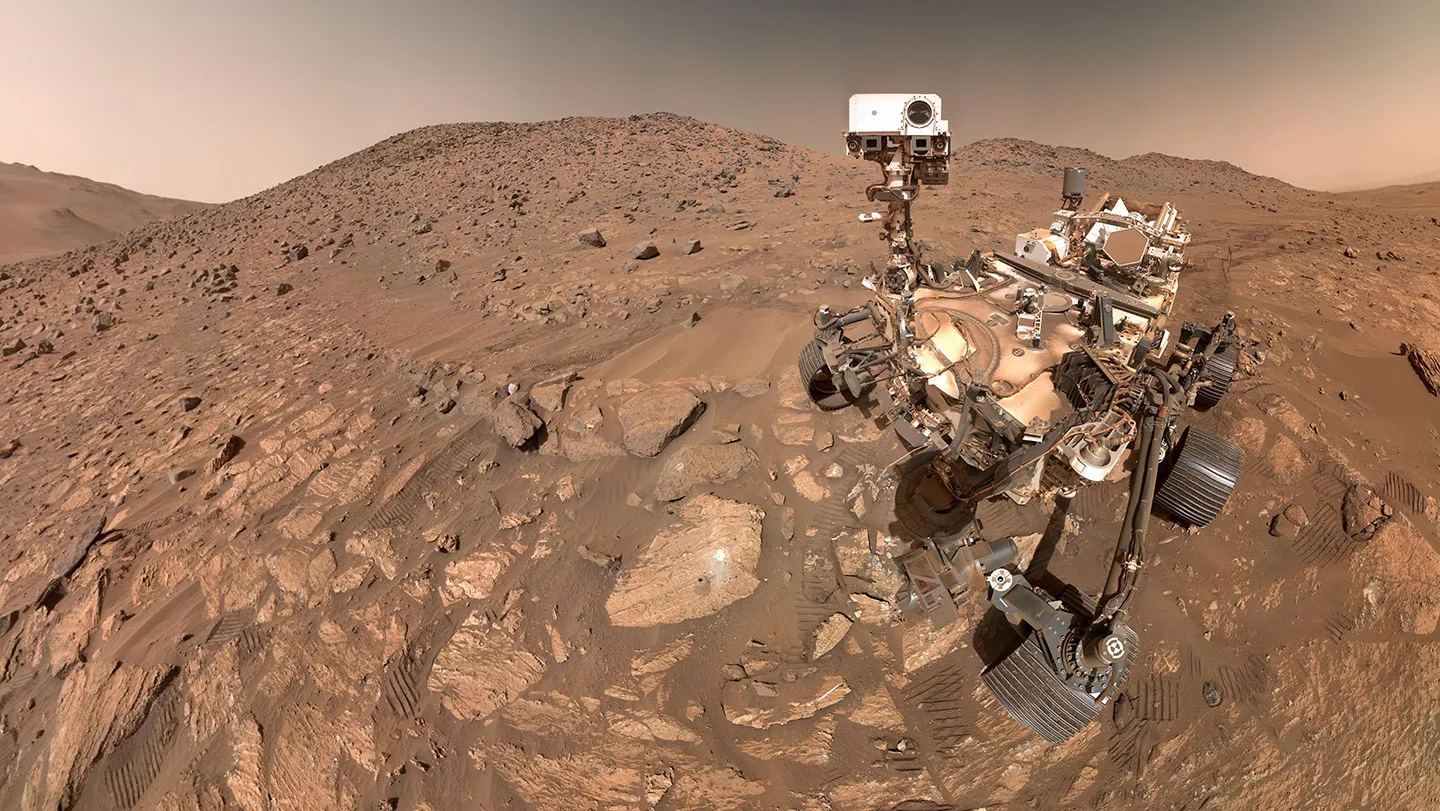
The eternal quest to answer whether humanity is alone in the cosmos has taken a thrilling, yet wonderfully complicated, turn along the ancient riverbeds of Mars. Recently, NASA’s tireless Perseverance rover stumbled upon an intriguing clue: complex organic carbon detected both within and on the surfaces of Martian rocks. Published in the journal Science Advances, this milestone discovery represents a breakthrough spearheaded by planetary scientist Ashley Murphy and her team at the Planetary Science Institute in Tucson, Arizona. What makes this finding particularly remarkable is that it marks the very first time such organic compounds have been identified on a rock that the rover did not have to physically drill into. Instead of relying on invasive drilling to expose pristine subterranean layers, Perseverance’s sensitive sensors read these signatures right from the weathered surface, adding a wealth of new geological context to what could very well be the chemical footprints of ancient microbial life. For space enthusiasts and scientists alike, this is a profound reminder of Mars’s dynamic history, showing us that the planet was once a place of active, evolving chemistry that could have set the stage for life.
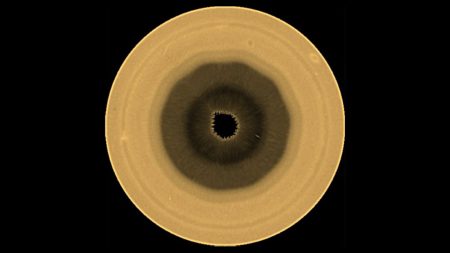
To truly appreciate the significance of this discovery, one must travel back billions of years to a time when Mars was a damp, blue world. Today, the sterile and wind-swept expanse known as Jezero Crater looks like a desert, but it was once a bustling basin home to a deep lake fed by a network of winding rivers. Along one of these dried-up river channels, in a formation dubbed “Bright Angel,” Perseverance conducted a series of crucial measurements. It was here that the rover first captured the world’s imagination by discovering what scientists vividly describe as “leopard spots.” These tiny, light-colored patches are rimmed with iron phosphate, a mineral structure that immediately set off alarm bells for astrobiologists. On Earth, these exact types of physical and chemical patterns are typically created when microbial lifeforms interact with their environment, reducing iron and using chemical energy to survive. The presence of these spots suggests that the very same biological mechanisms that shaped early Earth could have played out on the banks of Mars’s ancient rivers.
The puzzle pieces became even more intriguing when researchers took a deeper look using SHERLOC, one of the rover’s most advanced instruments. Short for Scanning Habitable Environments with Raman & Luminescence for Organics & Chemicals, SHERLOC is a high-tech robotic hand-lens that allows scientists on Earth to examine the microscopic textures and chemical fingerprints of Martian stones. By aiming SHERLOC at four specific targets across three rocks at Bright Angel, Murphy and her colleagues discovered that this newly identified organic carbon is not just clinging to the surface, but is intricately woven into the rocks’ history. It is mixed with both the original silicate sediments that settled when the river first flowed, and the later-forming carbonate and sulfate minerals. This dual distribution tells a fascinating story of two distinct eras: the carbon was likely deposited when the river sediments first accumulated, and then remobilized or added to much later when liquid water seeped through the cracks, leaving behind fresh mineral veins. It paints a picture of a planet that remained hydrologically active and chemically complex over massive stretches of time.
Yet, as exciting as “organic carbon” sounds, scientists are careful to temper our expectations with healthy skepticism. As planetary scientist Paul Byrne from Washington University in St. Louis points out, organic chemistry is not a synonym for biology. While it is true that all life as we know it is built on carbon, carbon molecules can also be forged through entirely lifeless, natural processes. The organic carbon detected at Bright Angel could easily have arrived on the wings of ancient meteorites or cosmic dust that regularly pelted the Martian surface. Alternatively, it could be the byproduct of purely abiological hydrothermal reactions, where hot volcanic waters reacted with underground rocks to weave complex chains of carbon without ever needing a single cell of life. This baseline is a critical reality check for researchers; before we can definitively claim we have found alien biology, we must first rule out all the clever ways that chemistry can mimic life.
However, if we zoom out to look at Mars as a whole, the discovery at Jezero Crater starts to connect with a wider, global pattern. Over ten years ago in 2014, NASA’s Curiosity rover made its own historic detection of organic molecules in Gale Crater, a site located more than 3,500 kilometers away from Jezero. Finding organic matter in two vastly different craters, separated by thousands of miles of rugged Martian terrain, suggests that organic compounds were not some localized freak accident. Instead, it hints at a planet-wide phenomenon. If these discoveries do eventually point back to ancient life, it means that Martian microbes were not restricted to a solitary, lucky lakebed. Rather, they may have been widespread, thriving in diverse aquatic ecosystems across the entire globe during Mars’s warm, wet youth—a realization that makes the search for past life feel infinitely more hopeful.
To cross the threshold from hopeful speculation to scientific certainty, we must face a hard truth: Perseverance cannot solve this mystery alone. The rover is an incredible scout, but its onboard laboratory simply lacks the power to analyze the fine atomic structures and isotopic fingerprints needed to definitively prove a biological source. This is why Perseverance has carefully cached 30 precious geologic samples, including a rock core beautifully named “Sapphire Canyon” that contains the exact organic carbon found at Bright Angel. Bringing these samples home to Earth through the proposed Mars Sample Return mission is currently plagued by budget cuts and shifting political priorities, but researchers like Byrne remain adamant that the journey is worth every penny and every delay. Whether modern terrestrial laboratories ultimately reveal that Sapphire Canyon contains the remains of ancient alien microbes, or simply shows us a breathtakingly complex, lifeless chemistry, the answer will fundamentally reshape our understanding of how life arises in the universe—making these rocks some of the most important treasures humanity has ever sought.