


Bridging the Rise of Regional Anxiety: Rubio’s Diplomatic Tightrope in the Gulf
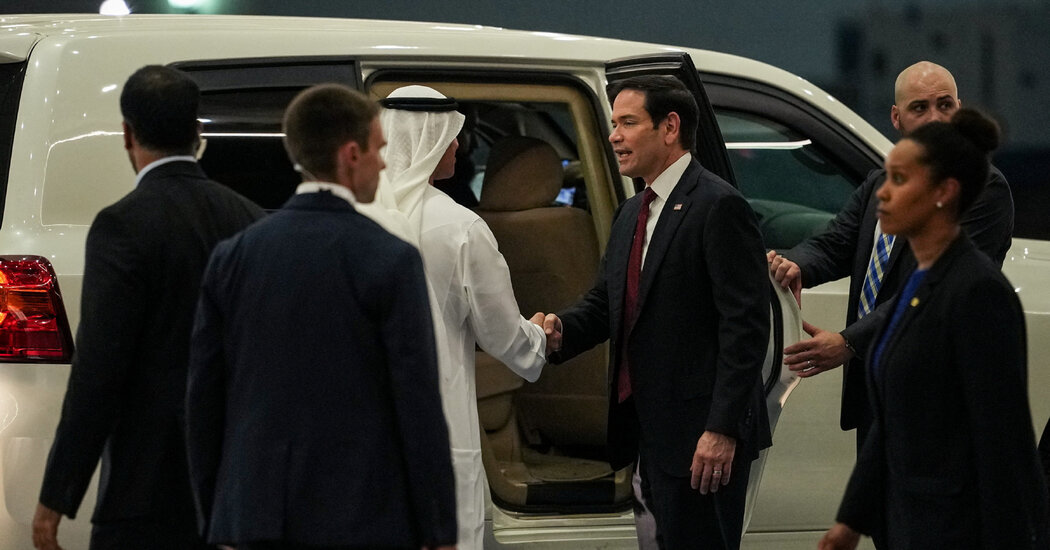
In a high-stakes bid to steady relations with Washington’s most critical Middle Eastern allies, Secretary of State Marco Rubio embarked on a swift, multi-nation diplomatic tour across the Persian Gulf this week, seeking to neutralize the mounting anxiety surrounding a volatile, preliminary peace accord between the United States and Iran. Arriving in Kuwait City before heading to Manama, Bahrain, for a high-profile summit of the Gulf Cooperation Council (GCC), Rubio faced the arduous task of convincing wary Arab leaders that their security interests had not been sacrificed on the altar of American political expediency. “We’re going to be completely aligned with our partners in the Gulf,” Rubio declared to a scrum of reporters in Kuwait, delivering a calculated message of solidarity designed to quiet fears that Washington’s unilateral diplomatic maneuvers might leave its traditional partners exposed to Iranian regional ambitions. Yet, beneath the polished veneer of diplomatic reassurances lies a deep-seated apprehension among Gulf monarchies; these nations have watched with growing alarm as the Trump administration negotiates a fragile truce that leaves several of their most critical security vulnerabilities unaddressed, forcing Rubio into a delicate balancing act to preserve the integrity of decades-old security coalitions.
The Strait of Hormuz Standoff: A Battlefront Over Sovereignty and Shipping Tolls
At the heart of the immediate geopolitical tension is the Strait of Hormuz, a narrow, strategically vital choke point through which approximately a fifth of the world’s petroleum passes daily, and which has recently mutated into a rhetorical battleground over international maritime law and economic sovereignty. While Rubio traveled between Gulf capitals, President Donald Trump took to social media to state that Tehran had explicitly guaranteed that no arbitrary tolls, transit fees, or supplementary insurance surcharges would be levied against commercial vessels navigating the strait—warning that any violation of this assurance would result in an immediate, unilateral termination of peace talks. Rubio reinforced this hardline stance, asserting that any attempt by the Islamic Republic to monetize passage through these international waters would directly violate long-standing global norms, even as Iranian officials remained pointedly silent on the matter, having previously asserted their sovereign right to charge service fees for the upkeep and security of the waterway. The impact of the conflict on global energy corridors remains starkly visible; although maritime data analyzer Kpler reported a slight uptick in shipping traffic with thirty-one vessels transiting the strait on Tuesday, this figure remains a mere fraction of the pre-war volume of roughly 130 ships per day, illustrating how deeply maritime commerce has been choked by the threat of asymmetric naval warfare and unresolved diplomatic disagreements.
Unaddressed Arsenals: Why the Preliminary Accord Fuels Deepening Gulf Skepticism
+————————————————————————-+
| THE STRAIT OF HORMUZ SHIPPING GAP |
| |
| Pre-War Normal: ========================================= [130 Ships] |
| Post-Agreement: ========= [31 Ships] |
+————————————————————————-+
While leaders across the Arabian Peninsula have publicly welcomed the implementation of a fragile ceasefire to halt a destructive phase of regional conflict, the structural omissions within the preliminary U.S.-Iran agreement have triggered a profound strategic reassessment from Riyadh to Abu Dhabi. The source of their frustration lies in Washington’s decision to exclude Iran’s proliferation of ballistic missiles and highly advanced drone programs from the current negotiating framework—weapons systems that were deployed with devastating precision against Saudi and Emirati civil infrastructure during the retaliatory exchanges following initial U.S.-Israeli strikes in late February. By focusing almost exclusively on nuclear deceleration and broad-spectrum de-escalation while leaving Tehran’s conventional offensive capabilities untouched, the current agreement has left Gulf states feeling increasingly vulnerable under the American security umbrella, a sentiment further compounded by Iranian President Masoud Pezeshkian’s defiant declaration that restrictions on his nation’s missile defense programs will never be on any negotiating table. This perceived abandonment has accelerated a broader, structural realignment of Gulf foreign policies, as regional capitals look to diversify their defense partnerships and build independent, multi-layered deterrence networks to protect their highly integrated, modern economies from future iterations of regional instability.
The Lebanese Powder Keg: Israel’s Offensive Actions and the Battle for Beirut’s Sovereignty
The fragility of the current peace process is further threatened by the ongoing hostilities along the Lebanese-Israeli border, where Israel continues its aggressive military campaign to dismantle Hezbollah infrastructure despite the broader ceasefire, drawing fierce threats of retaliation from Iran. While American, Israeli, and Lebanese diplomats convened in Washington in a bid to reinforce the state’s official military presence and enable an eventual withdrawal of Israeli ground forces from southern Lebanon, Rubio offered an unyielding defense of Israel’s tactical operations, arguing that Jerusalem’s military actions are purely defensive measures designed to neutralize persistent rocket attacks launched by Hezbollah across the Blue Line. This perspective, however, clashes with the broader regional consensus in Arab capitals, where leaders fear that continued Israeli airstrikes on Lebanese territory could inadvertently trigger a renewed cycle of dynamic escalation, drawing Iran back into direct conflict and jeopardizing the economic gains of the newly established ceasefire. The ongoing regional friction underscores the limitations of the current diplomatic framework, which attempts to isolate specific bilateral disputes while failing to resolve the interconnected proxy networks that have dictated the security architecture of the Levant and the Persian Gulf for decades.
Shadows in the Boardroom: Unofficial Envoys and the Rocky Road to Switzwerland
      [ THE SWISS DIPLOMATIC TRACK ]
                    │
                    ▼ (Next Tuesday)
      ┌────────────────────────────┐
      │ Technical Working Groups   │
      ├────────────────────────────┤
      │ • Nuclear Site Inspections │
      │ • Gulf Shipping Protocols  │
      │ • Sanctions Clarification  │
      └────────────────────────────┘
Adding a layer of domestic political intrigue to this delicate diplomatic mission was the unexpected presence of Michael Boulos, President Trump’s son-in-law and a prominent private businessman with no official government portfolio, who sat immediately adjacent to Secretary Rubio during critical bilateral discussions with UAE President Sheikh Mohamed bin Zayed in Abu Dhabi. While his inclusion raised eyebrows among senior diplomats and foreign policy analysts, who questioned the mixing of private family ties with formal statecraft, Rubio quickly sought to downplay the incident, telling reporters that Boulos was merely visiting to “catch up” and had played no active role in the formal policy negotiations. As the diplomatic delegation prepares to send technical working groups back to Switzerland to finalize the details of the preliminary accord, the presence of unofficial actors highlights the unconventional, highly personalized nature of the current administration’s foreign policy framework, which often operates outside of traditional State Department protocols. These upcoming Swiss negotiations are expected to be exceptionally contentious, as negotiators attempt to translate a vague statement of intent into a legally binding treaty that satisfies the demands of international lawyers, nervous regional allies, and deeply cynical domestic audiences in both Washington and Tehran.
The Price of Peace: Triumphalist Rhetoric, Nuclear Audits, and an Uncertain Future
As the international community watches these negotiations unfold, the path toward a permanent, comprehensive peace remains fraught with political landmines, driven by domestic posturing and fundamental disagreements over international oversight of Iran’s damaged nuclear infrastructure. In Tehran, political hardliners have sought to frame the preliminary agreement as a major strategic victory, with parliamentary speaker Mohammad Bagher Ghalibaf labeling the accord a “declaration of defeat” for the United States—a triumphalist narrative designed to shield the centrist administration of President Pezeshkian from conservative critics who view any engagement with the West as an act of treason. This domestic posturing stands in stark contrast to the rigid, non-negotiable demands of the United States and its European allies regarding the immediate, unfettered return of International Atomic Energy Agency (IAEA) inspectors to Iranian nuclear facilities, a core commitment that Rubio emphasized must be fully executed before any permanent sanctions relief can be considered. With global oil markets remaining highly volatile and shipping lanes operating under a cloud of systemic uncertainty, the success of this diplomatic gamble rests on whether foreign policy leaders can bridge the vast ideological gulf between the triumphalist demands of the Iranian state and the deep-seated security requirements of America’s closest allies in the Middle East.