



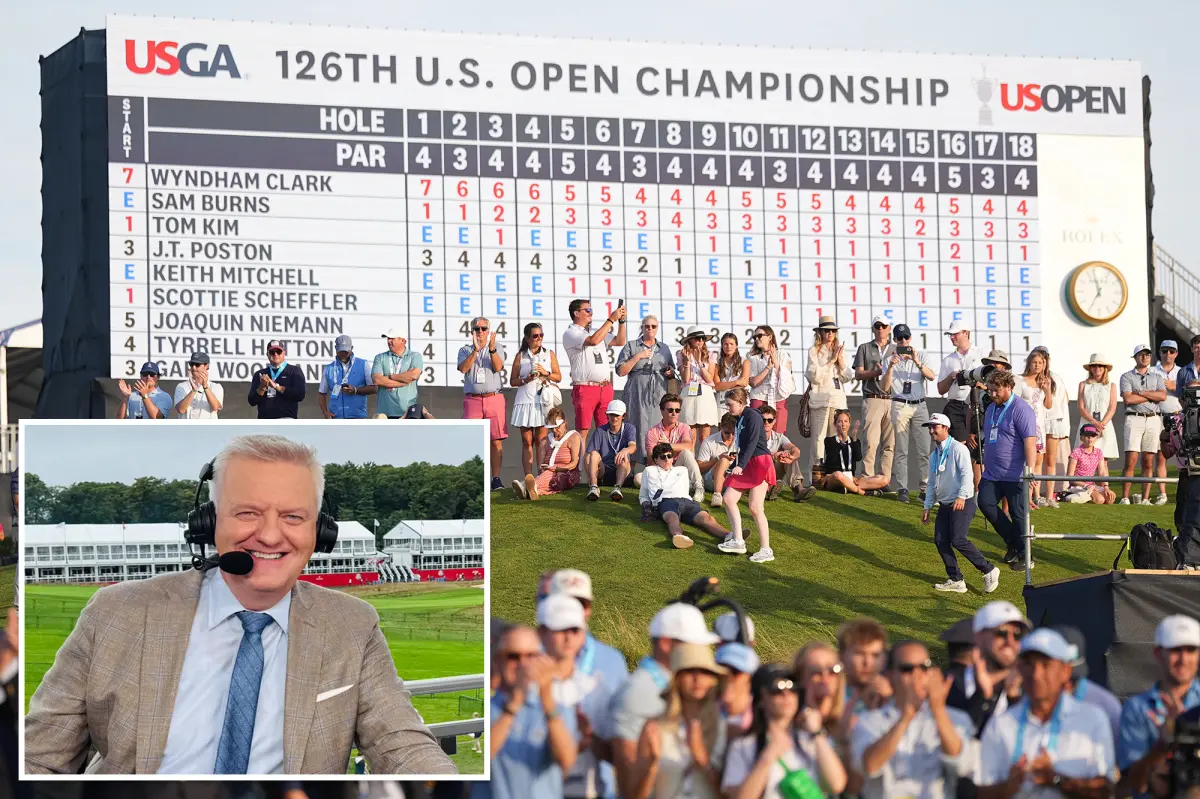
The morning sun over Shinnecock Hills usually brings a quiet, almost reverent serenity, where the salty Atlantic breeze sweeps across the undulating fairways and the only sound is the crisp, satisfying crack of a titanium driver meeting a pristine golf ball. For generations, this landscape has stood as a monument to the ancient and honorable game—a place where decorum, silence, and mutual respect are woven into the very fabric of the turf. But when the U.S. Open rolled into town, bringing with it the pressure-cooker environment of a major championship, that tranquil silence was thoroughly shattered by the unmistakable, high-decibel roar of the local sporting public. Golf, at its highest level, is a mental tightrope walk, but on the eastern end of Long Island, that tightrope is suspended over a roaring canyon of passionate, opinionated, and fiercely loyal sports fans. When Wyndham Clark fought his way through a grueling final round to secure a wire-to-wire victory, he wasn’t just battling the punishing course conditions; he was navigating a psychological gauntlet thrown down by thousands of vocal spectators who treated the golf course less like a quiet sanctuary and more like the rowdy bleachers of a Friday night baseball game. This cultural collision reached a boiling point when a prominent commentator decided to draw a line in the sand, unleashing a wave of criticism that instantly set off a fiery, defensive reaction from the local community. For the residents of Nassau and Suffolk counties, sports are not a passive viewing experience but an active, participatory event where the audience plays a vital role, and they were not about to let an outsider redefine their passion as a defect.
The catalyst for this cross-continental war of words was Eamon Lynch, an eloquent but sharp-tongued Irish analyst for the Golf Channel, who seemed utterly appalled by the lack of traditional etiquette on display throughout the tournament weekend. Following Clark’s hard-fought victory, Lynch took to the airwaves to deliver a scathing critique of the spectators, famously labeling Long Island golf fans as a permanent “stain on the game of golf” and arguing that their behavior made them entirely unworthy of hosting future high-profile tournaments. His irritation went far beyond a simple critique of a few bad actors; he went so far as to suggest that the Professional Golfers’ Association of America should reconsider its schedule and strip Bethpage Black—the legendary public course known for its intimidating atmosphere—of the 2033 PGA Championship. What particularly rankled locals was the calculated nuance in Lynch’s elitism, as he made a point to clarify that his disdain was directed specifically at the working-class crowd of Long Island, carefully sparing the wealthier, more traditional northern suburbs of Westchester County from his sweeping generalizations. To the ears of those who call the South and North Forks home, this sounded like the classic condescension of a golf purist who prefers the muted claps and predictable rhythms of private country clubs over the raw, authentic enthusiasm of everyday people who live and breathe the sport. By suggesting that these passionate fans should be barred from hosting major championships, Lynch touched a raw nerve, transforming a debate about course etiquette into a defensive crusade for the regional identity of one of the country’s most fiercely independent sports hubs.
The backlash from the community was swift, colorful, and entirely unapologetic, reflecting the gritty resilience of a population accustomed to battling heavy traffic on the Long Island Expressway and weathering the skepticism of mainlanders. Among those leading the countercharge was Holly Burton, a dedicated local resident and mother of an avid young golfer, who summed up the prevailing sentiment with a classic piece of New York pragmatism: “If you can’t handle the heat in the kitchen, get out.” Burton’s words echoed through local diners, sporting goods stores, and public putting greens, serving as a reminder that the hyper-competitive, high-stress atmosphere of the tri-state area naturally breeds fans who are louder, tougher, and more demanding than their counterpart spectators elsewhere. To these residents, the suggestion that they should book a one-way ticket on the Hampton Jitney and leave the island for good was a badge of honor, proof that their unfiltered passion had successfully rattled the buttoned-up establishment of a notoriously exclusive sport. Carlos Cruz, another passionate golfer from the area, defended his neighbors by pointing out that this intense energy is driven by a deep love for the game rather than malice, arguing that outsiders have no right to dismiss their entire culture based on a few moments of high-stakes tension. This defense highlighted a fundamental truth about the local sporting soul: on Long Island, showing up means showing out, and if a professional athlete cannot handle the vocal pressure of a championship crowd, then perhaps the fault lies not with the spectators but with the competitor’s mental fortitude.
To truly understand the source of Lynch’s frustration, one had to look at the dramatic scenes unfolding on the final Sunday of the tournament, where the line between traditional golf spectating and rowdy stadium heckling faded entirely. As Wyndham Clark marched down the closing stretch, clinging to a narrow lead with his nerves stretched to the limit, several spectators decided to test his resolve with targeted shouts of “don’t choke, Wyndham!” and urging his ball to “get in the bunker” during crucial shots. The behavior was disruptive enough to result in several fans being escorted off the historic grounds of Shinnecock Hills by security, a rare and dramatic intervention that fueled the narrative that the local crowd had crossed an ethical line. Yet, rather than shrinking away in shame, many local sports enthusiasts, like Holbrook resident Connor Sullivan, openly embraced the rough-and-tumble reputation of their community. Sullivan freely acknowledged that they tend to be a more obnoxious crowd, but he argued that this intimidating environment is precisely what makes Long Island courses some of the most uniquely challenging venues in the world. In this view, a major championship shouldn’t just test a player’s physical ability to swing a club; it should test their character, their poise, and their capacity to perform under the direct, unvarnished scrutiny of a hostile crowd that refuses to treat them like fragile royalty.
However, the debate within the community was not entirely uniform, as some local golfers looked at the changing landscape of the sport with a degree of self-reflective concern. Outside a sporting goods store in Patchogue, twenty-three-year-old Daniel admitted that when he read Lynch’s harsh criticisms, he felt a painful pang of agreement, recognizing that the rowdiness on his home turf could sometimes overshadow the incredible achievements of the players on the course. This internal conflict was echoed by Terrence Reid, a regular golfer who pointed out that the erosion of traditional decorum is not a unique geographic stain on Long Island, but rather a symptom of a broader, generational shift occurring across the entire sporting world. Reid argued that we are living in a fast-paced social media era dominated by a younger generation of fans who come to tournaments less to appreciate the subtle strategies of the game and more to capture viral footage, seek attention, and recreate the chaotic, populist energy of the movie Happy Gilmore. From this perspective, the shouts and heckling are not a product of New York grit, but rather a global trend of digital-age spectators prioritizing personal clout and entertainment over the quiet respect that has traditionally defined the sport’s history.
Ultimately, this clash between the traditional golfing establishment and the vibrant, unfiltered spirit of Long Island sports culture reveals a sport in the midst of a profound identity crisis. As golf seeks to expand its reach, attract younger audiences, and shed its historic reputation as an elitist, exclusionary pastime, it must find a way to reconcile the quiet reserve of its past with the loud, passionate, and democratic energy of its modern fanbase. Eamon Lynch’s dream of pristine, silent courses populated by polite, nodding spectators represents a bygone era that is increasingly incompatible with the realities of modern, high-energy sports entertainment. The people of Long Island will not apologize for their volume, their honesty, or their competitive edge, because these traits are the very elements that define their communities and rescue the sport from clinical monotony. Whether the PGA and the arbiters of golf etiquette like it or not, the boisterous crowds of Nassau and Suffolk counties have permanently asserted their place in the game’s narrative, proving that the heart of American golf no longer beats in the quiet confines of private boardrooms, but in the loud, unpredictable, and fiercely human arenas of the public greens.