


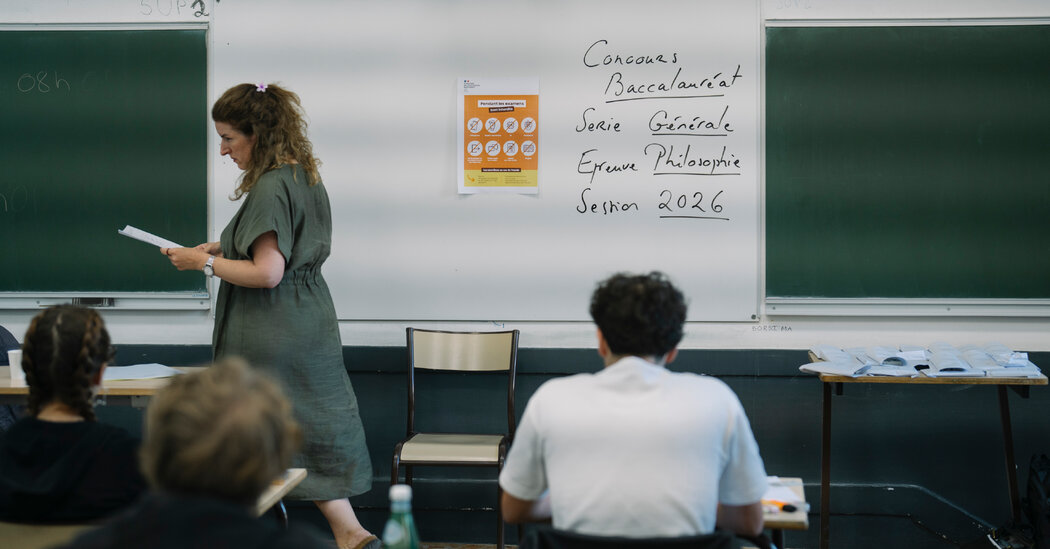
Every June, as the summer heat begins to settle over the boulevards of Paris and the countryside of France, a quiet, collective anxiety grips the nation, transcending the typical modern distractions of geopolitical crises, sporting events, and political theater. While the international press might fixate on the latest diplomatic spats at the Group of 7 summit, shifting tensions in Eastern Europe, or the high-stakes drama of the World Cup, the French public redirects its collective gaze inward to confront an entirely different set of foundational questions. This year, the national conversation did not revolve around the strategic calculations of world leaders, but rather around two deeply introspective inquiries: Can one be happy when others are not? and Do we have control of our words? These prompt questions formed the core of the baccalauréat, the formidable national exam taken simultaneously by more than half a million seventeen- and eighteen-year-old students across the country. For four grueling hours, locked in high school gymnasiums and classrooms, these teenagers are tasked with either dissecting these complex moral inquiries or conducting a rigorous rhetorical analysis of a dense philosophical text—which, in this instance, was drawn from Friedrich Nietzsche’s seminal 1878 work, Human, All Too Human. Far from being a mere academic hurdle quietly cleared in isolation, the philosophy exam is a major national event. Major media outlets dedicate live-blogs to the test, analyzing the prompts in real-time alongside global breaking news, while prominent contemporary philosophers are invited onto television and radio programs to debate how they themselves would answer the questions. This annual phenomenon represents a unique cultural philosophy: that a society’s maturity is measured not just by its economic output or military strength, but by its willingness to pause, reflect, and engage in the slow, deliberate work of human thought.
To understand why a country of nearly seventy million people stops to watch teenagers write philosophy essays, one must look to the historical architecture of the French state and its deep belief in intellectual emancipation. The introduction of philosophy into the secondary school curriculum dates back to 1809 under Napoleon Bonaparte, who originally envisioned the discipline as a tool to train a disciplined class of imperial administrators. However, the true transformation of the subject occurred in the 1880s, a periods marked by the fragile consolidation of the Third Republic following decades of imperial rule and monarchical restoration. Seeking to build a durable democratic citizenry, the new republican government sought to dismantle the dominant influence of the Roman Catholic Church over public education. As educational historian Bruno Poucet notes, the young republic relied heavily on the rationalist principles of the Enlightenment to liberate its citizens, both intellectually and politically, from ecclesiastical authority. Philosophy was repositioned not as a luxury for the academic elite, but as an essential civic shield designed to teach young citizens how to think critically and resist manipulation from either demagogues or dogma. This dedication to intellectual development is woven into the very fabric of French literary identity; as the great writer Victor Hugo famously suggested in a paraphrase of his novella Claude Gueux, the best way to prevent societal degeneration is not to execute those who stray, but to fill their minds with the light of knowledge. This educational legacy lives on today through prestigious elite institutions like the École Normale Supérieure, where generations of towering intellectual figures—from Jean-Paul Sartre and Michel Foucault to Jacques Derrida—were paid by the state to study, ensuring that philosophy remains a central pillar of French public life.
This insistence on philosophical training functions as a modern secular rite of passage, serving a social purpose comparable to military conscription or religious confirmation in other cultures. According to Anne-Sophie Moreau, an editor of Philosophie Magazine, the preparation for and completion of this exam represents a shared national journey toward mature citizenship. It is built on the democratic premise that to fully participate in a self-governing society, an individual must first engage in shared reflection on the fundamental values of human existence—such as justice, freedom, truth, and the nature of the state. This intellectual orientation is not left behind in the classroom upon graduation; rather, it actively shapes how French society functions at every level. Modern corporations regularly hire philosophical consultants to lead seminars for their staff, helping employees navigate complex contemporary challenges like ethical investing, corporate social responsibility, and workplace alienation through a philosophical lens. Even the media ecosystem reflects this cultural priority, with academic philosophers frequently moonlighting as public figures and radio hosts who dissect current events through the timeless questions of human existence. The baccalauréat philosophy exam, therefore, is not merely a test of academic capability; it is a collaborative national ritual that renews France’s commitment to reason and introspection with each passing generation.
What this looks like in practice is a vibrant, sometimes messy classroom environment far removed from the sterile memorization of historical facts. In a public high school in the tree-lined Paris suburb of Neuilly-sur-Seine, veteran teacher Nicolas Franck has spent thirty-five years guiding students through the seventeen core concepts—such as work, language, happiness, and justice—that form the official curriculum. During a typical session exploring the question of why humans work, Franck sits casually on his desk, encouraging students to challenge their own assumptions rather than simply feeding them information. When a student suggests that work is merely a practical means to earn a living, Franck challenges the class to explain why people continue to strive and accumulate wealth far beyond their material needs, prompting them to look for deeper societal and psychological motivations. Rather than expecting students to memorize historical texts, Franck focuses on developing their ability to structure a coherent argument and analyze complex ideas. Over the course of a single lesson, the classroom becomes a developmental bridge across centuries of thought, contrasting Blaise Pascal’s seventeenth-century view of work as a tragic distraction from existential dread with Karl Marx’s nineteenth-century theory of labor as the primary means through which humans transform both the physical world and their own inner selves. In this way, Franck treats his students’ initial personal biases and unexamined convictions as the raw material that must be carefully shaped to help them develop independent minds.
The true value of this rigorous curriculum is found in its profound, transformative impact on the teenagers who undergo it. For students like seventeen-year-old Raphaël Bakouch, the philosophy classroom is not just a place to prepare for an exam, but a space that fundamentally alters how they experience the world around them. Simple, comfortable certainties about identity, society, and morality become delightfully complex. Grappling with the timeless question of selfhood, Bakouch reflects on the fact that while he inherited his name and social position from his parents, his true personal identity is something he must actively construct through his own work, creations, and choices. This realization illustrates the ultimate goal of the French education system: to guide adolescents through the journey of self-discovery, helping them transition from passive recipients of inherited identity to active creators of their own lives. By forcing young people to confront these deep questions, the curriculum helps them develop the intellectual resilience required to navigate the complexities, ambiguities, and moral challenges of adult life.
Yet, this national endeavor is not without its anxieties, frustrations, and humbling realities, as the exam is widely considered the most difficult and subjective test of a student’s high school career. The average grade sits at a demanding 10.8 out of 20, a full two points below the general grade point average, meaning that for many, the test remains a source of lifelong humility. On the day the exam questions are released, adults across France—from high-ranking politicians to everyday citizens—find themselves looking back on their own experiences with a mixture of nostalgia and self-deprecation. While some, like the education minister, remember the course as a profound intellectual awakening, others, such as press secretaries and police officers, laughingly recall their low marks and struggle with the subject. As philosopher Frédéric Worms observes, the grade received on the philosophy exam is felt as a deeply personal assessment of one’s ability to engage with the deepest questions of human existence. When French citizens meet a philosopher, they almost instinctively share their high school philosophy score, as if it were a permanent marker of their reflective capacity. Ultimately, this national obsession with a four-hour writing test reveals a beautiful truth about French culture: it is a society that believes that if you cannot explain the meaning of life, or at least struggle honestly with the question, you have missed out on one of the most vital parts of what it means to be human.