

Rewrite the following content into a 2000-word, SEO-optimized article in English. Write it in the style of a professional journalist or news reporter. The article should be fully humanized, natural, and engaging — not robotic or repetitive.
Focus on clarity, flow, and storytelling while preserving the meaning of the original. Structure the article into 6 well-developed paragraphs with smooth transitions, strong headlines, and a professional tone. Use varied vocabulary, sentence lengths, and natural phrasing to make it read like human-written journalism.
Avoid keyword stuffing, but naturally integrate important SEO keywords throughout the article. Ensure the final article feels like it was written by a skilled reporter for a reputable news outlet.
President Lai Ching-te of Taiwan voiced “high hopes” on Thursday that President Trump would approve $14 billion in arms orders for the island, downplaying concerns raised last month when Mr. Trump suggested U.S. military support for Taiwan was negotiable, unsettling longstanding American policy.
Mr. Lai gave an optimistic take on Taiwan’s standing with the United States, which has taken a blow since Mr. Trump said in May that U.S. weapons sales were a “negotiating chip” with China and suggested that Mr. Lai was a source of instability across the Taiwan Strait — a characterization often pushed by Beijing.
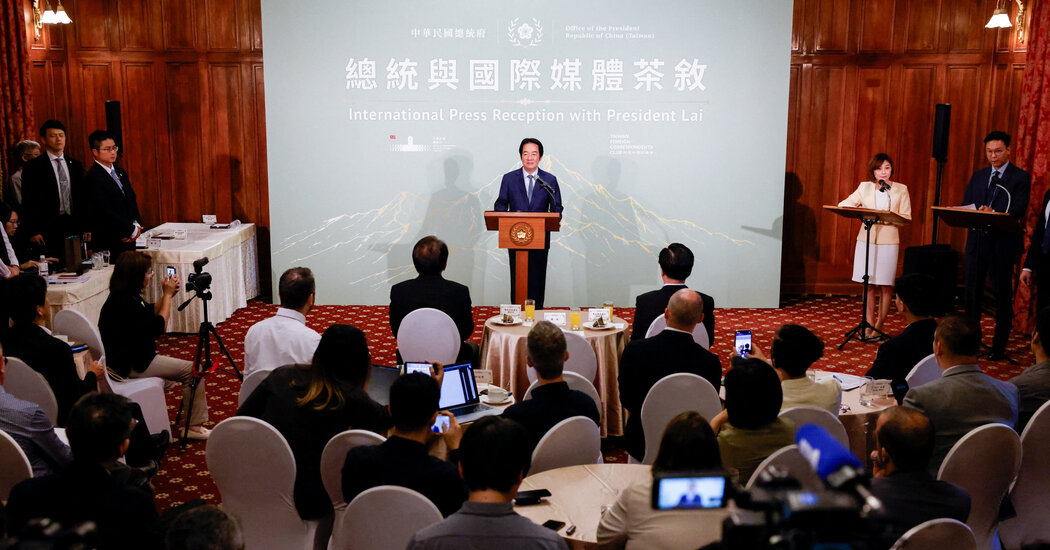
Mr. Lai, speaking at a news conference for foreign media outlets in Taipei, sought to assuage concerns, describing Mr. Trump as a strong supporter of Taiwan. The island has for decades relied on military and political support from Washington to counter an increasingly powerful Beijing, which claims Taiwan as its territory. In the most extreme scenario, China could try to take Taiwan by force, risking a war that could draw in the United States.
During Mr. Trump’s first term, he approved $18 billion of weapons sales to the island, Mr. Lai said. And late last year, Mr. Trump approved an $11 billion arms package for Taiwan, drawing condemnation from Beijing. But Mr. Trump has held off on a decision about $14 billion of missiles and other military hardware from U.S. companies, which Taiwan’s legislature voted to pay for in May.
“President Trump’s arms sales for Taiwan have basically met Taiwan’s needs, and so we also have high hopes about these upcoming arms sales,” Mr. Lai said, when asked about the $14 billion package that Mr. Trump has delayed approving. “I’m confident that after the U.S. government conducts a detailed review, it can be passed.”
Not all experts and officials in Taiwan are as confident in Mr. Trump, who has lately focused on building relations with Mr. Xi.
When the two leaders met in Beijing in May, Mr. Xi warned Mr. Trump that Taiwan was “the most critical issue in China-U.S. relations.” Soon after the meeting, Mr. Trump told reporters that he saw the arms sales to Taiwan as a “very good negotiating chip” with China, which he is counting on to make major purchases of American goods. He also suggested that a longstanding American promise not to discuss weapons sales to the island with China was out of date.
Mr. Trump later appeared to echo Mr. Xi’s view that Mr. Lai was seeking independence for Taiwan, a step that Beijing has said could prompt war. (Mr. Lai has said that Taiwan is already in practice independent and that he is not seeking a formal change to its status.)
Since taking office in 2024, Mr. Lai has made strengthening ties with the United States and other Western countries a key theme of his administration. But the uncertainties about Mr. Trump’s intentions have cast a shadow over Taiwan’s military plans and Mr. Lai’s political prospects.
Some Trump administration officials have recently become cooler in their rhetorical support for Taiwan. During his speech at a recent security forum in Singapore, Defense Secretary Pete Hegseth did not mention Taiwan, a marked shift from his comments at the same event last year.
To counter the anxieties, Mr. Lai and his officials have repeatedly cited statements from Trump administration officials that U.S. policy toward Taiwan remains unchanged. Earlier this month, Secretary of State Marco Rubio told the Senate Foreign Relations Committee that the United States does not “consult with the Chinese on these arms sales” and the $14 billion package was “under review.”
“What I can confirm is that the United States’ security commitment to Taiwan remains unchanged and that both sides are in accord on the goal of strengthening security and accelerating the buildup of Taiwan’s defense capabilities,” Mr. Lai said on Thursday.
Still, experts have said that Mr. Trump may delay an approval of the $14 billion in proposed weapons until after a planned summit with Mr. Xi in September, and possibly longer. If Mr. Trump approves even part of that package, the reaction from China could be intense, said Chieh Chung, an adjunct associate research fellow at the Institute for National Defense and Security Research, a government-funded body in Taipei.
“Xi Jinping himself has linked the issue of arms sales to Taiwan to his own prestige,” Mr. Chieh said. If Mr. Trump signs off on the arms sales for Taiwan in coming months, Mr. Xi could “postpone his visit to Washington and refuse to fulfill the purchase commitments that he made to the U.S. during the Trump-Xi summit” in Beijing, Mr. Chieh said.