



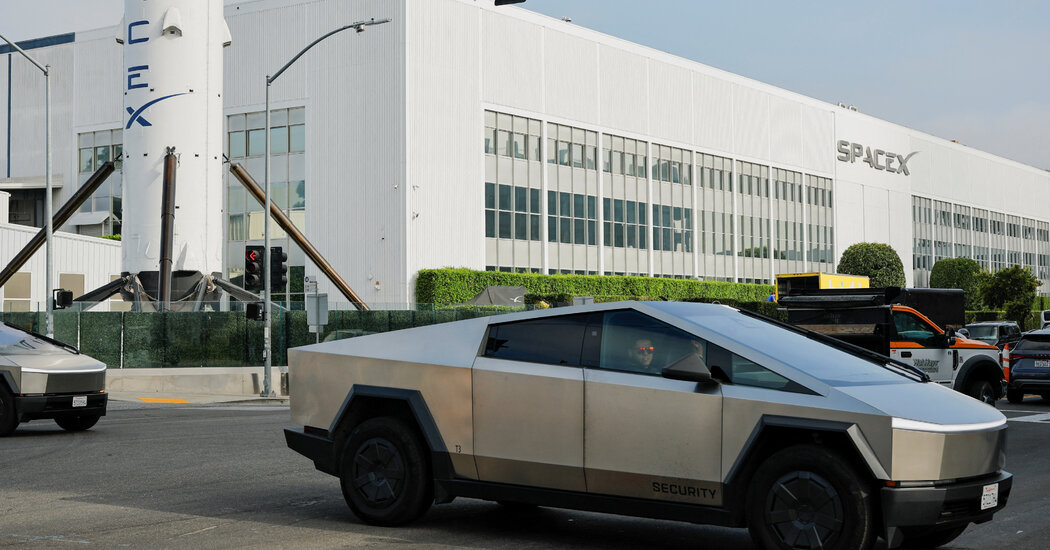
In the corridors of global finance and Silicon Valley, a quiet but electrifying scenario is beginning to dominate conversations: the potential birth of “Elon, Inc.” While SpaceX is rumored to be preparing for what could be the largest initial public offering in Wall Street history, some of the company’s most ambitious investors and close observers are anticipating an even grander endgame. Rather than keeping his corporate empires separate, there is growing expectation that Elon Musk will orchestrate a historic merger between SpaceX and Tesla, his pioneering electric vehicle giant. Such a deal would consolidate rocket manufacturing, satellite internet, artificial intelligence, electric transit, and robotics into a single, massive tech conglomerate with an estimated valuation hovering around $4 trillion. Far from mere social media speculation, this potential merger has been openly discussed by market analysts, shared in investment research notes, and even touched upon by top executives. Gwynne Shotwell, the president and chief operating officer of SpaceX, recently acknowledged on television that combining the two entities could make Musk’s life significantly easier, highlighting that there are undeniable synergies built into their respective futures. For years, the boundaries between Musk’s businesses have been highly porous, with the companies routinely sharing executive talent, collaborating on multi-billion-dollar initiatives, and trading hardware. Merging them would simply formalize an existing truth: Musk has built a sprawling, highly interconnected ecosystem that operates under a singular vision of the human future, both on Earth and beyond.
A merger of this scale—where a chief executive essentially negotiates a multi-billion-dollar acquisition with himself—would ordinarily trigger an immediate avalanche of corporate lawsuits from disgruntled shareholders claiming self-dealing. However, Musk has spent the last few years quietly building an incredibly robust legal shield around his business empire. His highly publicized decision to relocate both Tesla and SpaceX’s corporate dominions from Delaware to Texas was a calculated move to escape investor-friendly judiciaries. Corporate law in the Lone Star State is notorious for making it exceptionally difficult for unhappy investors to challenge management decisions in court. To file a derivative shareholder lawsuit in Texas, a plaintiff or group of plaintiffs must hold a minimum of three percent of a company’s total outstanding stock. At Tesla’s current valuation of roughly $1.5 trillion, that threshold is a staggering hurdle: dissident investors would need to collectively own and mobilize shares worth at least $45 billion just to walk through the courthouse door. The only shareholders with that kind of capital are massive institutional investment firms like Vanguard and Fidelity, which historically prefer private, diplomatic engagement over messy, public legal battles. Consequently, legal scholars agree that by moving his corporate headquarters to Texas, Musk has effectively insulated himself from the shareholder revolts that would halt almost any other executive in the world.
Even if a legal avenue were open, Musk’s corporate control is further protected by a deeply loyal, almost reverential base of retail investors who view his eccentricities as a precursor to genius. To the millions of individual shareholders who have built personal fortunes on Tesla’s volatile climb, Musk is not a typical executive to be monitored by a traditional board; he is a generational visionary. This loyalty was vividly demonstrated when Tesla’s retail base overwhelmingly approved a historic, nearly trillion-dollar long-term compensation package for him, signaling their willingness to support his wildest strategic redirects. Furthermore, Tesla’s board of directors is heavily populated by Musk’s close personal friends, long-time business partners, and crossover directors who also sit on the board of SpaceX. Critics often describe this setup as an echo chamber, but for Musk, it represents a friction-free pipeline to execute his grandest ideas. Meanwhile, on the SpaceX side of the equation, Musk’s control is absolute. He owns a special class of super-voting shares that awards him ten votes for every single share, giving him a crushing 82 percent of the voting power. This dual-class structure, combined with protective shareholder agreements, means the acquisition of Tesla would only require the blessing of one person: Musk himself. By using SpaceX as the acquiring vehicle, he could absorb Tesla while seamlessly retaining majority voting control over the entire combined conglomerate, preserving his ultimate authority over both enterprises.
The operational logic underpinning this potential merger extends far beyond saving Musk a few calendar entries; it lies in the deep, complementary technologies both companies are actively developing. Supporters of the deal point to a highly sophisticated web of strategic collaborations that are already reshaping the tech landscape. According to recent regulatory filings, Tesla and SpaceX are actively planning to co-develop artificial intelligence chips at a cutting-edge facility code-named Terafab, while simultaneously designing advanced AI software through a joint project called Macrohard. Furthermore, SpaceX recently absorbed Musk’s private artificial intelligence start-up, xAI, which had already received significant backing and battery hardware integration from Tesla. This convergence is highly attractive to investment managers like ARK Invest, which holds significant positions in both stocks. They argue that Tesla’s specialized expertise in custom semiconductors and massive data center construction perfectly matches SpaceX’s ambition to construct orbital, solar-powered data centers. By dropping launch costs to historic lows, SpaceX could theoretically deploy supercomputing servers directly into Earth’s orbit, running massive AI models completely free from the real estate and energy constraints of terrestrial grids. This space-based infrastructure would give Musk’s AI initiatives an immense structural advantage over terrestrial competitors like OpenAI and Google, while seamlessly linking Tesla’s self-driving Cybercabs and humanoid Optimus robots to an impenetrable orbital cloud.
Despite the compelling tech synergy and internal legal protections, the geopolitical, national security, and regulatory landscape presents a far more unpredictable set of obstacles for a $4 trillion mega-conglomerate. Merging global satellite communications, national security launch infrastructure, terrestrial electric transit, and advanced robotics under the control of a single private citizen is unprecedented. Under normal circumstances, federal regulators at the Federal Trade Commission and the Department of Justice would heavily scrutinize such a massive concentration of critical infrastructure. However, the political environment in the United States offers Musk a unique window of opportunity. Having maintained close ties with the incoming Donald Trump administration and having donated hundreds of millions of dollars to political campaigns, Musk is uniquely positioned to navigate federal scrutiny. While national security experts worry about the implications of a single conglomerate controlling both the Pentagon’s primary space lifelines and global autonomous transit networks, domestic regulators are highly unlikely to block the deal under an administration that champions deregulation and American corporate champions. The real regulatory friction is far more likely to come from across the Atlantic, where European Union antitrust authorities have shown a persistent appetite for targeting big tech infrastructure. Yet, even European regulators may struggle to construct a solid legal theory to block a merger between two companies operating in fundamentally different commercial sectors, leaving Musk with a surprisingly clear path forward.
Ultimately, the most formidable threat to the realization of “Elon, Inc.” does not lie in a courtroom, a regulatory office, or a political corridor, but rather in the unpredictable psychology of the financial markets. A merger of this magnitude relies heavily on high stock prices and a prolonged bull market to cushion the immense financial disruption of combining two corporate giants. When the markets are soaring and everyone is generating wealth, investors are highly tolerant of unconventional corporate governance and speculative, multi-decade visions of a space-faring, robotic future. However, if the global economy faces a severe downturn, or if the electric vehicle market experiences a prolonged slump, the delicate spell keeping investors captive could easily break. Legal experts warn that if the terms of the merger are structured to heavily favor SpaceX at the expense of public Tesla shareholders, Musk could face a massive backlash from the very crowd that currently cheers him on. For the merger to succeed, key precursors—such as Tesla proving the commercial viability of its autonomous Cybercab fleet in cities like San Francisco and Austin—must materialize to solidify investor confidence. Until then, Musk continues to walk a high-wire act, attempting to merge the heavens and the earth into a singular, unprecedented industrial dynasty, proving that in the modern corporate theater, his primary limit is not what the law allows, but what the market is willing to believe.