


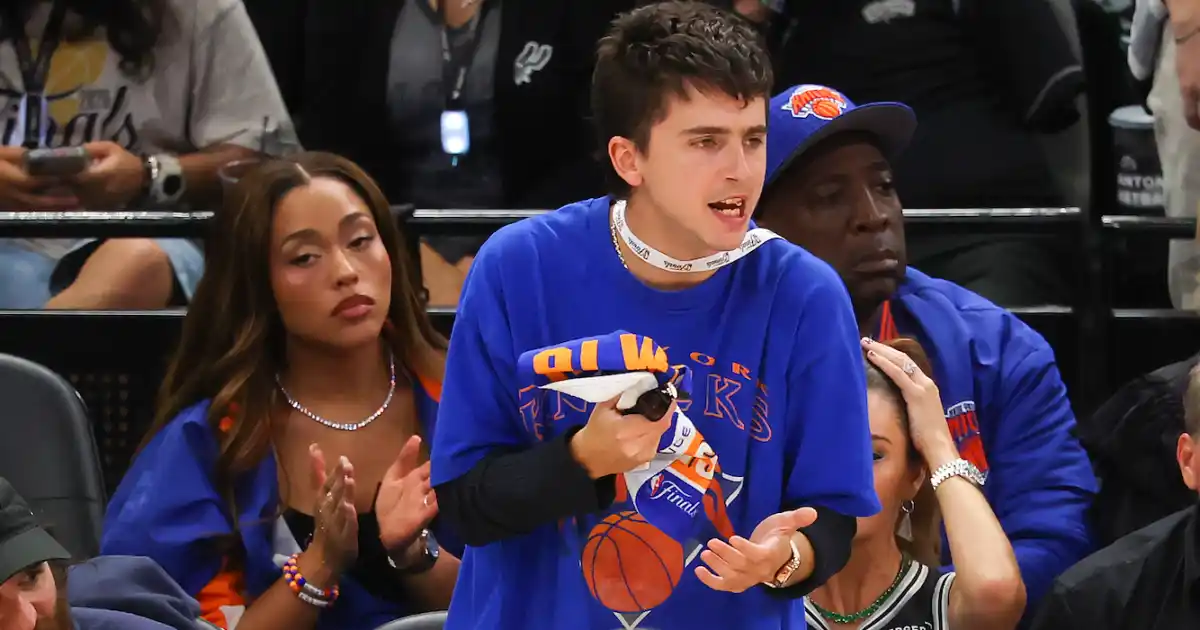
For any lifelong sports fan, there is a holy grail of moments—a singular, heart-stopping split second where decades of dedication, heartbreaking near-misses, and blind faith finally culminate in a championship victory. For Timothée Chalamet, that magical, once-in-a-lifetime moment did not take place on a glittering Hollywood stage under the warm glow of theatrical spotlights, nor did it involve holding a gold-plated statuette. Instead, it unfolded on the hardwood of San Antonio on a humid Saturday night, June 13, 2026, as the New York Knicks captured the NBA Finals in a grueling, emotional fifth game against the San Antonio Spurs. As the final buzzer sounded with the scoreboard reading 94-90, delivering a decisive 4-1 series victory to New York, the thirty-year-old actor transformed from an internationally acclaimed cinema icon into a weeping, screaming, unapologetic kid from Manhattan. Drenched in sweat and later soaked in the sting of locker room champagne, Chalamet could barely contain his ecstatic disbelief, famously proclaiming to reporters, “Way rather this than the Oscars! Come on, baby! Knicks are champions, baby!” It was a raw, unfiltered burst of pure humanity that reminded the world that beneath the designer suits, prestigious accolades, and cinematic mystique, he remains deeply connected to the visceral, earth-shattering joys of ordinary life.
To truly understand the depth of Chalamet’s tears in that locker room, one must understand his deep-seated roots in New York City. Long before he was commanding the silver screen in global blockbusters, he was a boy growing up in Hell’s Kitchen, navigating the bustling, chaotic streets of Manhattan and looking up at the iconic, glowing ceiling of Madison Square Garden as if it were a secular cathedral. For a New Yorker, supporting the Knicks isn’t merely a casual hobby; it is a hereditary condition, a shared cultural contract passed down through generations that requires enduring endless seasons of mediocrity and heartbreak in exchange for the faint promise of future glory. When Chalamet wept alongside the players during the post-game celebrations, jokingly telling reporters, “I’m not an athlete, I’m good… I’m not an athlete! Usually I have a stunt double do that,” he was bridging the gap between his highly orchestrated professional life and the chaotic reality of human fandom. In Hollywood, every line is scripted, every movement is choreographed, and every emotional beat is carefully curated by directors and editors. But in the crowded, raucous atmosphere of an NBA championship locker room, surrounded by towering athletes spraying luxury sparkling wine, there are no stunt doubles, no second takes, and no safety nets—just the overwhelming, beautiful reality of a childhood dream fulfilled in real-time.
This profound moment of celebration served as a euphoric release after a demanding and bittersweet awards season earlier in 2026, which put Chalamet’s artistic resilience to the ultimate test. As a deeply committed artist, Chalamet had poured his heart, soul, and creative capital into Marty Supreme, a stylized, critically acclaimed biographical feature centered around the intense world of professional ping-pong. Directed by the visionary Josh Safdie, the project was a monumental milestone for Chalamet, who not only delivered an intense, transformative lead performance but also stepped behind the camera as a producer, earning his first-ever Academy Award nomination for Best Picture alongside a Best Actor nod. When the Oscars rolled around in March, however, the night belonged to Michael B. Jordan and his cinematic juggernaut One Battle After Another, leaving Chalamet empty-handed at the Academy Awards once again. Despite the disappointment of missing out on the Oscar for the fourth time in his career, the journey of making and championing Marty Supreme cemented Chalamet’s status as a formidable force in independent cinema, proving that his dedication to storytelling goes far beyond the pursuit of individual glory and resides in the collaborative, gritty process of bringing complex human narratives to life.
While the elusive Oscar statuette may have slipped through his fingers once more, the early months of 2026 were far from devoid of professional triumph for Chalamet, who swept through the winter awards circuit with major victories at both the Critics Choice Awards and the Golden Globes. His win at the Globes in January provided a peek behind the curtain of his carefully guarded inner life, revealing a young man profoundly shaped by familial values and an enduring sense of humility. Standing at the podium, visibly moved, Chalamet expressed his deep appreciation to director Josh Safdie for believing in his creative vision, while keeping the audience laughing with a self-deprecating joke about thanking Kevin O’Leary, the famous “Mr. Wonderful” from Shark Tank, who somehow played a eccentric role in the film’s promotional lore. “Thank you so much from the bottom of my heart. I’m in a category with many greats,” Chalamet shared with the star-studded crowd, reflecting openly on the philosophy of life instilled in him by his father. He recalled his father’s steady advice to always practice a spirit of gratitude, explaining how this mindset allowed him to walk away from previous high-profile losses with his head held high, appreciating the sheer privilege of being in the room rather than harboring bitterness over what was not won. This perspective made his winter triumphs feel incredibly sweet, proving that his emotional maturity is just as developed as his acting prowess.
At the center of this emotional maturity and grounding is Chalamet’s steady, supportive relationship with his partner, Kylie Jenner. Since they first began dating in 2023, the couple has quietly built a solid foundation, navigating the intense, often invasive glare of global paparazzi and media scrutiny with remarkable grace. Rather than letting the relentless spotlight pull them apart, they have integrated their lives in a way that feels surprisingly normal, frequently spotting them cheering passionately from courtside seats at Madison Square Garden or sharing quiet whispers of encouragement at high-profile industry events. During his emotional Golden Globes acceptance speech, Chalamet chose to cut through the industry politics and professional pleasantries to publicly dedicate his triumph to the people who keep him anchored in his day-to-day life, concluding his remarks with a heartfelt declaration: “For my parents, for my partner, I love you. Thank you so much.” For a young actor operating at the absolute peak of Hollywood stardom, having an unwavering source of emotional stability and unconditional support at home is invaluable, transforming the unpredictable, dizzying roller coaster of fame into something manageable, safe, and deeply shared.
Ultimately, Timothée Chalamet’s thrilling, champagne-soaked weekend in San Antonio stands as a beautiful testament to what it means to live a balanced, passionate, and authentic life in the public eye. At thirty years old, he has successfully demystified the traditional archetype of the aloof, untouchable Hollywood movie star, choosing instead to show up as his true self—vulnerable, enthusiastic, deeply loyal to his roots, and unafraid to shed tears of joy over a basketball game. He reminds us that the pursuit of external validation, whether in the form of gold trophies or critical reviews, is ultimately empty if we do not hold onto the raw, simple passions that connected us to the world in our youth. Whether he is producing complex cinematic art, expressing heartfelt gratitude on a glamorous stage, holding hands with the person he loves, or screaming at the top of his lungs in a championship locker room, Chalamet is actively choosing to feel every single moment of his journey. In prioritizing the gritty, unscripted triumph of his beloved New York Knicks over the polished prestige of an Academy Award, he has shown us that the greatest victories in life are not the ones we perform for an audience, but the ones we feel deep in our souls.