




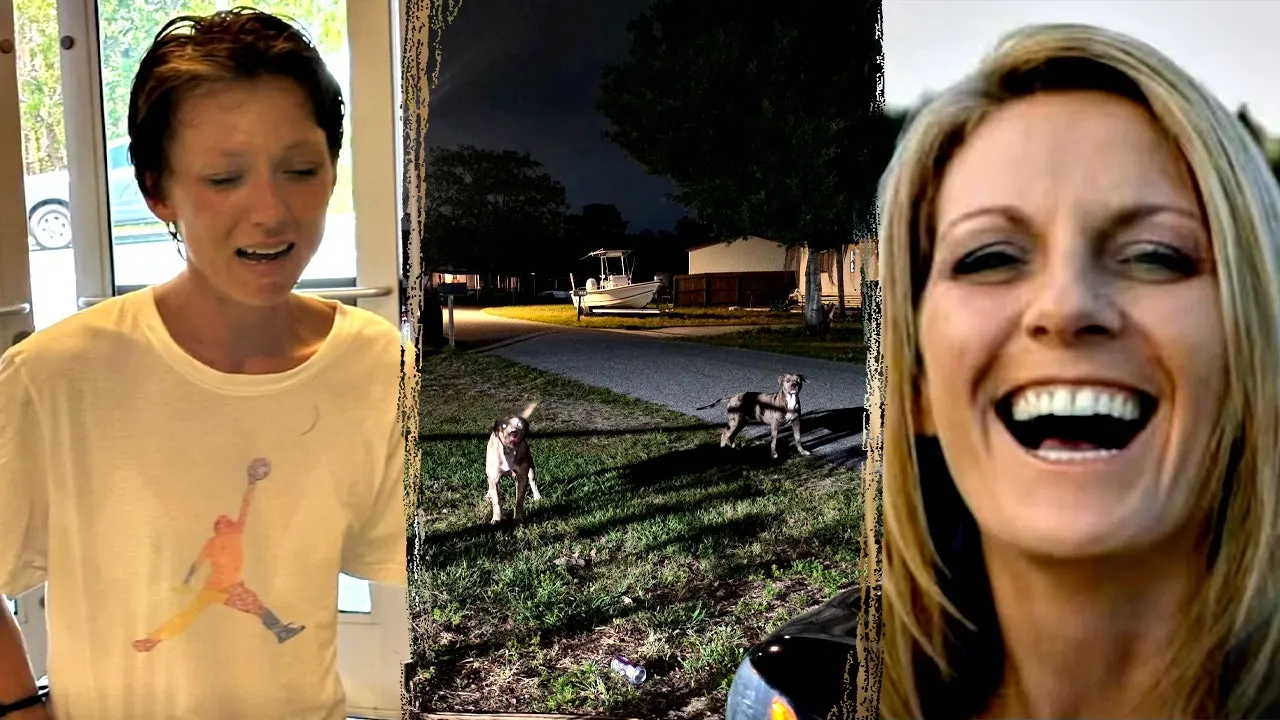
The quiet, sun-baked streets of Brevard County, Florida, recently became the backdrop for a harrowing tragedy that highlights the fragile boundaries between suburban peace and violent neglect. It began with the sudden, violent death of fifty-year-old Jodi Cowan, a local resident whose life was cut short when she was savagely mauled by two large, aggressive dogs belonging to her next-door neighbor. Yet, as the community struggled to process the sheer horror of her passing, a bizarre and deeply unsettling secondary investigation emerged from the aftermath of the tragedy. Just weeks after the fatal attack, Brevard County Sheriff’s deputies were called back to the very travel trailer where Jodi had lived, drawn by reports of a putrid, sickening odor clinging to the summer air. Once inside, investigators made a grim and perplexing discovery: the lifeless, decomposing bodies of three dogs were left inside the home, which was currently under the care of Jodi’s surviving boyfriend. While her own little dog, who had accompanied her on that fateful night, was thankfully found safe, the discovery of these three deceased animals has triggered a brand-new criminal inquiry. Public Information Officer Tod Goodyear has confirmed that authorities are awaiting complex veterinary necropsies to determine how these animals died, hinting that further criminal charges may be on the horizon depending on the results. This eerie post-mortem discovery has added a layer of gothic horror to an already heartbreaking story, leaving a grieving neighborhood to wonder how so much darkness, neglect, and silent suffering could have coexisted on a single, unremarkable street without anyone intervening before it was too late.
To truly understand the depth of this tragedy, one must look closely at the terrifying moments of May 19, when the predictable safety of a suburban night was shattered by screams of absolute terror. It was nearly two in the morning when Donnell Smith, Jodi’s partner of thirty years, was startled awake by his worst nightmare: the distant, agonizing cries of his soulmate echoing from just outside their home. Sprinting blindly into the midnight darkness, Donnell encountered a scene of pure savagery as Max and Mako, the neighbor’s one-year-old littermates, relentlessly tore into Jodi. Armed only with a knife and an overwhelming desperation to save the woman he loved, Donnell threw himself into the fray to ward off the attacking beasts while frantically dialing 911. The recorded eight-minute emergency call captured a chilling audio landscape of desperate struggle; the dogs can be heard snarling and snapping viciously in the background, while Donnell frantically begs the operator for help as he desperately tries to staunch the torrential bleeding from Jodi’s neck. In the background of this auditory nightmare, Jodi’s failing voice can be heard whimpering her tragic final words, recognizing the gravity of her injuries: “I’m dying. Can’t breathe.” By the time a medical helicopter managed to airlift her to a regional trauma center, her carotid artery and jugular vein had been completely severed. Despite the valiant, desperate efforts of her lifelong partner and emergency medical personnel, Jodi succumbed to the catastrophic injuries inflicted by the animals, leaving Donnell to face a silent home haunted by the memories of a rescue that came just minutes too late.
What makes Jodi Cowan’s death particularly tragic is the compounding realization that this was not a sudden, unpredictable freak accident, but rather the catastrophic climax of a long-standing history of terror that had held the neighborhood hostage. Court documents and arrest warrants paint a damning picture of Max and Mako, revealing that the two dogs had routinely escaped their inadequate four-foot chain-link fence to terrorize local residents. Only five weeks prior to the fatal attack on Jodi, the very same canine duo had launched a vicious assault on another neighbor, John Argila, who had been peacefully walking down the road pushing his bicycle with a flat tire. When John tried to yell at the dogs to go home—a tactic that had previously sufficed—the dogs charged him with predatory coordination, ignoring his commands and biting him deeply across his arms as he desperately tried to use his bicycle as a shield. Tellingly, it was Donnell Smith who had run out that day to help pull the aggressive dogs off John, subsequently warning their owner, Linda Cutler, about her pets’ dangerous behavior. John only escaped more severe mutilation because a passing driver stopped and pulled him into her vehicle, allowing him to survive with painful puncture wounds that were still visible to deputies weeks later. This prior attack, documented and known to the neighborhood, serves as a searing indictment of a system that allowed these dangerous animals to remain in the community, transforming a public street into a ticking time bomb where a walk down the road became a gamble with life and death.
As investigators dug deeper into the background of twenty-nine-year-old Linda Cutler—who now sits in the Brevard County Jail held without bond on charges of manslaughter—they uncovered a chilling multi-generational pattern of canine aggression and profound owner neglect. When questioned, Cutler admitted to deputies that she had noticed a marked spike in aggressive behavior from Max and Mako in the months leading up to the attack, offering a bizarre, defensive theory that someone must have been doing something to her dogs to deliberately alter their temperaments. Veterinarians who examined the dogs after the attack noted that the animals suffered from “Littermate Syndrome,” a psychological condition occurring when two puppies are raised together without developing independent social skills, leading to heightened anxiety, fear-based aggression, and a pack mentality that turns lethal in unfamiliar situations. Yet, this aggressive streak was bred into their very DNA; Cutler revealed that the dogs’ mother had previously attacked her so violently that her boyfriend had to strangle the animal to death to save her life. Furthermore, the puppies’ father, Boomer, had also bitten a human, resulting in a formal citation from Brevard County Animal Services. With eleven separate complaints logged against Cutler’s household since September 2025 regarding loose dogs, animal harassment, and even the killing of a neighbor’s cat, Cutler’s conscious decision to rely on a flimsy fence she knew her dogs could easily bypass represents a shocking disregard for human life that ultimately culminated in her arrest.
Jodi’s needless death has once again reignited a fierce, highly polarized national debate regarding public safety, animal welfare, and how society should handle breeds with known histories of severe violence. Statistics fuel this intense conversation: according to the National Center for Health Statistics, nearly five hundred people in the United States lost their lives to dog attacks over a ten-year period, with pediatric studies consistently identifying pit bulls as the breed most frequently involved in severe cases requiring complex reconstructive surgery. In response to these alarming figures, many communities aggressively lobby for breed-specific legislation, hoping that outright bans on pit bulls and other large breeds will secure their neighborhoods. However, animal welfare advocates strongly argue that breed bans are a fundamentally flawed, outdated solution to a complex problem. Holly Sizemore, the chief mission officer of Best Friends Animal Society, emphasizes that restricting specific breeds does not make communities safer but instead wastes valuable local resources on enforcement while ignoring the root causes of animal behavior. Sizemore advocates for laws that focus strictly on individual canine behavior and owner accountability, a sentiment echoed by the nearly two dozen U.S. states that have passed laws preventing local municipalities from enacting sweeping breed bans, arguing instead for a more nuanced approach to public safety.
Ultimately, resolving the crisis of dangerous animals in our neighborhoods requires a shift in focus from the inherent nature of the dog to the actions and accountability of the human at the other end of the leash. Michael Gould, a seasoned dog bite expert and founding member of the New York Police Department’s Canine Unit, has spent thirty years testifying in court regarding these tragic incidents, and his verdict remains unwavering: the blame always rests on human shoulders. Gould argues passionately that dogs who are properly socialized, trained, and secured do not transform into killers, stating that breed bans are merely a feeble, archaic Band-Aid applied to a systemic issue of human negligence. From his perspective, law enforcement and local municipalities must prioritize proactive public safety over administrative bureaucracy, asserting that when an animal has demonstrated a clear and documented history of aggression, the state must step in immediately to impound the animal before a tragedy can unfold. The heartbreaking case of Jodi Cowan serves as a somber, definitive reminder that when pet owners fail to train and secure their animals, and when authorities fail to act on repeated warnings, it is innocent neighbors who pay the ultimate price. True public safety can only be achieved when society demands absolute, uncompromising accountability from pet owners, ensuring that no more lives are cut short in the dark by animals that should have been restrained long before they had the chance to destroy a family.