


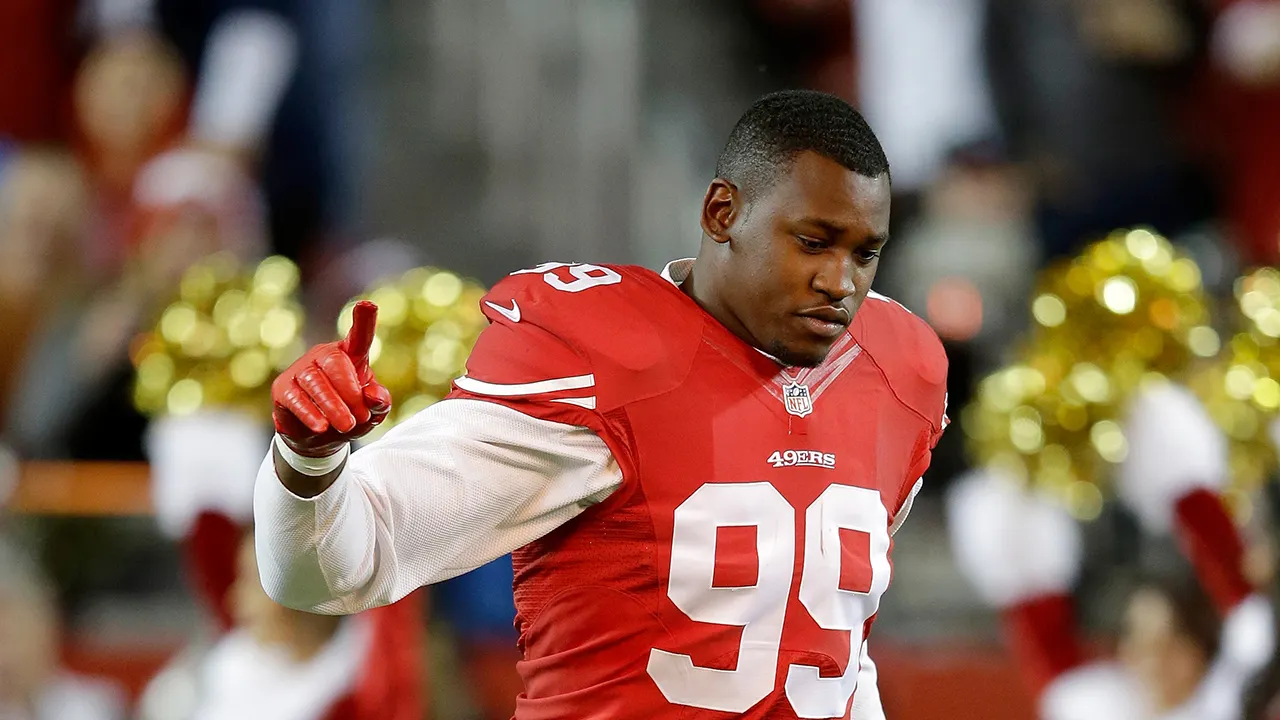
The global sports community was plunged into a state of profound shock and solemn reflection following the devastating announcement that former NFL defensive standout Aldon Smith had passed away at the tragically young age of 36. The heartbreak was officially shared by the San Francisco 49ers, the organization where Smith first reached the pinnacle of athletic stardom and captivated millions of football fans with his extraordinary gifts. In a deeply emotional public statement, the franchise expressed their utter devastation over his sudden and tragic passing, seeking to honor both the athlete who dominated the field and the human being who existed beneath the famous gold helmet. The 49ers remembered him as a player of undeniable talent and sheer dominance from the very moment he set foot in their facilities, cementing himself as the creator of one of the single most spectacular rookie seasons the league had ever witnessed. Yet, beyond his ferocious prowess on the gridiron, the team made a poignant point to emphasize his humanity, fondly recalling his infectious, radiant smile that possessed the rare capacity to instantly light up any room he walked into, leaving a lasting impression on everyone he met. As condolences pour in from former teammates, coaches, and fans to the grieving Smith family and all those who held him dear, his untimely death at such a young age casts a somber shadow, forcing the public to look past the glitz of sports entertainment and confront the fragile, precious nature of human life.
To truly grasp the magnitude of Aldon Smith’s passing, one must appreciate the sheer, breath-taking magic of his early career, which remains a benchmark for defensive excellence in NFL history. Drafted seventh overall by the San Francisco 49ers in 2011 out of the University of Missouri, where his raw athleticism had already made him a collegiate sensation, Smith exploded onto the professional stage with an immediate, terrifying force. Despite playing primarily as a situational pass-rusher during his rookie campaign, his unique blend of explosive speed off the edge, long reach, and instinctive power allowed him to amass an incredible 14.0 sacks, putting the entire league on absolute notice. He somehow exceeded those lofty expectations during his historic sophomore season in 2012, setting a 49ers legendary franchise record with a staggering 19.5 sacks, earning First-Team All-Pro honors, and serving as the defensive spearhead that propelled the team to an appearance in Super Bowl XLVII. His rapid ascent was statistically and historically unprecedented; by recording 30 career sacks in just 27 games, Smith shattered the record for the fastest player in NFL history to reach that milestone, eclipsing a legendary standard previously held by the late, immortal Hall of Famer Reggie White. During this golden era in the Bay Area, Smith was widely regarded as an unstoppable force, a generational prodigy whose physical gifts suggested a guaranteed, straight-line trajectory to the Pro Football Hall of Fame and permanent legendary status.
However, the dizzying heights of his professional success were accompanied by a parallel, intensely private struggle that began to visibly fracture his life under the relentless glare of the public spotlight. The intense pressure of carrying the expectations of a historic franchise, combined with personal vulnerabilities, began to manifest outwardly in 2013 when Smith voluntarily made the brave decision to enter a rehabilitation facility, missing five games to address his struggles with substance abuse. The following year, in 2014, his momentum was further halted when he served a lengthy nine-game suspension handed down by the NFL for violations of the league’s substance abuse and personal conduct policies. These events revealed a painful reality: behind the seemingly invincible, armored exterior of an elite athlete was a young man wrestling with deep-seated mental health and addiction crises. The sports world, which often commodifies raw physical talent as a form of weekend entertainment, was forced to witness the heartbreaking vulnerability of a young star grappling with the overwhelming weight of fame, expectation, and internal pain. His early career became a poignant case study in how quickly a person’s life can be destabilized when the internal scaffolding of mental wellness is lacking, proving that no amount of athletic dominance can insulate a human spirit from the harrowing battle against dependency.
The downward spiral deepened to a heartbreaking breaking point in August of 2015, when the San Francisco 49ers made the incredibly difficult decision to release their former franchise cornerstone following his third arrest for driving under the influence. Though the Oakland Raiders quickly offered him a potential lifeline and a fresh start just a month later, the opportunity proved temporary; Smith played only nine games before the NFL issued a severe, one-year suspension in November of 2015. What followed was a devastating, prolonged exile that stretched over four full seasons, during which Smith remained indefinitely suspended from the game that had defined his identity, isolated from the highly structured world of professional sports. This period of forced retirement became a grueling test of survival, characterized by ongoing legal battles, personal turbulence, and a quiet, desperate struggle to find his footing in a world without the cheering crowds or the daily support systems of teammates and coaches. The prolonged absence of a superstar in their prime years is a rare and tragic occurrence in modern sports, serving as a bleak reminder of the profound isolation that can envelop athletes once they are stripped of their uniform. For several years, Aldon Smith’s name became synonymous with unfulfilled potential, a sobering reminder of how easily a brilliant life can be sidelined by the relentless, progressive disease of addiction.
Yet, in a testament to the resilient and stubbornly hopeful nature of the human spirit, Smith engineered an extraordinary and profoundly moving comeback in 2020 that turned a story of tragedy into one of incredible redemption. Having successfully applied to the NFL for reinstatement after nearly five years away from competitive football, he was signed by the Dallas Cowboys, completing a physical and psychological journey back to the gridiron that many medical and sports experts had deemed impossible. Far from being a mere sentimental addition to the roster, Smith defied the odds by starting all 16 games for Dallas, recording 5.0 sacks and 48 tackles while proving that his elite physical instincts had survived the long, dark years of his absence. This chapter of his life was about much more than reclaiming his athletic prestige; it was an inspiring, living demonstration of the human capacity to heal, rebuild, and return from the absolute brink of destruction. Although he subsequently signed with the Seattle Seahawks in April of 2021 and was released before the regular season began following another legal setback, his brilliant, fleeting season in Dallas stood as a powerful monument to his determination. It showed a world that often discards those who fall that recovery is a continuous, non-linear journey, and that Aldon Smith was, at his core, a fighter who refused to let his struggles define the final boundary of his life.
With his sudden passing at the age of 36, for which an official cause of death has not yet been publicly disclosed, the narrative of Aldon Smith comes to a quiet, heartbreaking, and terribly premature conclusion. His life stands as a beautiful yet deeply complex mosaic of historic athletic triumph, profound human vulnerability, and the persistent, quiet struggle for peace of mind. As the NFL community and sports fans across the globe mourn his loss, his story serves as a critical, urgent reminder of the desperate need for more holistic support systems, earlier interventions, and deep compassion for those battling mental health issues and substance addiction under the public eye. We must resolve to remember Aldon Smith not merely as a statistics-generating machine who shattered records and dominated backfields, but as a complete human being who loved deeply, struggled mightily, and possessed a legendary, light-filled smile. His journey challenges us to look upon those who stumble with grace rather than judgment, recognizing the shared humanity that connects us all. In his final rest, far removed from the physical toll of the game and the exhausting weight of his earthly battles, one can only hope that Aldon Smith has finally found the enduring tranquility, grace, and peace that so often eluded him during his remarkable, turbulent life.