

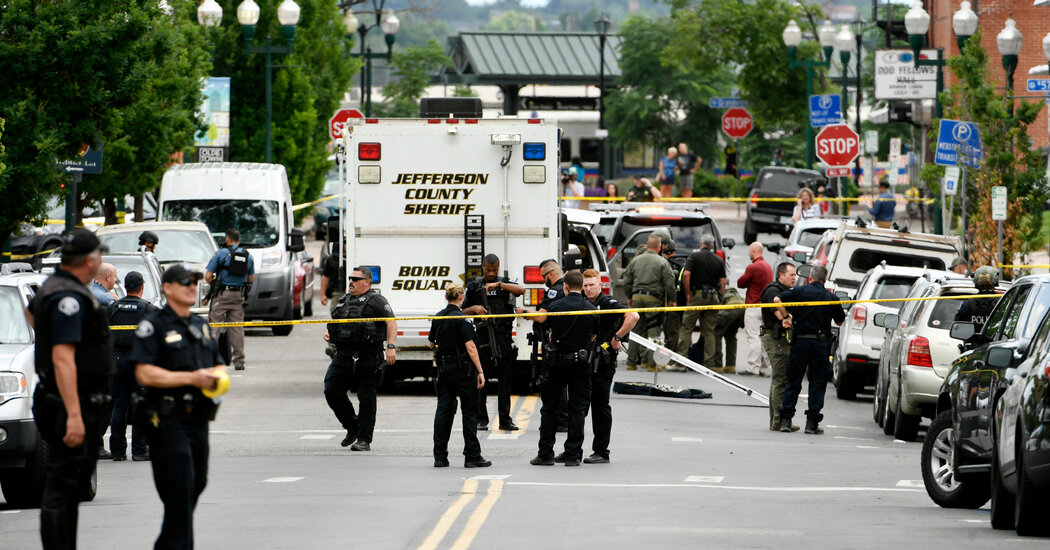
The morning of June 21, 2021, began for fifty-nine-year-old Ronald Troyke in the quiet, isolated confines of his Arvada, Colorado, apartment, where he immersed himself in a digital landscape of outrage. Surrounded by the sparse, clinical remnants of a deteriorating life—a informational pamphlet on concealed firearms, a storage tub clinical in its label of “gun stuff,” and gentle greeting cards from a sister whose written words betrayed a deep, aching worry for his mental state—Troyke fed his growing mania with YouTube videos documenting police misconduct. By mid-morning, he had finished watching a particularly disturbing clip of an Ohio officer running over a pedestrian, a video that seemed to solidify his fractured sense of purpose. Driven by a volatile mix of paranoia and self-styled righteousness, he taped a jagged, handwritten manifesto to his bedroom wall, its scribbled capital letters and aggressive underlining screaming of systemic corruption and a lack of public accountability. In his wallet, he tucked a final, chilling covenant promising to execute as many Arvada police training officers as possible before his day was done. Armed with a handgun, a semiautomatic shotgun, a tactical AR-15-style rifle, and vast drums of high-capacity ammunition, he drove his Ford pickup to Olde Town Square, a picturesque community hub featuring brick walkways and a children’s spray park. There, he waited and watched for over an hour, sipping ice water until Officer Gordon Beesley, a beloved school resource officer on summer patrol, strolled into the nearby alleyway. Beesley, a warm-hearted humanitarian known for playing guitar with marginalized middle school students and waking early to help disabled kids ride their bikes to school, was happily counting down the final minutes of his shift to celebrate his son’s fourteenth birthday. In a flash of sudden, unprovoked violence, Troyke jumped from his truck, pursued the unsuspecting officer, and fired multiple rounds into Beesley’s head and chest, leaving the beloved lawman dead on the brick pavement—the first officer in Arvada’s history to fall in the line of duty.
The echoed crackle of gunfire instantly shattered the peace of the square, sending terrified shoppers fleeing and diners scrambling beneath restaurant tables as Troyke began firing indiscriminately at parked patrol cars. The local police department, despite operating within a serene, arts-focused suburb often compared to the fictional oasis of Mayberry, possessed a grim, firsthand familiarity with mass casualty events. Much of this psychological preparation came from Deputy Chief A.J. DeAndrea, a widely respected active-shooter training pioneer who had navigated the horrors of the 1999 Columbine High School massacre, a fatal 2006 tactical hostage rescue at Platte Canyon High School, and a local missionary center shooting in 2007. These profound traumas had convinced DeAndrea that standard patrol officers could no longer wait for SWAT teams; they had to act immediately to stop active killers, a philosophy he preached to law enforcement agencies across all fifty states. DeAndrea’s obsession with active-shooter response was not merely professional, but deeply personal; three years earlier, his daughter Madalena had survived the horrific Borderline Bar shooting in Thousand Oaks, California, after sending her family a coded text message of distress. That civilian horror had convinced DeAndrea’s daughter to carry a concealed weapon herself, a development that filled him with both fatherly pride and a quiet, underlying anxiety about what might happen if a armed citizen attempted to intervene in a chaotic police response. To prevent panic and ensure that officers could make split-second, high-stakes decisions under immense stress, DeAndrea spearheaded rigorous tactical training programs in Arvada, preparing his force to rapidly determine when to deploy lethal force, how to shoot through barrier glass, and how to identify an active threat when operating completely alone.
As the violence unfolded in the square, the complex, parallel lives of two deeply ideological Arvada residents reached a tragic convergence. Ronald Troyke’s journey to that alleyway had been marked by a slow, bitter radicalization; once a quiet Illinois transplant who hauled mountain mail and rode ATVs with his brother, his worldview soured in his later years, consumed by legendary tales of administrative police abuse and high-profile tragedies like the death of Elijah McClain. Troyke’s escalating anti-authoritarianism had manifested just weeks earlier when he aggressively filmed local officers, including Officer Kraig Brownlow, loudly declaring his belief that all police officers were inherently dangerous. Across the street from Troyke’s position, stocking up on items inside a local military surplus store, stood thirty-eight-year-old Johnny Hurley, a passionate community activist who harbored his own profound distrust of government authority and police overreach. Hurley was a fascinating study in human contradiction: a dedicated champion of individual liberties who protested pipelines and COVID-19 mandates, yet practiced quiet yoga, promoted pacifist meditation, distributed free clothing to the unhoused, and stood on street corners offering warm hugs to strangers. Despite holding a personal philosophy that rejected systemic policing, Hurley took personal responsibility for the safety of those around him, undergo tactical weapons training and privately confiding to his closest friends that, as a single man without a family of his own, he would willingly sacrifice his life to neutralize an active shooter. This defensive philosophy had recently caused a heartbreaking, tearful rift with his best friend and former partner, Taylor Garland, who wept over his acquisition of a tactical AR-15 rifle, fearing that his embrace of firearms would not protect him, but would instead magnetize danger into his peaceful life.
When Troyke’s rifle fire began to systematically tear through the historic square, Johnny Hurley did not run for cover with the other frantic shoppers; instead, he stepped out of the military surplus store, drew his concealed handgun, and advanced deliberately toward the active threat. Crouched low to the ground and utilizing a brick wall for cover, Hurley carefully timed his movements, locked eyes with another terrified civilian hiding among the parked vehicles, and stepped directly into the path of the heavily armored Troyke. With exceptional precision and poise, Hurley raised his firearm and discharged several rounds, striking Troyke and causing him to collapse lifelessly onto the pavement, effectively terminating what could have easily become a catastrophic mass casualty event. Believing the imminent threat had been successfully neutralized, Hurley exited his cover and ran forward to retrieve Troyke’s fallen AR-15 rifle, seeking to disarm the weapon and prevent any further loss of life. Inside a nearby office, three Arvada police officers who had been eating lunch—including Kraig Brownlow, a six-year veteran with extensive active-shooter training—were watching the chaos through a restricted window, their visibility heavily obscured by a dense tree canopy, parked cars, and trash dumpsters. Spying a man wearing a red t-shirt holding a tactical rifle and apparently manipualting the weapon’s action, Brownlow operated on his intensive training, which taught him that active shooters sometimes wore armor, changed clothes, or acted in coordinated tactical teams, reminiscent of the two shooters at Columbine. Fearing that the man with the rifle was preparing to turn the weapon on him or fire on additional fleeing civilians, and believing he was too vulnerable to issue a verbal warning, Brownlow fired three rapid shots through the doorway, hitting Hurley in the hip, severing his central arteries, and instantly killing the very savior of Olde Town Square.
In the immediate, chaotic aftermath of the double shooting, a dense cloud of confusion, grief, and administrative panic descended upon the city of Arvada. During an initial, hastily assembled press conference, police officials mistakenly announced to the public that the courageous young bystander had been shot and killed by the primary gunman, a false narrative that spread rapidly throughout the local community. Meanwhile, federal agents arrived at the Colorado Springs home of Hurley’s mother, Kathleen Boleyn, delivering the crushing news of her son’s tragic death while instructing her to avoid watching local media reports because the official details of the shooting remained highly volatile and unconfirmed. Back in Arvada, Deputy Chief DeAndrea, who had been traveling to Louisiana to lead an active-shooter training seminar, cut his trip short and boarded the first available flight home, proceeding directly to the county coroner’s office to personally relieve the honor guard and stand a silent, grieving vigil over the body of his fallen colleague, Officer Beesley. As the internal investigation progressed and physical evidence made it undeniable that Hurley had been killed by friendly fire, Arvada police leaders faced the agonizing task of inviting the Hurley family to headquarters to confess the horrific sequence of events. While the official prosecutors ultimately declined to file criminal charges against Officer Brownlow—ruling that his split-second decision to shoot was legally justified given the chaotic environment, the visual of Hurley holding the perpetrator’s rifle, and the reasonable belief that a second mass killer was active—the city later reached an extensive civil settlement with Hurley’s grieving family, leaving the community to grapple with the bitter irony of his heroic death.
The tragedy in Olde Town Square cast a long, complicated shadow over the national debate surrounding the Second Amendment, specifically challenging the popular, highly idealized political narrative that a “good guy with a gun” represents a simple, foolproof solution to public mass shootings. While Hurley’s heroic actions undeniably saved countless innocent lives, historical data shows such success stories are vanishingly rare, with only a tiny fraction of active shooter incidents being ended by armed citizens, and often resulting in devastating instances of mistaken identity, such as the tragic police shooting of security guard Jemel Roberson in Illinois. Today, the retired A.J. DeAndrea continues to travel the country training school guards and law enforcement officers, working alongside his daughter Madalena, who serves as the director of school safety for the regional district, both of them constantly wrestling with the messy, unpredictable reality of civilian intervention in active gunfights. DeAndrea openly acknowledges that in an armed society, citizens must take ownership of their personal defense, yet he remains deeply sobered by the realization that even the most meticulous, advanced tactical training cannot fully eliminate the terrifying fog of war when bullets fly. Outside the Arvada training center, a physical sign still bears Officer Beesley’s signature life philosophy: “Look for the good in every day.” That gentle, enduring message stands as a bittersweet monument to both a fallen officer who dedicated his life to community kindness, and a brave, complex civilian hero who laid down his life for his neighbors, leaving a community forever changed by a single, tragic afternoon of overlapping courage and devastating misfortune.