



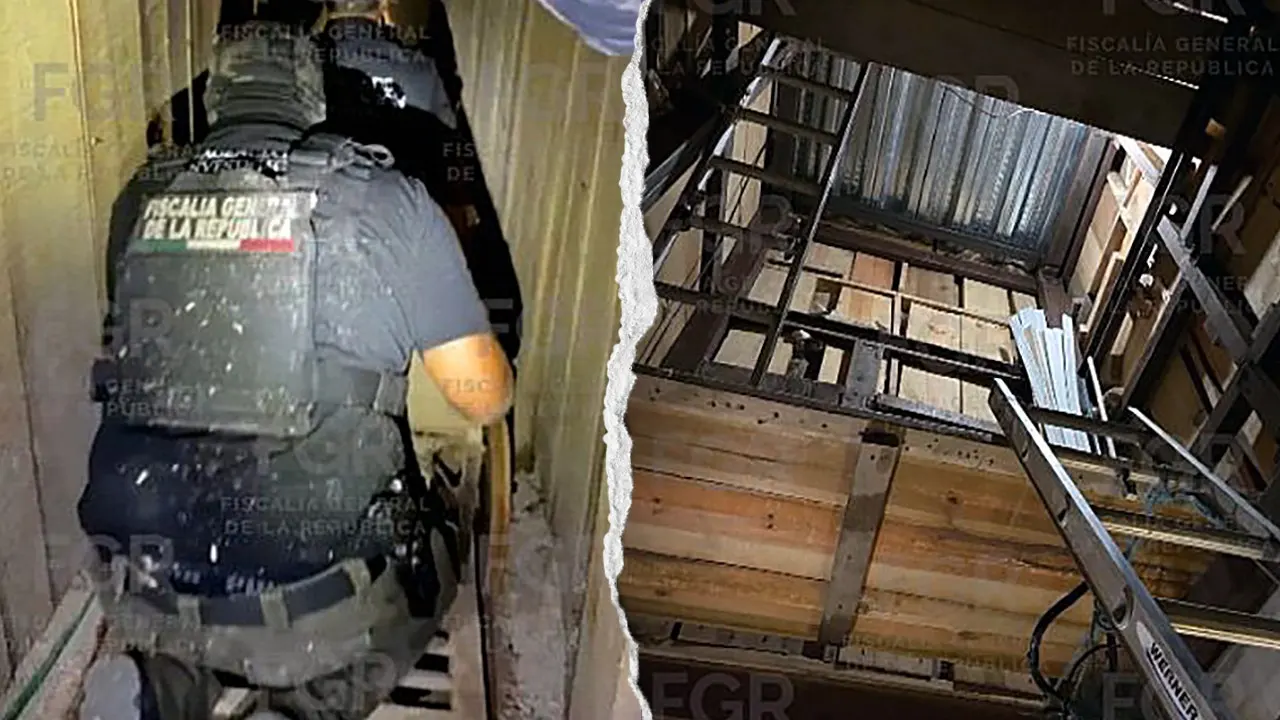
Deep beneath the bustling, sun-baked asphalt of the Nueva Tijuana neighborhood of Tijuana, Baja California, a quiet but monumental shift was taking place, completely hidden from the eyes of the ordinary citizens walking above. For months, perhaps even years, footsteps and the rumble of urban traffic echoed on the concrete sidewalks of this vibrant border community, with locals completely oblivious to the reality that just twenty-one feet below their living rooms and local shops, a masterpiece of illicit engineering was humming with life. The relative quiet of this suburban-industrial zone was shattered when elite agents from Mexico’s Attorney General’s Office, widely known as the FGR, executed a high-stakes search warrant on what had previously seemed to be an unremarkable, mundane property. What they uncovered upon breaching the threshold was not merely a crude, hand-shoveled hole in the dry Mexican dirt, but a highly sophisticated, industrial-grade passage measuring approximately 870 feet in length. Stepping down into the cool, damp darkness of this freshly unearthed artery, investigators did not discover a dark, claustrophobic cavern, but rather a chillingly organized, fully operational underground highway designed to run silently beneath the heavily fortified international boundary. To the armed federal officers who first stepped into the abyss, the air inside was filled with the heavy scent of damp clay, hydraulic fluid, and the faint hum of electrical currents, underscoring the immense physical labor, financial capital, and technical planning that went into carving this subterranean tunnel out of the earth. The discovery immediately transformed a seemingly ordinary residential street into the epicenter of a massive, multinational intelligence operation, offering a stark and sobering reminder of the invisible, parallel structures that constantly snake through the earth beneath the communities of the Tijuana-San Diego border zone. This was not simply a physical breach of a political line on a map; it represents a deep, subterranean manifestation of human ambition, criminal ingenuity, and the relentless, shadow-bound economy of the borderlands.
What makes this discovery truly remarkable, and deeply unsettling to law enforcement officials on both sides of the border, is the astonishing level of logistical sophistication integrated into its construction. Far from the primitive trenches of the past, this modern corridor was fully equipped with structural support beams, continuous professional-grade electrical lighting, and a complex ventilation system designed to pump fresh air deep into the Earth so that workers could breathe during long, arduous shifts of digging and trafficking. Perhaps the most striking feature discovered by the FGR investigators was a custom-engineered electronic sliding transport system, essentially a miniature underground railway designed to quickly and efficiently whisk heavy crates of cargo back and forth between the two nations. This mechanized rail network bypassed the physical limits of human endurance, transforming what would have been a grueling hike through a narrow, low-ceilinged crawlspace into an efficient, push-button logistics operation. Looking at the neatly strung wires, the perfectly spaced light bulbs illuminating the damp walls, and the smooth metal tracks stretching into the horizontal distance, one cannot help but think of the human handiwork behind it—the specialized electricians, structural engineers, and laborers who spent countless hours in the dark, risking cave-ins and suffocation to build an outlaw marvel. These anonymous workers operated in absolute secrecy, utilizing heavy machinery and specialized tools to quietly displace hundreds of tons of soil without drawing the attention of neighbors or seismic sensors. By mimicking the techniques of modern civil engineering, the builders of this passage managed to conquer the challenging geological conditions of the border region, constructing a resilient passageway that could withstand the immense weight of the earth pressing down from above, all while keeping their activities completely shielded from the sophisticated aerial and satellite surveillance utilized by modern border enforcement agencies. This tunnel serves as a vivid physical testament to the corporate-style evolution of transnational criminal syndicates, illustrating how they have transitioned from desperate, high-risk smuggling attempts on the surface to investing millions of dollars in permanent, high-tech, and nearly invisible infrastructural assets.
When the FGR’s Criminal Investigation Agency, working in seamless coordination with Mexico’s federal Security Cabinet, finally breached the secure facility, they did not just find empty space and machinery; they discovered a snapshot of life interrupted in the middle of a frantic, illicit routine. Scattered throughout the staging area and the tunnel entrance itself were the telltale remnants of a busy logistics hub, offering a fascinating and grim glimpse into the daily operations of the tunnel smugglers. Investigators carefully bagged and cataloged a substantial cache of evidence, which included quantities of suspected methamphetamine, bricks of marijuana, and crates of live ammunition destined for the heavily armed cartels that hold sway over the region. Yet, amidst the dangerous contraband and instruments of violence, it was the mundane, deeply human items that told the most compelling story: discarded cell phones, hurriedly left-behind personal documents, and clothing that suggested workers had fled in a state of absolute panic just moments before the authorities arrived. These ordinary objects paint a vivid picture of the human cogs in this massive illegal machine—individuals who lived, ate, and worked in these dark spaces, constantly looking over their shoulders, knowing that at any second, their world could collapse around them. Each confiscated cell phone represents a web of human connections, containing frantic text messages, logistical coordinates, and perhaps the final warnings sent in desperation as the sound of federal boots echoed from the surface above. The recovered documents, too, provide a paper trail of a highly organized shadow corporation, detailing the mundane paperwork, payrolls, and receipts required to keep a multi-million-dollar transnational smuggling operation running smoothly under the constant threat of state intervention. By analyzing these seemingly trivial artifacts, forensic investigators are now piecing together the identities of the facilitators, drivers, and lookouts who populated this subterranean ecosystem, transforming raw physical evidence into an intricate map of a human network that crossed borders as easily as the tunnel itself.
The successful excavation and dismantling of this route was not a stroke of mere luck, but rather the hard-won culmination of months of meticulous intelligence work, undercover surveillance, and cross-border cooperation. In Mexico, where the violent footprint of cartels is a constant and tragic reality of daily life, the agents of the FGR and the Security Cabinet must operate with extreme caution, navigating a landscape of corruption, fear, and immense danger. For the residents of Nueva Tijuana, a neighborhood characterized by its dense mix of modest homes and industrial warehouses, the revelation of the tunnel brings a complex mixture of relief and profound anxiety. Many families in these border towns live in a state of perpetual vulnerability, knowing that their neighborhoods are often co-opted by powerful criminal syndicates who exploit the local geography for international trafficking. The cartels often use threats of violence to force property owners into silence, or buy up strategic real estate under false pretenses to use as staging grounds for their deep-digging operations. Consequently, the discovery of such a tunnel highlights the deeply tragic human cost borne by innocent civilians who find themselves unwilling neighbors to international drug cartels, living on top of literal landmines of criminal activity. For the law enforcement officers involved in the raid, every step down into an unverified tunnel is a gamble with death, as these passages are frequently booby-trapped with explosives or rigged to collapse to prevent seizure or protect escaping smugglers. This operation represents a rare and significant triumph for the rule of law, proving that even as cartels become more technologically advanced, the relentless dedication of intelligence agents can still penetrate their most heavily guarded secrets. The sheer bravery required to descend into an unventilated, potentially unstable underground shaft, knowing that heavily armed cartels could be waiting in the shadows or that the roof could cave in at any moment, underscores the immense human sacrifice behind every major border bust.
While the Mexican side of the tunnel has been thoroughly secured, mapped, and cataloged, a profound air of mystery still surrounds its northern terminus, which Mexican authorities believe emerges directly onto a street in San Diego, California. As of yet, United States federal agencies have not publicly confirmed whether they have located the exit point on their side, creating a tense, unresolved narrative of a passage that exists in a state of geopolitical limbo. This half-revealed pathway serves as a powerful metaphor for the deeply interconnected, yet sharply divided relationship between the two nations, where a physical, heavily guarded wall stands high in the open air while a secret, seamless connection thrives in the darkness below. To the people who live and work along the border in San Diego, the thought that a highly organized smuggling channel could open up on an ordinary, familiar American street is a surreal and jarring realization. It speaks to the porous, almost liquid nature of the border, demonstrating that despite the billions of dollars spent on high-tech surface fencing, thermal cameras, and increased patrol presence, the subterranean space remains a frontier of wild vulnerability. This half-disclosed connection highlights the critical necessity of bilateral trust and coordination; without simultaneous action on both sides of the fence, a shuttered tunnel in Tijuana can simply be re-excavated or diverted to a new exit point just a few blocks away in San Diego. The situation forces us to look past the political rhetoric surrounding border security and confront the raw, human reality of the borderlands: a place where the lives, economies, and fates of two different nations are so deeply intertwined that even the earth itself refuses to remain divided. Until the American exit point is conclusively found and sealed with concrete, the ghost of this tunnel lingers in the minds of local residents, a physical manifestation of the invisible currents of trade, migration, and crime that flow constantly beneath the surface of their daily lives.
Ultimately, the seizing of this sophisticated subterranean corridor is far more than a routine law enforcement victory; it is a significant, symbolic blow to the criminal syndicates that rely on these hidden lifelines to maintain their global empires of narcotics, weapons, and human trafficking. By cutting off this high-capacity artery, federal prosecutors in Baja California, who are now spearheading the ongoing investigation, have disrupted the flow of millions of dollars in black-market revenue and potentially saved countless lives from the scourge of drug addiction and gun violence. Yet, even as public officials celebrate this major success, there is a sobering quiet that follows the bust, a recognition that the battle for the border is a seemingly endless, evolving cycle of adaptation and counter-adaptation. As long as the demand for illicit goods remains high and the economic disparities between the two nations persist, there will always be desperate individuals willing to dig, and powerful cartels willing to fund them. This tunnel, now silent and empty of its frantic workers, stands as a monument to a tragic waste of human ingenuity—an incredible engineering feat that, under different circumstances, could have been a marvel of legitimate infrastructure, but was instead corrupted by the pursuit of lawless profit. As concrete is poured down the shafts to permanently seal this passage, it leaves us to ponder the deep human struggles that occur far from the light of day, and the tireless, often dangerous work of those who labor in the shadows to protect the safety and sovereignty of their communities on both sides of the border. The legacy of this discovery will not just be recorded in court documents and police files, but in the collective memory of the borderlands, serving as a reminder that true security cannot be achieved merely by building higher walls on the surface, but by understanding and addressing the complex, human forces that drive people to dig so desperately into the earth.