


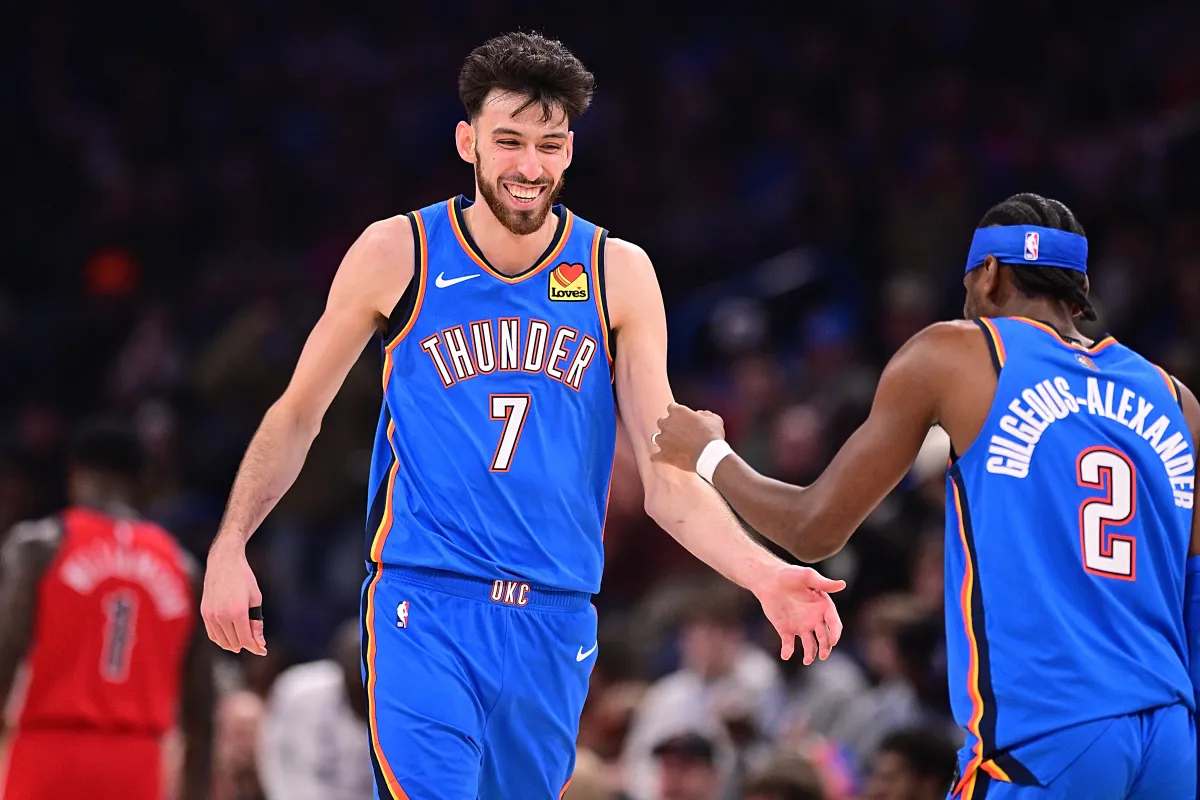
The atmosphere inside the Paycom Center during Saturday night’s Game 7 of the Western Conference Finals was electric with the heavy, trembling anticipation of a fanbase desperate to see their beloved Oklahoma City Thunder secure a passage back to the grandest stage of the NBA Finals. The stakes could not have been higher, and yet, sports have a cruel, poetic way of shredding even the most carefully crafted scripts. On this fateful night, as the visiting San Antonio Spurs executed a masterclass in disciplined basketball, a foundational pillar of the Thunder’s championship-caliber identity unexpectedly buckled under the weight of the moment. Chet Holmgren, the towering and brilliant young big man whose presence on both ends of the floor had been instrumental to Oklahoma City’s success all year, mysteriously vanished in the midst of the most important game of his young life. Over 33 exhausting minutes on the hardwood, the versatile former top draft pick was reduced to a mere spectator in his own jersey, finishing the high-stakes, win-or-go-home contest with a highly uncharacteristic stat line of just four points and four rebounds while attempting a meager two shots from the field. For a player who normally exerts an immense vertical and offensive gravity on the game, this sudden passivity was as shocking as it was devastating for the home crowd. The final buzzer sounded on a heartbreaking 111-103 defeat, instantly extinguishing OKC’s high-flying aspirations of securing back-to-back league championships. In an instant, the triumphant noise of the arena was replaced by a heavy, paralyzing silence, leaving fans and commentators alike wondering how such a talented star could experience such a profound disappearing act when his team needed him most. This singular game, played under the absolute microscope of national television, highlighted the unforgiving nature of elimination basketball, where previous accolades are instantly wiped clean and only the present performance remains.
While Holmgren spent the evening agonizingly searching for his rhythm, reigning back-to-back NBA MVP Shai Gilgeous-Alexander fought with the heroic desperation of a true champion. Refusing to let his team’s championship dreams die without an absolute war, the brilliant guard put on a masterclass of individual brilliance, carving through the Spurs’ defense with surgical precision. During his massive effort, Gilgeous-Alexander racked up a magnificent game-high 35 points to go along with nine stellar assists, showcasing his sublime all-around skill. Yet, basketball is a deeply interconnected game of collective harmony, and even an MVP performing at the very peak of his powers cannot single-handedly drag a team across the finish line when one of its main engines has completely stalled. As the game wore on, Shai’s brilliant passes frequently found teammates who were out of rhythm, and the team’s half-court offense became stagnant, lacking the crucial spacing and dynamic lob threats that Holmgren normally provides so effortlessly. Every time Oklahoma City threatened to make a run, the balanced, energetic, and highly motivated San Antonio attack responded with a crushing blow of their own, exploiting the Thunder’s sudden lack of interior size and scoring versatility. It was a lonely, exhausting uphill battle for Gilgeous-Alexander, who left everything on the court only to run out of time and options as the final seconds ticked away. The stark contrast between Shai’s individual masterpiece and the team’s offensive struggle highlighted the harsh reality that championship dreams are rarely realized by a single hero, but rather by an entire unit operating in complete unison. Without Chet’s usual defensive intimidation and pick-and-roll dynamism, the Spurs were able to double-team Shai late in the game, forcing the ball out of his hands and exposing the lack of secondary playmaking on the perimeter. It was a sobering lesson in the limits of individual greatness in the face of a cohesive, championship-level opponent.
In the immediate aftermath of such a devastating loss, it would have been incredibly easy for a superstar of Shai Gilgeous-Alexander’s stature to succumb to frustration, point fingers, or subtly distance himself from his teammates’ struggles. Modern professional sports exist in a relentless 24-hour media loop where scapegoating is the default setting, and dynamic young stars are frequently encouraged to preserve their own reputations by throwing underperforming teammates under the bus. Instead, Gilgeous-Alexander delivered a clinic in elite emotional leadership, choosing a path of profound empathy and solidarity that solidified his place as the true cultural heartbeat of the Oklahoma City Thunder. Stepping up to the microphone during Sunday’s highly anticipated exit interviews, the reigning MVP refused to let the narrative of Game 7 define his young teammate’s value or divide the locker room. “We need Chet Holmgren,” Shai stated with absolute, unwavering conviction, immediately shutting down any attempts to minimize the big man’s importance. He went on to offer an incredibly powerful defense of Holmgren’s identity, asserting, “Before Chet was here, we weren’t who we are today. We wouldn’t have the success we have today. When he’s the best version of himself, we’re the best version of ourselves.” This was not merely a series of generic public relations platitudes designed to appease the press, but a deep, authentic declaration of brotherhood and shared destiny. By publicly lifting Holmgren up in his moment of deepest professional vulnerability, Shai demonstrated that true leadership is not measured solely by points scored on the court, but by the loyalty extended to teammates in the immediate aftermath of a heartbreaking defeat. His words shielded him against public criticism, reminding the entire basketball world that the Thunder’s success is not built on individual isolation, but on a collective pact of mutual trust and respect that cannot be broken by one poor shooting night.
This culture of deep empathy, collective accountability, and long-term perspective is no mistake; it is a philosophy actively championed by Oklahoma City’s head coach, Mark Daigneault. Known throughout the basketball world as one of the league’s most astute minds, Daigneault mirrored his superstar’s protective stance during his own post-season reflections on Sunday. Rather than dissecting Holmgren’s tactical stagnation or focusing on the geometric defensive errors of Game 7, the visionary coach took a macro approach, emphasizing Holmgren’s absolutely central role in the entire architecture of the franchise’s historic rise to a championship powerhouse. Daigneault’s messaging was a masterclass in modern player coaching and sports psychology, reinforcing the fundamental truth that player development is never a simple, linear path but rather a turbulent journey defined by both exhilarating breakthroughs and humbling setbacks. He made it clear to both the media and the players that the Thunder’s complex identity, defensive versatility, and offensive spacing are entirely predicated on Holmgren’s unique, gravity-defying skill set. This absolute alignment between the front office, the coaching staff, and the superstar leader has created a rare psychological safety net in Oklahoma City, allowing young athletes to fail, learn, and grow without the paralyzing fear of being discarded or publicly scapegoated. By validating Holmgren’s immense value, Daigneault ensured that the young center’s confidence remained intact, reminding everyone involved that championship foundations are built on patience, structural belief, and the understanding that adversity is simply the price of future glory. He emphasized that a single game, no matter how high the stakes, does not erase the hundreds of hours of flawless execution and defensive dominance that Chet displayed over the season. A true championship culture does not panic after a single storm; instead, it uses the rain to nurture the growth of its young stars for the long, challenging journey ahead.
For Chet Holmgren, a fierce competitor whose rookie year was defined by a quiet toughness, hearing these passionate public declarations of love and support from his coach and MVP teammate was both deeply humbling and profoundly reassuring. When it was his turn to sit at the podium for his exit interview on Sunday, the strain of the previous night’s defeat was visible, but so was a quiet, mature determination to grow from the experience. He did not dodge questions or make excuses, but he carried himself with an admirable vulnerability that resonated deeply with those in the room. “It’s always great to have support from people that are not only great people, but are as talented as they are at what they do,” Holmgren reflected, his voice quiet but filled with genuine gratitude for the brotherhood that had shielded him from the storm. He went on to explain how observing their poise in moments of intense pressure acts as a blueprint for his own career, adding, “It’s always inspiring to see their lead and try to follow that.” For a young player navigating the crushing, hyper-critical spotlight of modern NBA stardom, knowing that your immediate family inside the bunker has your back is the ultimate catalyst for genuine growth. This painful, humbling Game 7 experience, while incredibly difficult to digest in the short term, has the potential to become the most important milestone of Holmgren’s career, transforming a moment of heartbreaking defeat into an inexhaustible reservoir of mental toughness, hunger, and resolve. It showed him that his worth to this franchise is not transactional, but relational, rooted in a mutual pursuit of excellence that accommodates human imperfection. Empowered by this unconditional belief, the young big man left the arena not with a broken spirit, but with a clear vision of the physical and mental work required to elevate his game to the heights his teammates already believe he can reach.
As the dust settles on this Western Conference Finals battle, the relentless machine of the NBA postseason marches onward, indifferent to the personal heartbreaks and broken dreams of those left in its wake. The triumphant San Antonio Spurs, carried by their emotional Game 7 execution, now advance to the ultimate battleground of the NBA Finals, where they will battle the legendary New York Knicks. Meanwhile, the Oklahoma City Thunder find themselves in an early offseason, left to ponder the thin margins between victory and defeat while watching the remainder of the playoffs from their living rooms. Yet, despite the sting of failing to secure back-to-back championships, there is an overwhelming sense that the future in Oklahoma City remains incredibly bright, if not outright inevitable. In the grand, complex tapestry of building a sustainable, multi-year NBA dynasty, heartbreak is almost always an essential, non-negotiable ingredient; it is the refining fire that tempers the steel of young stars, teaching them the exact physical and emotional price of admission to the absolute pinnacle of professional sport. The maturity displayed by Shai Gilgeous-Alexander, the strategic and emotional wisdom of Mark Daigneault, and the quiet, burning hunger of Chet Holmgren suggest that this postseason exit is not a tragic end to their story, but merely a painful, necessary prelude to their greatest chapters. When this young Thunder squad eventually returns to this high-stakes arena—physically stronger, mentally tougher, and deeply bonded by shared adversity—they will look back at the bitter disappointment of this Game 7 not as a failure, but as the moment they truly became an unbreakable family. Their journey is far from over; it is merely pivoting toward a deeper level of preparation. For a franchise that has built its success on trust and organic growth, this defeat is simply a seed planted in fertile soil, destined to grow into a spectacular championship tree in the seasons to come.