

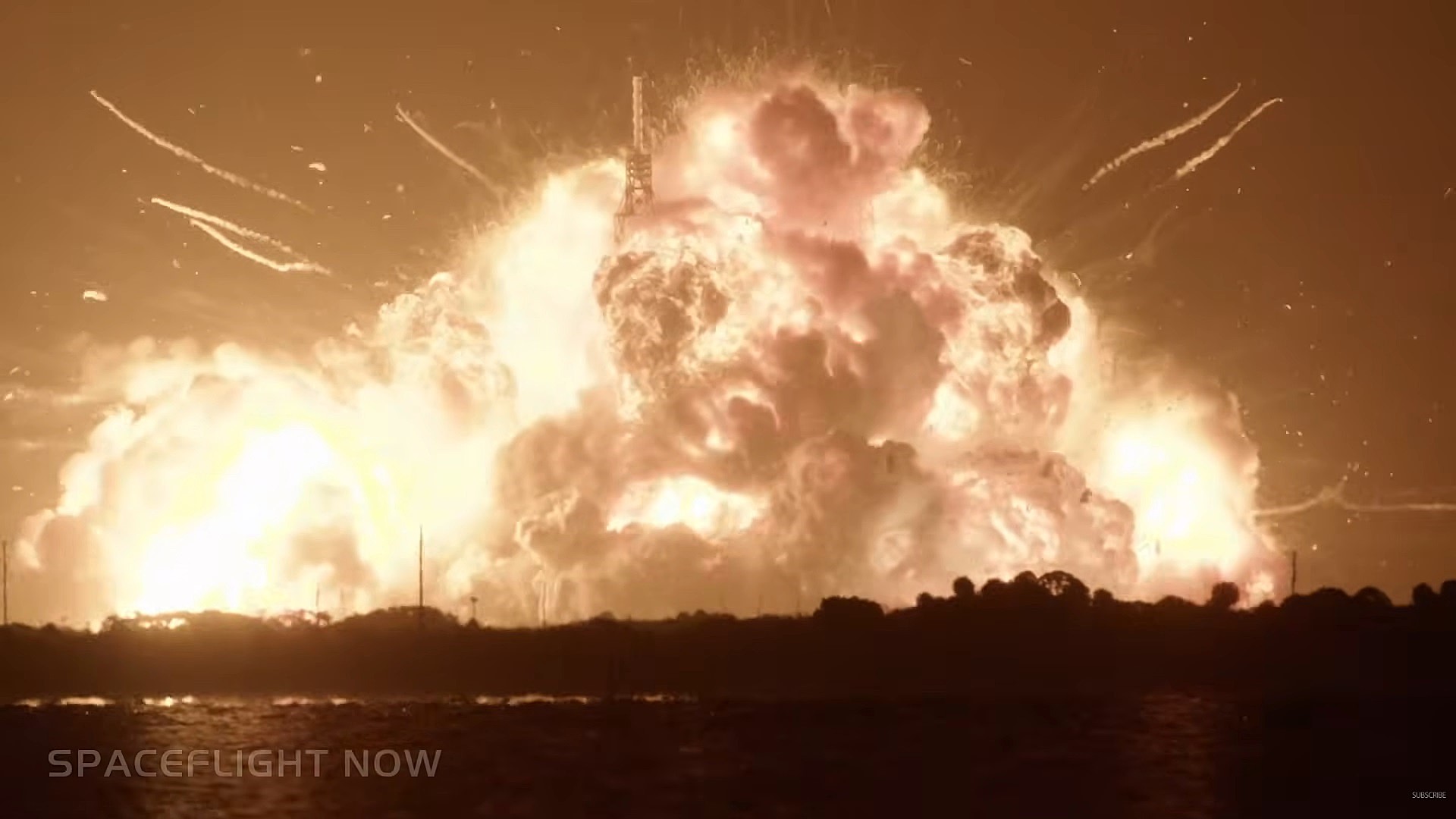
The sunset over Cape Canaveral is usually a symbol of quiet anticipation, but on this particular evening, the sky was violently torn apart by a blinding flash of orange and white. At Space Launch Complex 36, Blue Origin’s massive New Glenn rocket was undergoing what should have been a routine, albeit critical, static fire test—a moment meant to prove the readiness of its roaring engines before its highly anticipated maiden flight. Instead, within heartbeats of the ignition sequence, the 322-foot-tall vehicle erupted into a monstrous, churning fireball that lit up the Florida coastline and sent shockwaves through the local community and the global spaceflight industry alike. For those watching from afar, the sheer scale of the explosion was breathtaking, prompting astounded onlookers to declare that the launch pad had been “nuked.” Yet, amidst the terrifying visual spectacle of shattering metal and ignited propellant, the primary and most vital concern was the human cost. In a testament to rigorous safety protocols and remote testing procedures, the U.S. Space Force and Blue Origin leadership quickly confirmed that every single member of the launch crew and support team was entirely safe and accounted for. This miraculous absence of injuries provided a profound sense of relief, even as the emotional weight of the disaster began to settle over the team. Jeff Bezos, the visionary founder behind the aerospace venture, took to social media to address the heartbreaking setback with a mixture of raw honesty and unyielding determination, acknowledging that while it was a “very rough day,” the dream itself remained entirely intact. His resolve to rebuild whatever was lost and return to the skies captured the bittersweet essence of modern exploration: a realm where triumph is bought with patience, and where the path to the stars is inevitably paved with fire, ash, and the stubborn refusal to give up. The road ahead would undoubtedly be long, but the immediate safety of the people who built this machine served as a quiet reminder of what truly matters when humanity pushes the boundaries of the possible.
The destroyed rocket was not just a collection of metal tanks and complex plumbing; it was a physical manifestation of years of laboratory design, late-night engineering debates, and massive financial investments. Affectionately and aspirationally named “No, It’s Necessary”—a poignant nod to the cinematic themes of survival and cosmic destiny in the movie Interstellar—this particular New Glenn booster was slated to carry a crucial payload of 48 Amazon Leo satellites into low Earth orbit as early as the following week. These satellites represent Amazon’s ambitious entry into the global satellite internet market, aimed at bridging the digital divide and providing high-speed connectivity to the most remote corners of the globe. The upcoming launch was meant to be a triumphant declaration of capability, especially coming on the heels of a painstaking Federal Aviation Administration investigation into a previous flight anomaly that occurred in April. Having recently secured the FAA’s hard-won clearance to fly, the team at Blue Origin believed they were finally on the precipice of a new, historic chapter. The static fire test was the final, critical gatekeeper—a brief, secured ignition of the heavy-lift booster’s engines to ensure all systems were functioning in perfect harmony before the actual satellites were bolted to the top. Thankfully, because the satellites were not mounted on the rocket during this destructive test, the expensive and highly specialized hardware was spared from the blast. However, the loss of the booster itself, combined with the complete destruction of the vehicle’s intricate flight systems, represents an agonizing setback for the thousands of men and women who poured their souls into preparing “No, It’s Necessary” for its grand debut. The dream of seeing this mechanical giant ascend majestically into the heavens had been put on hold, replaced by the grim reality of cleanup and reflection.
Beyond the loss of the physical rocket, the destruction of Space Launch Complex 36 presents an incredibly daunting logistical nightmare that will reverberate through the aerospace sector for months, or perhaps even years. As the only facility specifically constructed and tailored to accommodate the unique, colossal footprint of the heavy-lift New Glenn, this specific launch pad is the literal gateway through which all of Blue Origin’s orbital ambitions must pass. The intense heat and pressure of the explosion did not just disfigure the rocket; they tore through the pad’s delicate support structures, scorched the critical fueling lines, and likely damaged the highly sophisticated ground telemetry and control systems. Repairing this highly specialized infrastructure is not as simple as pouring fresh concrete and replacing burnt wiring; it requires a meticulous forensic cleanup, followed by exhaustive structural integrity assessments to ensure the ground beneath future rockets can withstand millions of pounds of thrust. Compounding this physical challenge is the regulatory mountain the company must now climb. Under the watchful, uncompromising eyes of the Federal Aviation Administration, the U.S. Space Force, and independent safety boards, Blue Origin must sift through mountains of digital telemetry, high-speed video footage, and physical debris to pinpoint the exact root cause of the failure. For the engineers tasked with this autopsy of their own creation, the process is both intellectually grueling and emotionally exhausting, requiring them to confront their errors in the glare of a global spotlight while knowing that any future launch permissions hinge entirely on their ability to solve this mystery. Every sensor reading, every valve position, and every microscopic structural imperfection will be scrutinized in the search for answers. This meticulous process is essential for restoration, but it also delays the dreams of an entire company.
The ripples of this explosion extend far beyond the scorched perimeter of Cape Canaveral, casting a shadow over a complex web of commercial, scientific, and geopolitical timelines. The primary immediate casualty of the schedule disruption is Amazon’s Leo broadband network, which relies on a diverse array of launch providers to build out its constellation in space. Fortunately, other heavy hitters in the industry, including SpaceX, Arianespace, and United Launch Alliance, continue to carry out their scheduled launches without interruption, ensuring that Amazon’s broader network goals remain alive, as evidenced by an upcoming Atlas 5 launch. However, Blue Origin’s internal roadmap has been severely, perhaps critically, knocked offline. Before this incident, the company was aggressively preparing to dispatch its robotic Blue Moon Mark 1 lander to the lunar surface as early as this fall, carrying valuable NASA science payloads designed to scout the terrain for future human visitors. Even more critically, the schedule included a highly anticipated, crew-capable Blue Moon Mark 2 lander flight test in low Earth orbit next year—a vital precursor for NASA’s historic Artemis 3 mission, which aims to return humanity to the lunar surface. Just days before the disaster, NASA had proudly announced Blue Origin’s selection to deliver two state-of-the-art commercial lunar terrain vehicles to the moon by 2028. Now, these grand visions of astronauts driving across the dusty lunar plains are suspended in a state of profound uncertainty, as the fundamental vehicle meant to lift these dreams off the Earth sits in pieces on a ruined Florida launch pad, forcing agency officials and corporate executives alike to recalibrate their expectations and brace for extensive delays. The setback serves as a reminder of how interconnected the modern space ecosystem is, where a single valve failure can delay the return of humans to another celestial body.
In the wake of such a public and devastating failure, the reaction from the broader space exploration community has revealed a deep, underlying empathy that transcends corporate rivalries and political boundaries. NASA Administrator Jared Isaacman expressed a somber but steadfast commitment to the joint venture, reminding the public that spaceflight remains an utterly unforgiving endeavor where the laws of physics do not grade on a curve. Developing a brand-new, heavy-lift rocket capable of breaking Earth’s gravity is one of the most complex engineering tasks humanity can attempt, and Isaacman’s call for a thorough investigation was tempered by an unshakeable promise to support Blue Origin through the recovery process and eventually get back to the business of launching. Perhaps even more telling was the public message of support from Elon Musk, the CEO of SpaceX and Bezos’s most prominent competitor in the private space race. Musk, who notoriously experienced his own catastrophic launch-pad explosion in 2016 when a Falcon 9 rocket erupted during pre-flight preparations, reached out on social media to offer his sincere condolences and express his hopes for a rapid recovery. This gesture serves as a powerful reminder that within the high-stakes, highly competitive world of aerospace, there exists a unique, unspoken brotherhood. Those who dare to build machines that touch the heavens understand that every failure is a shared tragedy, and that the collective progress of humanity depends on the survival and success of even one’s fiercest rivals. They know that a setback for one is a sobering lesson for all, reminding every engineer in the industry of the delicate line between triumph and disaster. It was a moment of rare solidarity that highlighted the shared human aspiration under the cold, harsh realities of cosmic physics.
Ultimately, the dramatic destruction of “No, It’s Necessary” is not an obituary for Blue Origin’s dreams, but rather a grueling chapter in the ongoing story of human exploration. The history of flight, from the Wright brothers’ fragile wooden gliders to the towering Saturn V rockets of the Apollo era, is a narrative written in the language of persistence through failure. Every great leap forward has been preceded by moments of fire and doubt, and the true measure of an aerospace enterprise is not whether it encounters failure, but how it responds to the aftermath. As the smoke clears over Space Launch Complex 36 and the long, arduous process of rebuilding begins, the engineers, technicians, and dreamers at Blue Origin are reminded of why they chose this path. Jeff Bezos’s simple, profound declaration that “it’s worth it” speaks to a fundamental truth of the human spirit: the desire to reach beyond our terrestrial boundaries, to explore the unknown, and to secure a future for humanity among the stars is a calling that far outweighs the temporary pain of a broken rocket. In the coming months, the quiet hum of machinery will return to the Cape, the scarred launch pad will be patched, redesigned engines will fire once more, and a new New Glenn will stand tall against the Florida sky. When that day comes, the fire that consumed the launch pad in May of 2026 will not be remembered as a final defeat, but as the crucible that forged a stronger, safer, and ultimately successful path to the cosmos. The journey is incredibly hard, but the destination remains as breathtakingly beautiful as ever. The space race is not a sprint; it is an endurance marathon of hope, and Blue Origin is far from finished.