


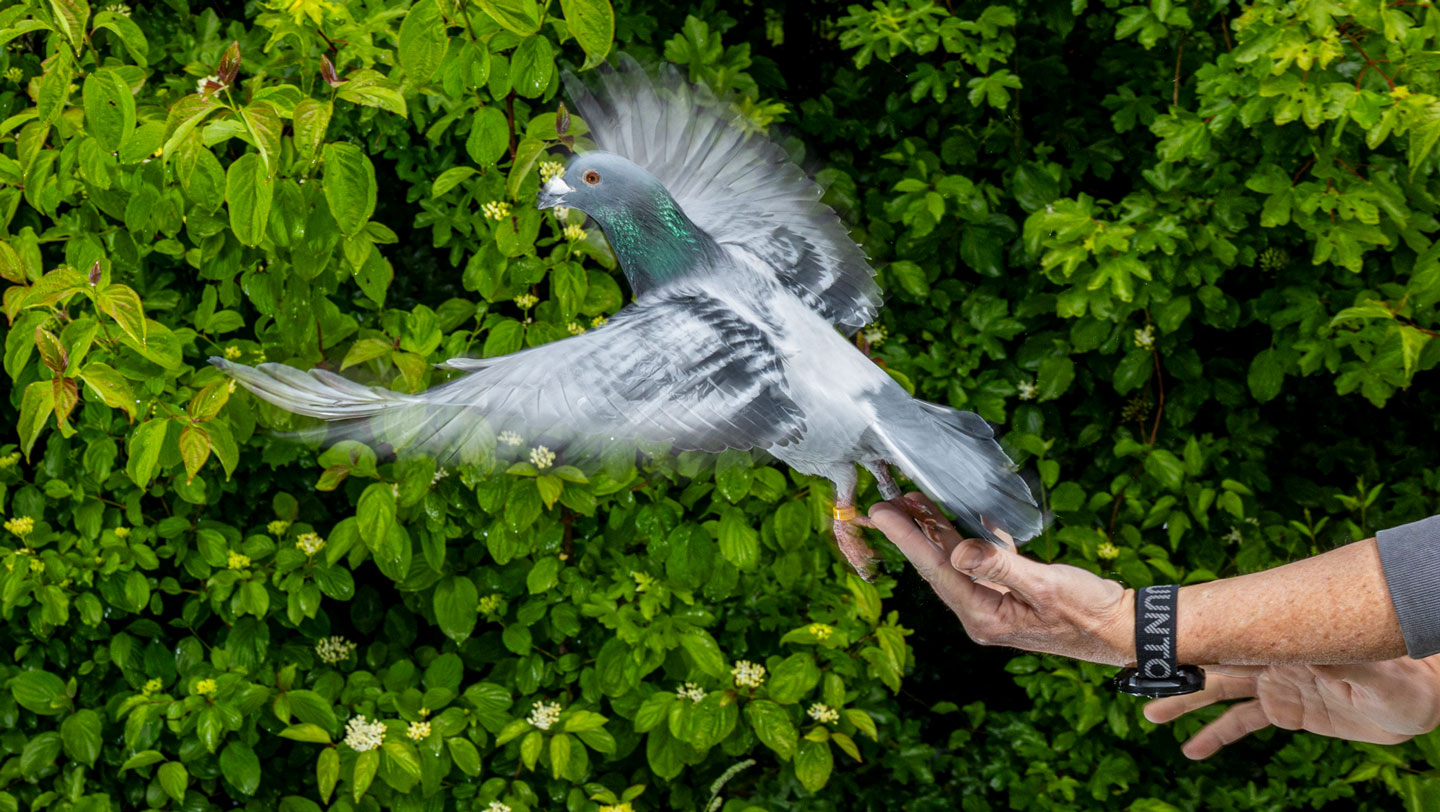
For thousands of years, humans have looked up at the sky in sheer wonder at the miraculous navigation skills of the homing pigeon. These extraordinary birds, capable of carrying vital messages across war zones and returning to their exact roosts from hundreds of miles away, have long baffled historians and scientists alike. For a very long time, we assumed their journeys were guided by a mixture of keen eyesight, a highly developed sense of smell, or some inexplicable, romantic gut instinct. As modern science progressed, researchers generally agreed that migratory animals possess a unique superpower: the ability to tap into the invisible magnetic field of the Earth to chart their global journeys. However, discovering exactly how they do this proved to be one of the most stubborn and deeply frustrating mysteries in biology. For several decades, the reigning explanation proposed a complex “quantum effect” occurring within light-sensitive proteins in the birds’ eyes, which supposedly allowed them to literally “see” magnetic field lines. While elegant, this theory was incredibly difficult to prove and fell short when applied to other creatures. Nocturnal animals like bats and deep-sea predators like sharks navigate perfectly using magnetic cues but completely lack these specialized eye proteins, leaving the scientific community locked in an academic stalemate, lacking a physical, tangible compass that could unite the animal kingdom.
The breakthrough that would finally crack this ecological mystery wide open did not come from an expensive, state-of-the-art avian laboratory, but from a casual, serendipitous conversation over a cup of coffee. More than a decade ago, Martin Wikelski, a passionate ornithologist from the Max Planck Institute of Animal Behavior, found himself sitting next to Christian Kurts, a dedicated immunologist from the University of Bonn, during a conference break. As they chatted, Kurts began venting his professional frustrations about a recurring headache in his immunology lab. He was trying to study mouse spleens, but his experiments were constantly being ruined because certain immune cells, called macrophages, kept stubbornly sticking to the magnetic columns he used to separate different cell types. Kurts discovered that these immune cells were behaving like tiny metal filings because their primary job was to recycle dead red blood cells, which left them heavily loaded with recycled iron. While Kurts viewed this as an annoying technical glitch in his mouse research, Wikelski’s jaw dropped. Having never been fully convinced by the abstract quantum-eye theories of bird flight, Wikelski suddenly realized that these everyday, iron-recycling immune cells might actually be the physical mechanism behind the animal kingdom’s mysterious internal compass.
This cross-disciplinary spark of inspiration quickly grew into a rigorous joint research project, spearheaded by cell biologist Clivia Lisowski at the University of Bonn. The team’s first goal was to locate these magnetic immune cells inside the bodies of homing pigeons (Columba livia). Lisowski systematically harvested and tested cells from various parts of the birds’ bodies—including the eyes and the upper beak, which had been the focus of magnetic research for generations—as well as the spleen and the liver, which act as the body’s natural iron-filtration systems. To their immense excitement, they found that only the macrophages taken from the pigeons’ livers locked onto the magnetic lab columns. Moving their search to the microscopic level, the researchers discovered that the pigeons’ livers were packed with millions of these iron-rich cells. Crucially, these cells were not just floating aimlessly; they were clustered in dense formations directly alongside the liver’s intricate network of nervous tissue. The biological implications were breathtaking in their simplicity: as a pigeon flies, the earth’s magnetic pull exerts a physical drag on the heavy iron deposits inside these liver cells, which in turn stimulates the adjacent nerves, sending precise, real-time spatial coordinate data straight to the bird’s brain.
To move their hypothesis from a laboratory concept to an undeniable scientific fact, the team had to design a highly creative and logistically challenging field experiment. They knew that pigeons are highly practical flyers who prefer to use the sun as their primary compass, relying on their magnetic sense only as an emergency backup when overcast skies block out the heavens. Therefore, the researchers had to play a patient waiting game with the unpredictable German weather, closely monitoring forecasts for perfectly cloudy, overcast days where the sun remained completely hidden from view. Once the ideal gray weather arrived, the team prepared a flock of thirty-four homing pigeons, administering a specialized treatment to half of them that temporarily neutralized their liver macrophages without causing any pain or permanent harm. The other half of the flock was left entirely untouched to serve as the control group. The scientists then loaded all thirty-four birds into carriers, drove them nineteen kilometers away into unfamiliar territory, and prepared to release them into the foggy skies, entirely dependent on their internal machinery to find their way home.
The dramatic test flights that followed provided stunning, visual confirmation of the liver’s role in navigation. Each pigeon was released with a tiny, high-tech GPS tracker carefully strapped to its back so the researchers could map every twist and turn of their flight paths. The untreated pigeons, cruising through the gray skies with their healthy liver compasses fully operational, paused briefly to orient themselves before charting a straight, remarkably efficient line directly back to their home roost, arriving safely in just seventy minutes. In stark contrast, the pigeons with the disabled liver macrophages were completely lost. Without the sun to guide them and without their magnetic liver cells to fall back on, they flew in chaotic, disoriented loops, scattering aimlessly in every direction and failing to make any progress toward home. They were forced to spend a confusing night in the wild, only managing to navigate back the following day when the cloud cover broke and the sun finally returned to offer them a visual landmark. To ensure the treatment hadn’t simply made the birds too sick to fly, the team ran a parallel trial on a bright, sunny day, finding that both the treated and untreated birds flew home with identical, flawless speed.
This remarkable discovery has completely revolutionized our understanding of animal physiology, challenging the traditional view of the liver as a mere digestive filter and elevating it to a highly sophisticated sensory organ. While some traditional researchers in the deeply competitive field of animal navigation will inevitably remain skeptical, the rigorous, hands-on methodology of the study makes these findings incredibly difficult to ignore. By bridging the gap between immunology and zoology, this landmark study has opened up a thrilling new frontier in science, prompting researchers worldwide to investigate whether other famed navigators like migrating songbirds, sea turtles, sharks, and bats rely on this same liver-based compass. It is a beautiful and humbling reminder that after decades of searching for exotic, high-tech quantum mechanisms in the eyes of migratory animals, the true answer to one of nature’s greatest mysteries was hidden in the most humble of places: a simple, hardworking immune cell tucked quietly inside the liver, pointing the way home.