



The Cost of Digital Slander: How an AI-Fueled Conspiracy Nearly Destroyed K-Drama Icon Kim Soo-hyun
The Fall and Redemption of a Hallyu Giant: Inside South Korea’s Battle with Digital Defamation
In the high-stakes, hyper-connected landscape of South Korea’s entertainment industry, where the line between public adoration and immediate social exile is razor-thin, a dramatic legal breakthrough has sent shockwaves through the global Hallyu community. On Tuesday, South Korean police took the decisive step of arresting Kim Se-ui, a prominent and highly controversial YouTuber behind the notorious online gossip channel Hover Lab, on charges of orchestrating an expansive, tech-enabled defamation campaign. The arrest marks a pivotal moment of vindication for actor Kim Soo-hyun, one of Asia’s most recognizable and commercially successful superstars, whose highly celebrated career was abruptly derailed last year by sensational allegations of statutory misconduct. For months, the actor endured a relentless public trial after Hover Lab accused him of engaging in an inappropriate romantic relationship with an actress when she was still a minor. While the YouTuber continues to deny all charges, alleging his reports were rooted in verifiable truths, investigators have uncovered a disturbing digital operation. Law enforcement authorities accuse Mr. Kim of deliberately fabricating text messages and utilizing advanced generative artificial intelligence to manufacture highly convincing, deeply damaging voice recordings designed to systematically dismantle the actor’s public standing. Following the arrest, representatives for the beleaguered actor expressed a profound sense of relief, signaling an end to a painful period of silent endurance; his management agency, Gold Medalist, issued a brief but emotionally weighted statement on Wednesday declaring that, “At last, the truth has been proven.” This high-profile arrest not only vindicates a beloved cultural icon but also highlights a growing crisis within South Korean society, where unregulated digital creators—frequently referred to as “cyber wreckers”—monetize fabricated scandals, exploiting the public’s insatiable appetite for celebrity gossip and exposing the severe, real-world vulnerabilities of the modern creative class.
A Looming Tragedy Explodes: The Sudden Loss of Kim Sae-ron and the Spark of Online Cruelty
To fully comprehend the scale and velocity of the online campaign against Kim Soo-hyun, one must trace the narrative back to a profound human tragedy that captivated the nation: the untimely death of actress Kim Sae-ron. Once revered as a beloved child prodigy who earned national acclaim for her raw on-screen emotional depth, Ms. Kim’s promising career took a steep and highly publicized downward turn in 2022 following a high-profile driving under the influence (DUI) incident. In South Korea’s notoriously conservative societal landscape, where celebrities are held to strict moral standards, her subsequent industry ostracization was absolute and unyielding. The immense psychological burden of her sudden fall from grace culminated in a heartbreaking discovery last February when she was found dead, with police officially ruling her passing a suicide. Instead of initiating a period of quiet reflection on the mental health challenges faced by young artists, her tragic death became a toxic catalyst for online tabloids and predatory content creators seeking to capitalize on public grief. Internet commentators eagerly dissected her private life, focusing their attention on historical, unconfirmed rumors surrounding her past relationship with Kim Soo-hyun—celebrated internationally for his legendary lead roles in the blockbuster fantasy drama My Love from the Star and the critically acclaimed film Secretly, Greatly. Seizing upon the volatile emotions of the moment, Hover Lab stepped forward to construct a dark, predatory narrative, transforming a tragic loss of life into an explosive weapon of character assassination against an active superstar who had no direct connection to her tragic end.
The Tech-Enabled Hit Job: How AI Deepfakes and Doctored Evidence Manufactured a Scandal
The methods employed by Hover Lab to construct this damaging controversy represent a dangerous new frontier in digital warfare, illustrating how modern tools of artificial intelligence can be weaponized against public figures with devastating precision. No longer relying on simple, unsubstantiated hearsay, the YouTuber Kim Se-ui presented his audience with what appeared to be immutable, concrete evidence of ethical misconduct. The channel published highly detailed, fabricated text message transcripts allegedly exchanged between the two actors during a period when Ms. Kim was just 15 years old and Mr. Kim was 28. To seal the narrative, Hover Lab broadcasted a highly convincing audio recording in which a voice indistinguishable from the late actress explicitly claimed that the older actor had initiated their romantic relationship while she was still a middle school student. The broadcast accused Kim Soo-hyun of “sexual grooming,” child exploitation, and subsequently abandoning the young actress to her financial ruin following her 2022 legal troubles. To lend an air of legitimacy to these shocking assertions, the channel claimed that this private evidence had been secured directly from the grieving family of the deceased actress—a claim that remains highly contested and legally ambiguous, as a legal representative for the family declined to comment on the matter. This strategic integration of deepfake audio and meticulously edited digital documents succeeded in exploiting the public’s natural protective instincts regarding minors, demonstrating how easily the boundaries of reality can be manipulated by malicious actors wielding generative AI tools designed to bypass traditional journalistic gatekeeping.
Silence and Exile: The Human and Financial Toll on Kim Soo-hyun’s Stellar Career
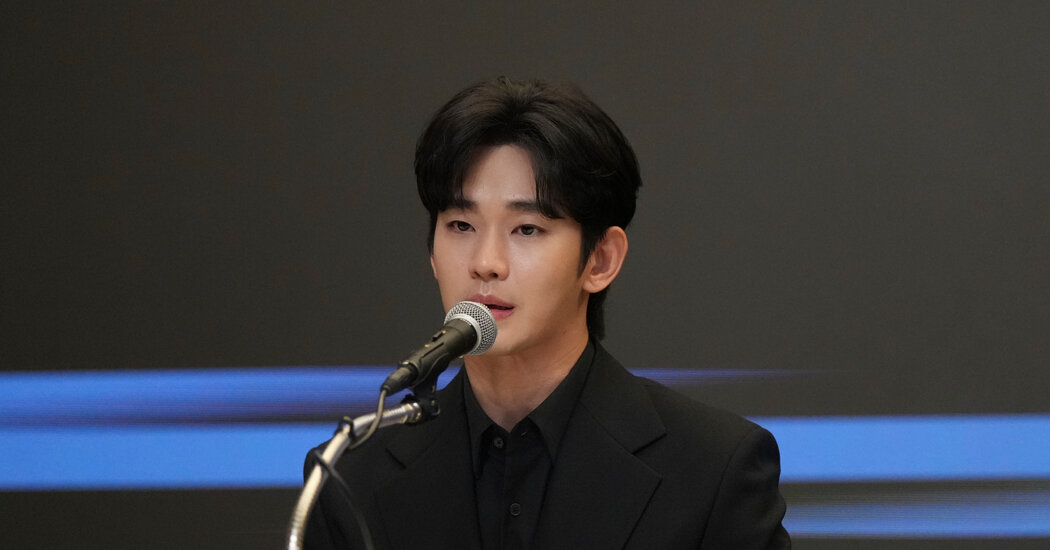
In the unforgiving ecosystem of South Korean media, an accusation of this magnitude behaves as an immediate professional death sentence, operating on a de facto principle of “guilty until proven innocent” in the court of public opinion. Almost overnight, Kim Soo-hyun, whose immense global popularity had previously secured him countless high-profile endorsements and critical acclaim, was treated as a pariah. Sensing the volatile nature of the public’s mounting fury, television networks quietly halted active casting discussions, major commercial brands rushed to dismantle prominent advertising campaigns featuring his likeness, and a cloud of intense skepticism hung over his every past achievement. The crushing pressure culminated in an exceptionally rare, emotionally charged press conference in March 2025, where the actor broke his silence to face a phalanx of reporters, speaking with a raw vulnerability that was a far cry from his polished on-screen personas. “I cannot admit to something I simply did not do,” he said, fighting back tears before a live national audience, before adding, “I did not date the deceased when she was a minor.” Despite his desperate pleas for basic fairness, the damage to his public image was so severe that his career was effectively frozen; since that faithful broadcast, one of South Korea’s most talented and sought-after performers has not appeared in a single new television drama, film representation, or modeling engagement within his home country, highlighting the devastating financial and psychological toll exacted when unverified online allegations are allowed to dictate reality.
A High-Stakes Forensic Showdown: Legal Redress and Defiant Media Figures
Determined to salvage his dignity and hold his digital persecutors legally accountable, Kim Soo-hyun took the courageous step of launching comprehensive criminal defamation lawsuits against both the provocative YouTuber and key individuals associated with the late actress’s circle. The legal battleground reached a fever pitch this Tuesday when Kim Se-ui arrived at the courthouse to contest the state’s request for an arrest warrant. Refusing to show contrition or retreat from his highly damaging claims, the defiant digital broadcaster stopped to address the assembled media, vigorously asserting his innocence and making the bold claim that the state’s own elite scientific body, the National Forensic Service, had formally authenticated the voice recording as genuine. “This arrest warrant is clearly and undeniably based on complete falsities,” he told reporters, attempting to cast himself as a victim of a powerful celebrity cover-up and leveraging the prestige of government agencies to preserve his credibility in his final moments of freedom. However, his assertions were quickly met with bureaucratic distance; the National Forensic Service declined to comment on his statements, promptly referring all press inquiries back to the Gangnam Police Station, which has spent months spearheading the investigation into the fabrication of the digital assets. This complex forensic showdown highlights the daunting challenges confronting modern law enforcement authorities, who must work untiringly to dismantle sophisticated deepfake technologies and establish clear, legally binding methodologies to prove digital fabrication within a court of law.
The Road to Reconstruction: Regulating the Dark Side of K-Culture’s Global Rise
As the legal proceedings against the creator of Hover Lab move forward, the broader South Korean entertainment industry stands at a critical historical crossroads, forced to confront the systemic vulnerabilities exposed by this painful chapter. The arrest of Kim Se-ui must serve as a watershed moment, prompting legislative bodies and media regulators to establish far more aggressive legal protections against the unregulated dissemination of AI-assisted defamation. While the global rise of the Hallyu wave has brought unprecedented soft power and economic prosperity to South Korea, it has also created a highly commercialized underbelly of toxic gossip where predatory creators exploit loop-holed digital platforms to profit handsomely off the systematic destruction of human lives. For Kim Soo-hyun, the long and arduous journey of reclaiming his hard-earned artistic legacy is only just beginning; though he has achieved legal vindication, the phantom scars left by calculated digital malice are not easily erased. True industry housing must involve a collective awakening among global fans, entertainment executives, and technology platforms alike, establishing robust guardrails to ensure that artificial intelligence becomes a tool for creative expression, rather than a weapon of mass reputation destruction used to terrorize creative minds.