


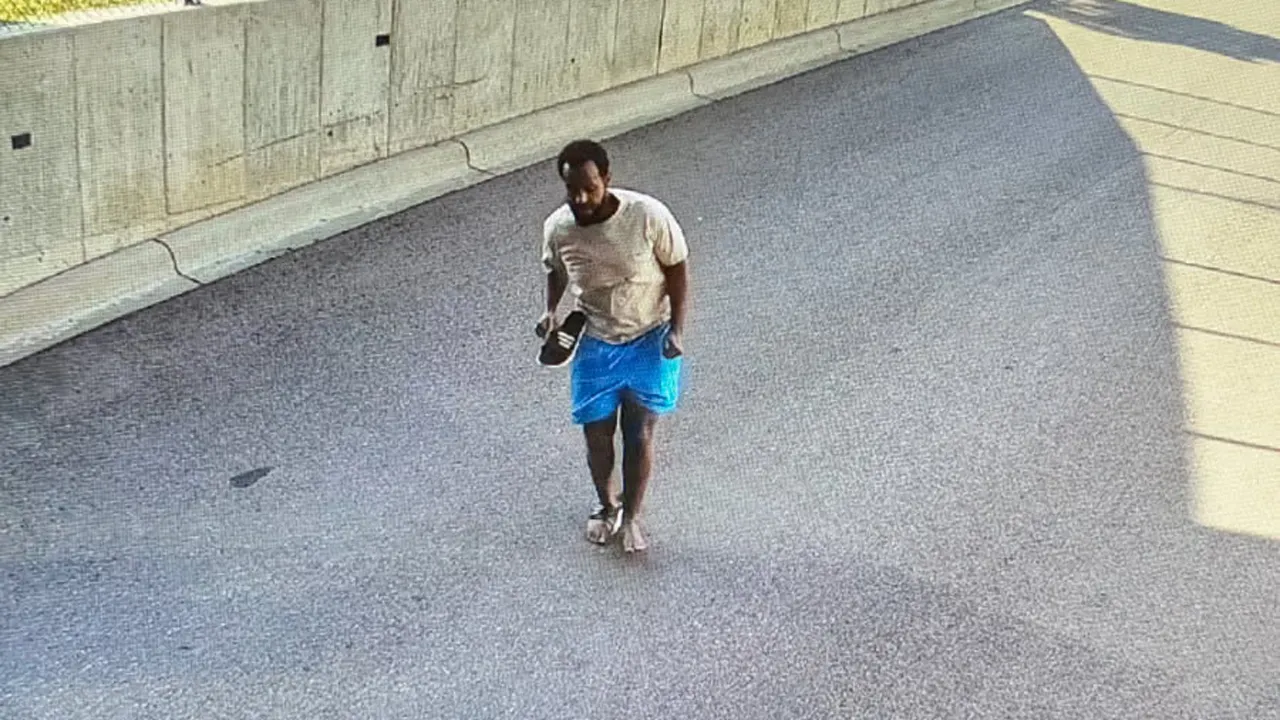
The tranquil morning air in Roseville, Minnesota, was shattered on a recent Thursday as a heavily armed contingent of federal agents converged on a residential complex. For thirty-two-year-old Muhammad Abdulqadir Omar, the sudden knock at the door did not represent a routine encounter with law enforcement, but rather the terrifying arrival of a day of reckoning he had desperately hoped to avoid. Faced with a multi-count federal indictment and the imposing presence of FBI tactical teams ready to execute a raid, Omar made a split-second, life-altering decision born of sheer panic. Rather than surrender to the inevitable, he bolted toward the balcony of his fourth-story apartment and plummeted through the air in a high-stakes, highly dangerous leap for freedom. It was a dramatic, cinematic moment of escape that left neighbors and investigators stunned, a physical manifestation of a man attempting to outrun the consequences of a multimillion-dollar deception. FBI Co-Deputy Director Christopher Raia later recounted this breathtaking escape during an intense afternoon press conference, describing a scene that illustrated just how desperate white-collar suspects can become when their elaborate paper empires finally collapse around them. Yet, the temporary liberty Omar bought with his gravity-defying plunge was agonizingly brief. Within a mere two hours, a coordinated, highly efficient dragnet of local and federal officers successfully tracked down, cornered, and arrested the fugitive. FBI Director Kash Patel took to social media to announce the swift capture, transforming what could have been a prolonged manhunt into a resounding victory for the interagency task force. The rapid resolution of the chase sent an unmistakable shockwave through the local community, serving as a visceral reminder that while white-collar crime is often fought with spreadsheets and audits, its culmination can be as raw, dangerous, and unpredictable as any street-level pursuit.
To understand the roots of this dramatic confrontation, one must look past the physical chase and peer into the cold, calculated mechanics of the financial scheme that precipitated it. At the heart of the federal indictment are thirty-two-year-old Muhammad Abdulqadir Omar of Roseville and twenty-five-year-old Ibrahim Bashir Abdi of Minneapolis. The two men operated as business partners, co-owning and directing North Home Health Care LLC, while Omar also maintained sole ownership of another entity, South Home Health Care LLC. Through these corporate vehicles, they purported to offer critical services under the umbrella of Minnesota Medicaid’s Housing Stabilization Services program. This state-administered initiative represents a lifeline designed to assist vulnerable, low-income individuals—including those suffering from mental illness, physical disabilities, or chronic homelessness—in finding and maintaining stable, safe housing in a state known for its harsh, unforgiving winters. Instead of functioning as compassionate stewards of this essential social safety net, Omar and Abdi allegedly viewed the program through a lens of profound opportunism. According to the United States Department of Justice, the pair systematically exploited the system by submitting a staggering $3.3 million in fraudulent claims for services that were either entirely fabricated or grossly inflated. Of this massive sum, the state-run Medicaid program paid out approximately $3.2 million, a massive fortune of public funds that was allegedly channeled directly away from the needy and into the personal bank accounts of the suspects to finance comfortable, illicit lifestyles.
The true tragedy of this extensive healthcare fraud lies not merely in the dry, astronomical statistics of the indictment, but in the devastating human cost inflicted upon society’s most vulnerable. Programs like the Housing Stabilization Services are constructed upon a foundation of fundamental trust and finite resources, designed to protect individuals who are often just one missed paycheck or one untreated health crisis away from the streets. When opportunistic operators siphon millions of dollars out of these public coffers, it creates a cascading crisis that directly impacts those with the least agency to fight back. Taxpayer dollars that should have paid for legitimate housing counselors, security deposits, and life-changing administrative support were instead diverted to enrich a select few who viewed the state’s compassion as a vulnerability to be mined. This case exposes a profound moral disconnect: for Omar and Abdi, the human beings relying on these stabilization services were apparently reduced to mere names on billing sheets, digital tokens used to unlock federal and state funds. By allegedly fabricating clinical records, falsifying face-to-face visits, and inventing hours of dedicated support that never actually occurred, the defendants did not just steal money; they actively undermined the long-term viability of a program meant to rescue people from the brink of despair. Each falsified entry was a betrayal of a system designed to elevate community dignity, showcasing how white-collar greed directly translates to back-alley suffering for those who rely on the integrity of public welfare.
This latest enforcement action does not occur in a vacuum, but rather against a darker backdrop of systemic fraud that has repeatedly thrust Minnesota into the national spotlight in recent years. The state’s generous, decentralized social welfare programs, designed to foster community trust and rapid assistance, have unfortunately become magnets for sophisticated, highly organized exploitation networks. The local public consciousness is still reeling from the staggering “Feeding Our Future” scandal, a monumental $250 million scheme that brazenly stole federal child nutrition funds during the height of the COVID-19 pandemic—a case so egregious that its mastermind was recently sentenced to nearly forty-two years in federal prison. From massive daycare billing rackets to the exploitation of personal care assistance programs, Minnesota has become a grueling battleground for federal law enforcement agencies determined to root out institutional rot. This climate of pervasive exploitation has forced a major tactical shift within the Justice Department and the FBI, leading to a much more aggressive, preemptive stance characterized by large-scale, multi-agency sweeps. The fifteen public healthcare fraud indictments announced on the very day of Omar’s dramatic flight represent a sweeping declaration of war against systemic corruption. For too long, bad actors have operated under the assumption that the sheer volume of social services would dilute the government’s oversight capacity, but these recent high-profile arrests signal a determined effort to reclaim the integrity of public institutions.
The process of building a bulletproof federal case against healthcare mock-ups is a monumental task that requires months, sometimes years, of tireless, unglamorous forensic investigation. While the physical arrest of Omar provided an instant burst of adrenaline, the real victory was crafted in quiet offices by FBI analysts, IRS investigators, and Medicaid fraud specialists who meticulously pieced together the paper trail. Fraudsters who manage multi-million-dollar schemes often construct intricate mazes of shell companies, interlocking bank accounts, and falsified documentation to insulate themselves from routine audits. In the case of North Home Health Care and South Home Health Care, investigators had to perform deep-dive audits of electronic health records, comparing billing timestamps against cellular tower data, physical locations, and testimonies from actual patients. They discovered that the records submitted to insurers were systematically falsified to show a level of intensive, round-the-clock care that was mathematically impossible for their staff to have provided. This painstaking investigation ultimately transformed a complex web of lies into a clear, cohesive narrative of greed that could be presented to a federal grand jury. This forensic methodology demonstrates that while criminals may attempt to outrun agents physically, they can never truly outrun the digital legacy of their financial crimes, leaving a trail of breadcrumbs that inevitably leads back to their doorstep.
As the smoke clears from this high-stakes confrontation, the swift apprehension of Muhammad Omar serves as a powerful testament to the evolving capabilities of modern law enforcement to ensure public accountability. In an era where trust in governmental and financial systems has been severely tested, the rapid response of the interagency task force provides a reassuring message to the taxpaying public that exploitation will not go unchecked. FBI Director Kash Patel’s strategic decision to publicly highlight the arrest on social media platforms underscores a modern law enforcement philosophy of transparency and active deterrence, proving that federal authorities are utilizing every tool at their disposal to communicate that justice is swift and absolute. For Omar and Abdi, the legal process will now unfold within the sterile confines of a federal courtroom, where they face severe penalties, including lengthy prison sentences, heavy fines, and the mandatory restitution of millions of stolen public dollars. However, the broader victory lies in the preservation of the safety net itself; by purging predatory actors from the Medicaid system, the government ensures that vital resources can once again flow uninterrupted to the families and individuals who genuinely need them. Ultimately, this dramatic episode serves as a stern warning to anyone who would seek to enrich themselves at the expense of the vulnerable: no matter how high one leaps, the long arm of the law possesses the patience, the reach, and the unyielding resolve to bring them back down to earth.