


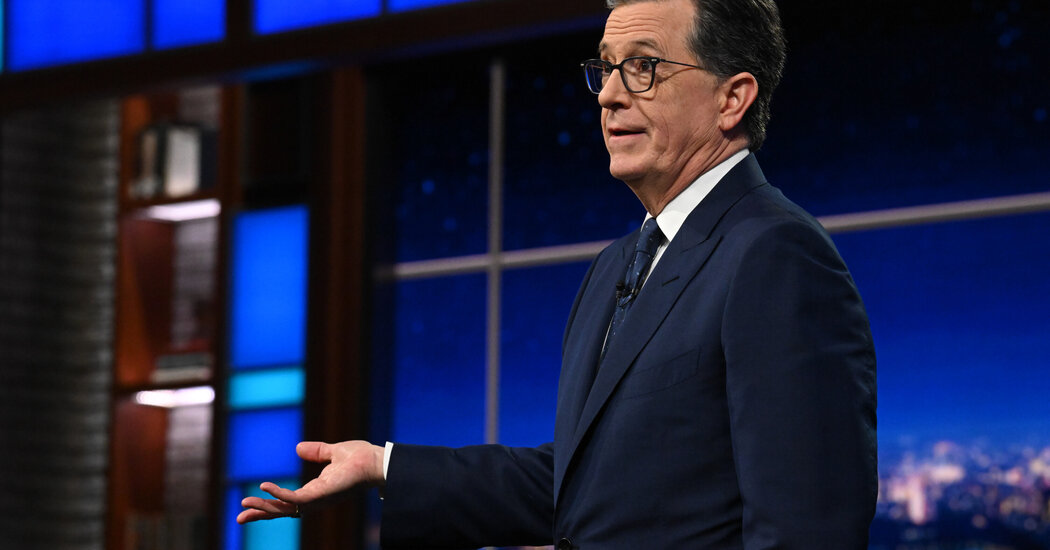
The historic Ed Sullivan Theater in the beating heart of New York City has always been far more than just a cavernous room filled with cameras, spotlights, and rows of seats; it is a sacred temple of American cultural history, a place where ghosts of legendary performances still seem to whisper from the rafters. On this particular evening, as Stephen Colbert stood on the very stage where musical revolutions were once born, the air was thick with a palpable sense of nostalgic reverence, heightened by the presence of Sir Paul McCartney himself. The legendary Beatle, embodying a lifetime of musical genius, presented Colbert with a beautifully framed, signed photograph of The Beatles performing on that exact stage during their earth-shattering American debut in 1964, a gesture that bridged sixty years of entertainment history in a single, quiet moment of mutual respect. Gasping in genuine awe, Colbert held the precious relic, his eyes shining with the unbridled excitement of a lifelong fanboy who could scarcely believe his own fortune. Naturally, the late-night host could not let the emotional weight of the moment linger without a touch of his trademark, self-deprecating wit; pretending to read the personalized inscription aloud to the roaring audience, he deadpanned, “To Stephen, you’re better than The Beatles, Paul McCartney,” instantly dissolving any potential solemnity into a wave of warm, shared laughter. It was a classic Colbert transaction: deep, heartfelt respect masked in a playful joke, proving that even when standing alongside the greatest cultural icons, the host remained grounded, approachable, and deeply human. This exchange was not just about a photograph; it was an acknowledgment of Colbert’s own place in the lineage of this theater, a passing of an invisible torch from a musical pioneer to a modern master of the television medium, leaving the audience suspended in a beautiful state of collective memory and joy as they witnessed two legendary figures celebrating one another and marking the commencement of an unforgettable, grand send-off for the host.
The emotional high of McCartney’s gift quickly transitioned into the delightfully absurd, surrealist comedy that has long defined Colbert’s creative voice, transforming the stage into a playground of cosmic science fiction as the broadcast neared its final moments. Suddenly, a roaring, celestial wormhole portal cracked open in the middle of the stage, threatening to swallow the entire production whole, a bizarre narrative twist that brought out an eclectic trio of rescuers: astrophysicist Neil deGrasse Tyson, cultural icon Andy Cohen, and Colbert’s longtime friend and mentor, Jon Stewart. The arrival of these three men felt like a physical manifestation of Stephen’s own multi-faceted personality, combining Tyson’s intellectual curiosity, Cohen’s cheeky appreciation for pop culture, and Stewart’s deep, brotherly affection. Jon Stewart’s oratory presence, in particular, carried a profound emotional weight, reminding viewers of the decades-long journey the two men had shared since their early days on The Daily Show, a bond forged in comedy clubs and writers’ rooms long before either became household names. As the mock-scientific anomaly pulsed with theatrical lights and dramatic wind machines, the trio stood at the edge of the abyss, trying to guide their friend through the cosmic threshold with a mixture of mock-serious scientific advice and hysterical exasperation. The wormhole served as a perfect, chaotic metaphor for the unpredictable nature of live television itself, a void that constantly demands to be filled with energy, creativity, and laughter, only to vanish into thin air once the credits roll and the studio lights finally go dark. Through this brilliantly silly plot device, Colbert and his friends invited the audience to lean into the absurdity of the moment, showing that even when faced with the metaphorical end of a chapter, the best response is always to surround yourself with old friends, laugh in the face of the unknown, and enjoy the wild, unpredictable ride of late-night show business as it carries us all forward into the bright, sparkling dawn of whatever wonderful, bright future adventures might await us next.
Just as Stephen wondered how he would survive this cosmic crisis, help arrived in the form of his trusted late-night rivals turned pandemic-era partners: the “Strike Force Five” cohort, comprised of Seth Meyers, Jimmy Kimmel, John Oliver, and the perpetually energetic “Handsome” Jimmy Fallon. This group of hosts, who had famously bonded during the grueling Hollywood writers’ strike to support their displaced staffers, showed up to offer their own hilariously unhelpful sage advice, showcasing the genuine, real-life camaraderie that exists behind the facade of late-night competition. “Without you, where will Americans turn to see a middle-aged white man make jokes about the news?” Seth Meyers quibbled with a smirk, perfectly capturing the self-aware, satirical spirit of their collective profession. When Colbert nervously questioned why his fellow hosts were not being pulled into the swirling vortex with him, Jimmy Kimmel offered a characteristically sharp, dryly humorous explanation, noting that one of those exact holes had actually opened at his own show the previous year, only to disappear after about three days, a clever, self-deprecating nod to ABC briefly pulling Jimmy Kimmel Live off the air following a minor public controversy. John Oliver, delivering his signature brand of grandiosely pessimistic comfort, added the final, hilarious touch by reminding Colbert that while the cosmic void might eventually come for all their shows, the important thing to remember was that tonight, it was going to eat Stephen specifically. This exchange highlighted the unique human beauty of their friendship: a group of highly successful, fiercely competitive men who, when the chips were down, chose to support, roast, and lift each other up with the kind of affectionate brutality that only true friends can manage, turning a raw moment of television transition into a genuine, joyful celebration of fraternal solidarity that reminded viewers of the deep human connections underlying the massive entertainment industry. This shared laughter was a beautiful demonstration of how true peer support can light up even the darkest moments, bringing genuine joy to everyone.
But instead of a cold, empty void of nothingness, the wormhole proved to be a vehicle of pure, unadulterated joy, sucking Stephen up and spitting him out directly into a high-octane, impromptu jam session centered around one of his all-time favorite songs, Elvis Costello’s infectious masterpiece, “Jump Up.” This musical interlude felt less like a scripted television segment and more like a spontaneous block party, as Colbert, clad in his classic suit, threw himself into the performance with the uninhibited energy of a man completely lost in the magic of the music. Sharing the microphone with him was none other than the brilliant Elvis Costello himself, whose gravelly, soulful voice perfectly complemented Colbert’s earnest vocals, alongside current bandleader Louis Cato and the beloved former bandleader Jon Batiste, who made a triumphant return to the stage that he had helped define for so many years. The reunion of Batiste and Colbert was a deeply moving sight for fans, as their decades-long chemistry instantly reignited, filling the room with an infectious, rhythmic joy that transcended the television screen and touched the hearts of everyone watching. To watch these incredibly talented musicians lose themselves in the groove, trading smiles and vocal licks with Colbert, was to witness the restorative, humanizing power of music in its purest form, a universal language that washes away the stress of the world and unites people in a single moment of shared, rhythmic breathing. It was a beautiful reminder that no matter how complex or cynical our political and social landscapes can become, there is still an essential, childlike happiness to be found in singing a great song with people you love, transforming the historic theater into a sanctuary of warmth, laughter, and unbeatable swing. The horns blared, the percussion echoed, and the pure, kinetic vibration of the instruments filled every corner of the room, washing away any remaining doubts or sadness with an ecstatic wave of pure, redemptive, late-night harmony that beautifully energized every single person present.
As the energy in the room reached a fever pitch, the musical celebration escalated into a historic, bucket-list moment when the legendary Paul McCartney stepped back onto the stage, joining Costello, Batiste, Cato, and Colbert for an unforgettable, show-stopping performance of The Beatles’ timeless anthem, “Hello, Goodbye.” This choice of song carried a profound, double-edged emotional resonance, serving as both a joyful celebration of new beginnings and a tender, nostalgic farewell to a beloved era of late-night television. As McCartney’s iconic voice filled the auditorium, the stage began to swarm with dozens of show staffers, writers, producers, camera operators, and lifelong friends, all pouring out from behind the scenes to join in the chorus, turning a slickly produced broadcast into a chaotic, beautiful, and deeply personal family reunion. The image of Stephen Colbert standing at the center of this sea of humanity, singing his heart out alongside a Beatle while surrounded by the hard-working men and women who had helped him build his show day after day, was a testament to his character as a leader and a colleague. There was no hierarchy on that stage in those final musical moments; there were only human beings united in song, swaying back and forth under the warm stage lights, celebrating the collective triumph of years of hard work, laughter, and shared trials. This grand, emotional crescendo humanized the massive television apparatus, reminding the audience that behind every joke, every interview, and every commercial break is a vibrant, dedicated community of real people who pour their hearts, souls, and lives into creating a tiny piece of joy for the world to enjoy every single night. These crew members, who typically exist only as nameless shadows behind massive cameras, were brought into the warm center of the spotlights where they belonged, recognized finally for their quiet, invaluable contributions. Their collective voices rose up to the rafters, echoing with the deep love, pride, and bittersweet satisfaction of an incredibly long and beautiful journey successfully completed together as one family.
When the last notes of the iconic song faded away, leaving a lingering, emotional silence in the historic theater, Colbert turned toward the control booth and gave Sir Paul McCartney a quiet, respectful nod to officially cut the master power. With a theatrical click, the lights vanished, and the grand, historic Ed Sullivan Theater was instantly transformed into a whimsical, miniature version of itself, beautifully encapsulated inside a delicate, musical snow globe that gently played the show’s familiar, jaunty theme song. But the final, most touching moment of human warmth came not from a legendary rock star or a high-tech visual effect, but from a sweet, quiet moment of ordinary life, as Colbert’s beloved Boykin Spaniel, Benny, padded into view to curiously sniff the tiny, glowing snow globe. In this single, endearing image, the entire grand spectacle of late-night television, the famous guests, the screaming crowds, the state-of-the-art cameras, and the legendary musical icons, was gently shrunk down to its true, human scale, reminding us that when the grand curtains finally fall and the applause dies down, we are all just quiet souls returning to the warm, comforting embrace of home and the simple love of our loyal pets. Benny’s curious sniff was the perfect, grounding punctuation mark to an extraordinary journey, a gentle reminder from Colbert that while the magic we make on our grand stages is beautiful and fleeting, the real treasures of life are the quiet, simple things that wait for us when the cameras stop rolling. Through this masterpiece of a finale, Stephen Colbert did not just say goodbye to an era; he gave his audience a heartfelt gift of laughter, connection, and a reminder that no matter how chaotic the world outside may become, there is always room for music, friendship, and the quiet comfort of a dog waiting for us at home. It was an exquisite, loving signature to a run of television that championed human decency and joy above all else, leaving us all with a lasting smile.