


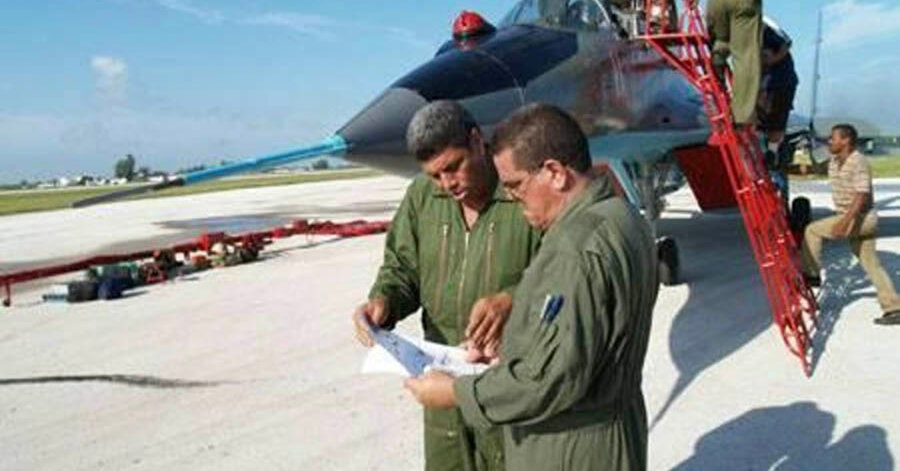
For nearly a decade, a man who once commanded the skies over Cuba walked the sunny streets of Florida as a ghost. To his neighbors, his family, and the casual observers he passed in Jacksonville, sixty-five-year-old Luis Raúl González-Pardo was merely another aging retiree visiting his sister, a quiet observer of the American dream who even paused to take tourist snapshots at the Kennedy Space Center in Cape Canaveral. Yet, hidden beneath this unassuming veneer of an ordinary traveler lay a heavy, closely guarded secret: for nearly thirty years, González-Pardo had been a highly trained pilot and lieutenant colonel in the Cuban Air Force, an institution deeply entangled with the island’s authoritarian regime. Traveling back and forth between Cuba and the United States since May 2017, he successfully bypassed American border screening by leaving his military profile completely blank on official immigration forms. The irony of his quiet existence deepened in 2024 when he was granted entry to the United States under a humanitarian parole program initiated by the Biden administration—a safe haven designed for those fleeing oppression, but utilized in this instance by a veteran of the very military apparatus responsible for that oppression. This fragile house of cards collapsed in November when federal authorities arrested him, exposing his systemic lies on immigration documents and initiating a legal reckoning that dismantled his quiet retirement and thrust his hidden past into the unforgiving light of a federal courtroom, where he eventually pleaded guilty in January to immigration fraud.
To understand the profound shockwaves of González-Pardo’s arrest, one must return to a dark, overcast day in February 1996, an afternoon that left a permanent scar on the heart of the Cuban-American exile community. On that day, four humanitarian volunteers—three American citizens and one U.S. resident, all of Cuban descent—took to the skies in unarmed, civilian Cessna aircraft under the banner of “Brothers to the Rescue.” Their mission was born of pure empathy: to fly over the dangerous, choppy waters of the Straits of Florida, scanning the horizon for the desperate, sun-baked rafts of their countrymen seeking freedom. But their humanitarian endeavor was met with devastating, state-sanctioned violence when Cuban military fighter jets intercepted them. In an instant, two of the civilian planes were obliterated by military missiles over international airspace, sending the four volunteers to watery graves and sending shockwaves of grief and fury through South Florida. While a third Cessna, piloted by the group’s founder José Basulto, narrowly managed to evade the pursuit and land safely in Miami, the Cuban government aggressively defended the lethal strike, claiming the light aircraft had repeatedly violated Cuban airspace to scatter anti-regime leaflets over Havana. The tragedy became a symbol of raw, unresolved injustice, an open wound for a community that watched the perpetrators remain safe and untouchable behind the protective borders of the island nation, leaving families to mourn in silence for nearly three decades.
For years, the official narrative surrounding the shoot-down remained frozen in time, with only two pilots and their commanding officer indicted by a U.S. federal court in 2003—men who remained permanently out of reach in Cuba, shielded from justice. But for Luis Domínguez, a relentless investigator working for the Foundation for Human Rights in Cuba, the passage of time was not an excuse to forget, but a call to search deeper into the shadows. Driven by a quiet, consuming obsession to bring closure to the victims’ families, Domínguez spent years acting as a civilian detective, painstakingly piecing together fragments of history that others had long abandoned. His breakthrough arrived in 2014 when he uncovered an obscure 1996 report compiled by the United Nations’ International Civil Aviation Organization, an official investigation into the tragedy that had sat quietly in the public record. For Domínguez, this document, which included raw radio transmission transcripts between the MiG pilots and their ground command on that fateful February afternoon, became his “Bible.” The translated radio communications revealed a terrifying, high-stakes game of cat-and-mouse, documenting how the military pilots eagerly hunted their civilian targets. As Domínguez read the cold, printed lines of dialogue—including the moment pilot “22” called back to base confirming visual contact with Basulto’s blue-and-white Cessna, only to lose it minutes later before being ordered to suspend the mission—he realized the official circle of those involved was far wider than the world believed.
Armed with the transcripts, Domínguez realized the pilots had made a critical, human error in the heat of the chase: one of them had momentarily discarded his military call sign, calling out to a colleague named “Gual.” This tiny fragment of a name became the thread that Domínguez pulled with infinite patience, embarking on a meticulous campaign of reaching out to former Cuban Air Force pilots who had defected to the United States over the years. Building trust through shared histories and quiet conversations, Domínguez slowly assembled the puzzle, eventually learning that the voice behind one of those fighter jets belonged to José Fidel Gual Barzaga, and that the second jet pursuing Basulto’s fleeing Cessna had been piloted by none other than Luis Raúl González-Pardo. The investigator’s disbelief turned to active pursuit when he discovered that this very same military pilot had not only traveled to Florida to visit family, but had even posed for tourist photos at iconic American landmarks like the Kennedy Space Center—standing freely under the very sky where he had once hunted American citizens. Armed with booking details, travel histories, and photographic evidence, Domínguez pushed his findings to federal investigators and reached out to Florida politicians, demanding to know how a man so intimately linked to a notorious tragedy could be permitted to walk American soil under the guise of an innocent migrant.
The legal trap, which began as a relatively straightforward immigration fraud case with a maximum ten-year sentence and a scheduled sentencing date of May 28, snapped shut with devastating force. The federal government unveiled a sweeping new indictment that dramatically elevated González-Pardo’s legal jeopardy, naming him as a co-defendant alongside former Cuban President Raúl Castro and four other members of the Cuban Air Force. The charge they face is nothing less than conspiracy to commit murder, a monumental accusation that carries the potential penalty of life in prison and represents the first major legal action in the Brothers to the Rescue case in over two decades. According to the indictment, although González-Pardo piloted one of the lethal MiG fighter jets tracking the civilian planes on that tragic afternoon, he did not pull the trigger himself. Nevertheless, his physical presence on American soil changes the entire landscape of this international legal battle; while his co-conspirators remain insulated within Cuba’s borders, González-Pardo sits in a local jail, represented by attorney Miguel Rosada, who has declined to comment on the escalating charges. As the sole defendant within the jurisdiction of the United States court system, his impending trial carries immense historic weight, offering a rare, unprecedented opportunity to finally put the details of that tragic day on the public record through the testimony of someone who was actually in the cockpit.
The indictment has brought a profound sense of vindication to South Florida’s exiled Cuban community, serving as a powerful reminder that history, though easily ignored by some, is rarely forgotten by those who suffer its consequences. The public outcry has been amplified by prominent Florida lawmakers, including Senator Marco Rubio, who previously demanded a rigorous investigation into how a former military operative could exploit humanitarian parole programs intended for victims of oppression. In their joint communications to federal officials, these representatives fiercely asserted that those who participated in the transnational persecution of Cuban-Americans and the oppression of innocent civilians must never find safe harbor within the United States. For investigators like Luis Domínguez, the arrest and subsequent indictment represent the culmination of a decade of solitary, patient labor, proving that the search for justice is a marathon, not a sprint. As González-Pardo awaits his fate behind bars, the legal proceedings offer more than just a punishment for immigration deceit or a potential life sentence; they represent a long-overdue accounting for the four lives lost in the Florida Straits, signaling to the world that even the most deeply buried secrets eventually rise to the surface, and that the sky has a long memory.