

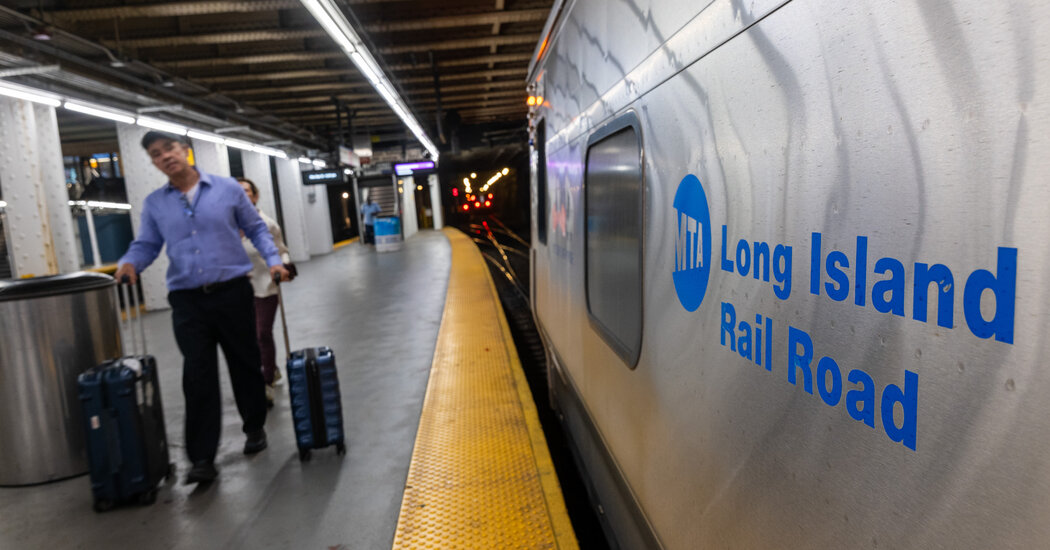
Summarize and humanize this content to 2000 words in 6 paragraphs in EnglishThousands of workers for the Long Island Rail Road walked off the job early Saturday morning, staging the first strike in more than 30 years for America’s busiest passenger railway and grinding service to a halt.After three years of failed contract negotiations, two federal interventions and a volley of last-minute bargaining, unions representing about half of the work force were preparing to take to the picket line to protest what they called insufficient wage increases.Five unions representing more than 3,500 workers — including engineers, signalmen and machinists — called the strike after contract discussions with the Metropolitan Transportation Authority, the state agency that runs the railroad, fell apart.The strike sets up a cascade of travel woes for the more than 270,000 daily riders who rely on the service to travel between New York City and Long Island, a sprawl of suburbs and bedroom communities where many of the region’s workers live.It also comes as Gov. Kathy Hochul, a Democrat, seeks re-election later this year. The governor, who lost Long Island in the previous election, is being challenged by the Nassau County executive, Bruce Blakeman, a Republican with close ties to the region.To mitigate the shutdown, the M.T.A. said it would provide free shuttle buses between six locations on Long Island and two subway stations in Queens.But the service will be unable to accommodate all the riders who rely on the railroad, and it won’t begin until Monday, leaving many scrambling for weekend travel alternatives.On Saturday, the New York Mets are set to face the Yankees at Citi Field in Queens, where thousands of Long Island-based fans were expected to arrive by rail.If a deal is not reached by Monday morning, buses will shuttle riders between the Bay Shore, Hicksville and Mineola L.I.R.R. stations, as well as Hempstead Lake State Park near the Lakeview station, and the A train stop at Howard Beach-JFK Airport. And buses from the Huntington and Ronkonkoma stations will take riders to and from the F train stop at Jamaica-179 Street.The buses to Queens are expected to run every 10 minutes from 4:30 a.m. to 9 a.m., and afternoon shuttles back to Long Island could run from 3 p.m. to 7 p.m. They will be able to handle up to 13,000 riders during the morning rush and another 13,000 in the evening.There will be a limited number of buses running in the non-peak direction at some of the stations.The Long Island Rail Road carried 82 million customers last year. Most were weekday commuters on their way to jobs in New York City, but an increasing number of passengers are using the service on weekends.There had not been a strike on the railroad since 1994, when a two-day suspension shut down the service for about 110,000 daily riders.Long Island residents have become even more dependent on jobs in New York City since the coronavirus pandemic, said Tom Wright, the president of the Regional Plan Association, an urban planning think tank.More than 300,000 Long Island residents work in New York City, according to a 2022 report by the group.The state comptroller’s office said on Friday that the strike could cost the region $61 million a day in lost economic activity.Discussion between the unions and management broke down on the final day of negotiations.The unions were seeking a retroactive 9.5 percent wage increase covering the last three years — the same deal the M.T.A. offered several other transit and civil service unions in recent months. But they were also seeking a 5 percent raise in the current year, a demand that exceeded what the M.T.A. has offered to other unions.The M.T.A. countered with a 3 percent raise for 2026, plus a lump-sum cash payment, which it said would avoid upending negotiations with more than 80 other unions.By Friday afternoon, the two sides were about 1 percentage point apart on wage increases, but were unwilling to compromise further.Leaders of the negotiating unions have argued that their workers don’t make enough money to keep up with the cost of living in one of the country’s most expensive metro areas. They have not received raises since 2022.Cash compensation for members of the five holdout unions averaged over $136,000 in 2025, according to M.T.A. figures, making them among the highest-paid rail workers in the nation.Earlier in negotiations, the M.T.A. had also sought to eliminate a number of work rules that often require higher pay for certain tasks. The unions declined to do so.For instance, if an engineer drives a diesel train at the start of a shift but is asked to switch to an electric train in the same day, the M.T.A. must compensate that worker with two days’ pay. If, on the same day, the engineer is asked to switch from driving passengers to driving a train back to a yard for maintenance or storage, that worker is entitled to a third day of pay.These penalty payments added almost 15 percent to the average engineer’s compensation in 2024, the M.T.A. said.The rail service has an annual operating budget of $2.2 billion, and labor accounts for nearly three-fourths of that budget.Unlike much of the M.T.A. work force, which is prevented from striking because it is governed by different rules, Long Island Rail Road workers are covered by a 1926 federal law called the Railway Labor Act.The law was designed to prevent major service disruptions by requiring mediation and an extended review period before a strike is authorized.But in an unusual move, the federal agency that oversees such disputes, the National Mediation Board, last year released the unions from mediation, a decision that cleared the path for a possible walkout.A strike was postponed twice within the past year, after the unions requested the intervention of two federally appointed review panels. The three-person panels, which were appointed by President Trump, said the unions should be paid more than what the M.T.A. was offering, but their suggestions are not binding.The M.T.A. said it made an offer that matched the dollar-value of the review boards’ recommendations, but the unions said they were seeking a higher percentage-based raise, rather than a one-time signing bonus.