


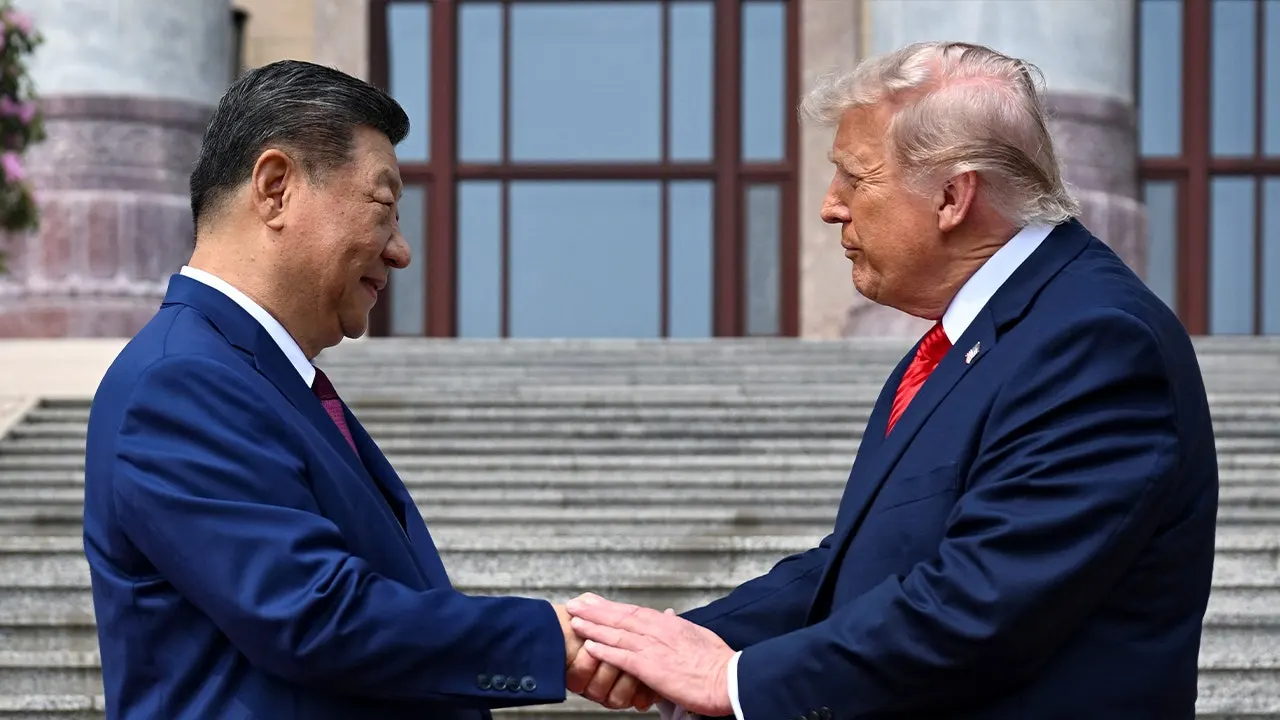
President Donald Trump’s arrival in Beijing for his high-stakes summit with Chinese President Xi Jinping felt like the start of a blockbuster movie, where two global powerhouses stepped into the spotlight, microphones humming and cameras flashing. It was Thursday local time, and from the moment Trump walked into that ornate room, the air was thick with anticipation. He didn’t dive straight into the usual political clashes or tariff talking points; instead, he flashed that signature warm smile and began with praise that caught everyone off guard. “We’ve had a fantastic relationship,” Trump said, his voice carrying the weight of reminiscence. He pointed out that theirs was the longest presidential pairing between the U.S. and China, and chuckled about how they’d always smoothed over problems quickly. Looking Xi right in the eye, he declared, “We’re going to have a fantastic future together.” It wasn’t just diplomatic speak; there was a genuine personal touch, like two old friends reuniting after a long time apart. As someone observing from the sidelines, you couldn’t help but think of Trump’s knack for personal diplomacy—it’s like he treats world leaders as buddies at a poker table, keeping things amiable even when the stakes are sky-high. This tone set the stage, making the room feel less like a negotiation battleground and more like a hopeful exchange between giants ready to build something grand.
Xi Jinping, ever the composed counterpart, responded with his own eloquent nod to cooperation, his words translated smoothly as he stood there in his tailored suit, exuding calm authority. He started by congratulating America on its 250th anniversary of independence—a nice, reconciliatory gesture that acknowledged the U.S. milestone—and wished the American people well. “We have more common interests than differences,” Xi emphasized, his voice steady and reassuring, like a wise mentor guiding a student. He painted a picture of mutual prosperity: success for one nation boosts the other, and a stable relationship benefits the entire world. It was a profound reminder that in the grand scheme of global affairs, cooperation yields wins for everyone, while confrontation leads to shared losses. Xi made it clear they should be partners, not rivals, working together to thrive in this “new era.” He even invited Trump to steer the “giant ship” of U.S.-China relations toward a historic 2026, a year that could mark the beginning of a fresh chapter. Listening to Xi, I imagined the weight on his shoulders—juggling internal pressures, economic demands, and international scrutiny—yet his words brimmed with optimism, humanizing the exchange by focusing on shared humanity rather than cold geopolitics.
What really brought a buzz to the room was Trump’s entourage, a high-powered delegation of American business titans that underscored the administration’s laser focus on economic ties amid lingering tensions. Trump beamed with pride as he introduced them, saying, “We asked the top 30 businessmen in the world, and every single one said yes.” It felt like a show of strength, a reminder that behind the diplomatic dance, American innovation and enterprise were poised to drive real change. Trump highlighted how these leaders—shapers of industries from tech to farming—represented the pinnacle of U.S. creativity and entrepreneurship. You could sense the excitement in the air; this wasn’t just a photo op; it was a signal that despite the noise of trade wars and geopolitical rumbles, the U.S. was all in on leveraging commerce to bridge gaps. As a journalist covering this, I couldn’t help but reflect on how Trump’s approach mixes big personalities with big business dreams, turning what could be adversarial into a collaborative feast.
Diving deeper into the delegation, it read like a who’s who of American corporate royalty, each name evoking stories of innovation and grit that many of us admire in our daily lives. Imagine Tim Cook from Apple, the pioneer who put smartphones in everyone’s pocket; Larry Fink of BlackRock, the financial wizard shaping retirement futures for millions; Stephen Schwarzman from Blackstone, the dealmaker turning investments into empires; Kelly Ortberg leading Boeing, soaring through the skies with aircraft that connect us globally; Elon Musk of Tesla and SpaceX, the visionary dreaming of electric cars and rockets to Mars; David Solomon from Goldman Sachs, navigating the turbulent seas of finance; and Cristiano Amon from Qualcomm, powering the digital backbone of our world. These weren’t faceless suits—they were human stories of ambition, from Musk’s late-night tweets to Cook’s quiet drive for privacy innovations. Flown to Beijing at Trump’s side, their presence humanized the summit, showing that at its core, this was about people—engineers inventing the future, executives betting on global stability, all hoping their efforts could chill the icy tensions and spark mutual growth between superpowers.
White House officials had sketched out their vision ahead of the trip, promising “more good deals” that would echo Trump’s promise of American prosperity, and the talks were primed to cover everything from aerospace to agriculture, energy to high-tech security. A senior official hinted at frameworks involving billions—think double-digit billions in commerce—with potential commitments from China on buying American aircraft, farming goods, and more. This “Board of Trade” and “Board of Investment” idea emerged as a potential anchor, a structured way to foster steady exchanges without the drama of constant disputes. It was refreshing to see the emphasis on tangible benefits, like imagining clearer pathways for American farmers to sell soybeans to China or engineers collaborating on future tech. Yet, beneath the optimism lurked the reality: years of Trump’s tariffs on Chinese goods, accusations of unfair practices from Beijing, and criticisms of past U.S. policies that boosted China into the global fold. Trump’s tariffs, maintained into his second term, had stung China’s exporters, fueling worries of another trade war. He often railed against Beijing’s closed markets, arguing they’d profited from open U.S. doors without reciprocity. So, while the dealmaking buzz was loud, it felt like a deliberate pivot toward stability, a human effort to mend frayed economic threads between these two interdependent nations.
In the end, Trump’s personal praise for Xi as a “great leader” and his friendship-centric diplomacy shone through as a calculated charm offensive, much like his dealings with other figures—Russian President Vladimir Putin or North Korea’s Kim Jong-un—where rapport becomes a tool in the negotiation toolkit. The bilateral dialogue extended to broader issues: ongoing talks on Iran sanctions, artificial intelligence rulings, and security matters that tug at the world’s fabric. Whether this warm start translates to concrete wins—like slashed tariffs or expanded markets—remains anyone’s guess, but it’s a testament to Trump’s unorthodox style: blend flattery with firmness, prioritize personal bonds, and let the business crowd lead the charge. As the meeting unfolded, with Xi looking forward to steering their shared “giant ship,” you sensed a delicate balance—hopeful yet cautious. For folks back home, glued to headlines, it highlighted how global relations aren’t just about policies; they’re about people bridging divides, finding common ground in a turbulent world. This summit could very well redefine U.S.-China ties for generations, turning adversaries into allies through sheer human will and economic savvy. And in a time when divisions feel insurmountable, watching these leaders emphasize cooperation over conflict is a reminder that, with effort, even giants can forge paths forward.