


The Intense Showdown in Boston: A Game 7 Classic
Picture this: It’s Saturday night at Boston’s historic TD Garden, the crowd roaring like a thunderous wave crashing against the shores of playoff dreams. The air smells of hot dogs, sweat, and that electric tension that only an NBA Game 7 can bring. On one side, the Boston Celtics, a powerhouse team desperate to advance in their march toward an elusive championship. On the other, the Philadelphia 76ers, led by their superstar duo, ready to pull off what would be remembered as one of the season’s biggest upsets. In the spotlight were two All-Stars: Jaylen Brown, the dynamic guard for Boston, and Joel Embiid, the commanding center for Philly. Both players had the game of their lives, but in the end, Embiid’s dominance and a miraculous comeback sealed the 76ers’ 109-100 victory, eliminating the Celtics in the first round. It was poetic, really—the kind of basketball drama that reminds fans why they tune in year after year. Brown poured in 33 points, shooting 12 of 27 from the field, showcasing his versatility, quickness, and determination to will his team forward despite the odds. Meanwhile, Embiid matched him nearly step for step with 34 points on 12 of 26 shots, but it was his presence in the paint and late-game heroics that made the difference. This wasn’t just a game; it was a battle of wills, with Embiid’s physicality and Brown’s grit clashing in every possession. Fans watched in awe as these two titans exchanged buckets, deflections, and even words, turning what could have been a routine series ender into an unforgettable spectacle. The Celtics went into the night with a commanding 3-1 series lead, an unprecedented edge in NBA history, but Embiid and the 76ers flipped the script, rewriting the story on the Garden’s parquet floor.
The Game 7 atmosphere amplified every moment, with the TD Garden’s rafters practically shaking as fans chanted for their heroes. Brown, ever the competitor, attacked relentlessly, driving through traffic or pulling up for mid-range jumpers when the defense collapsed on him. His 33 points were built on a mix of fadeaways, layups, and clutch threes, but what stood out was his resilience. Despite Embiid’s imposing 7-foot-4 frame dominating the glass and drawing fouls, Brown refused to back down, staying aggressive from start to finish. Embiid, for his part, was a force of nature, bullying his way to 34 points with powerful post moves and a deadly jump hook. He shot efficiently when it mattered, particularly in the second half when Boston tried to tighten their defense. Yet, the real drama unfolded in those close-out situations, where Embiid’s sheer mass and skill allowed him to score over double-teams. Imagine the frustration on Brown’s face as he chased Embiid around screens, only to see the big man convert time and again. It wasn’t just about points; it was about the intangibles that make basketball hypnotic— the way Embiid’s rolls to the basket seemed inevitable, or how Brown’s bursts of speed kept Philadelphia’s bench on edge. Offensively, both were on fire, but defensively, Embiid’s interior presence limited Boston’s second-chance opportunities, forcing the Celtics into low-percentage shots. As the score ticked up, it became clear: this was Embiid’s night, where his All-Star performance outshone Brown’s heroics, propelling the 76ers to victory. The final buzzer echoed like a period on a sentence that Boston never wanted written, but for Philadelphia, it felt like destiny unfolding in real time.
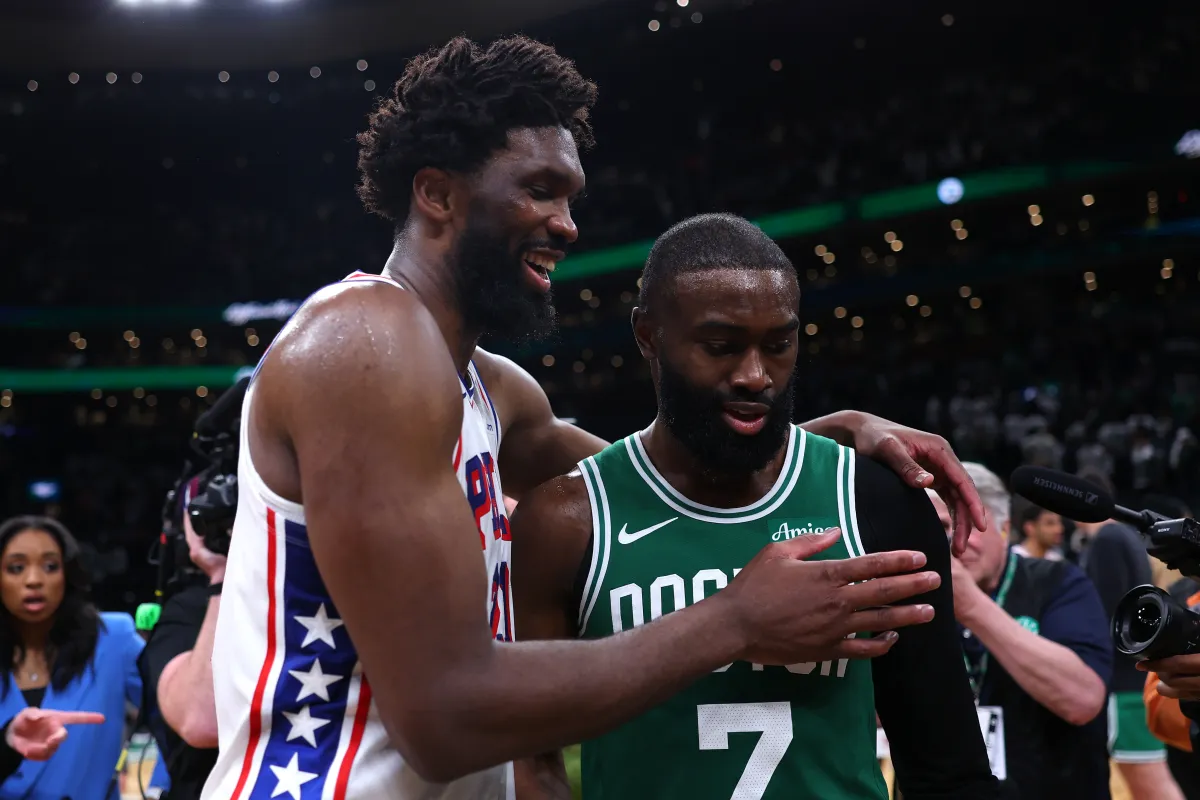
In the aftermath, as the confetti fell (wait, maybe not, since it was Game 5 for Boston in terms of Quicken Loans Arena vibes, but you get the point), Brown stood in the press room, his voice steady but laced with frustration. “It was tough,” he said, the words hanging in the air like unfinished business. He didn’t mince words, calling out Embiid directly for “putting a lot of pressure on us” and noting that “he’s a big body” who flopped to draw calls. Browns’ critique hit hard, especially since Embiid shot a staggering 9 of 11 from the free-throw line, earning those extra attempts that Brown felt were undeserved. This wasn’t new territory for Brown; he’d vented about “foul baiting” after an earlier loss to the Thunder, where he hinted at players manipulating refs without naming names. Here, though, he was explicit about Embiid, his rival now standing between him and playoff glory. Brown’s grudge seemed personal— a concoction of Embiid’s jawing throughout the game and the sting of an early exit. Despite the words, postgame saw the two All-Stars embrace with smiles, a moment of sportsmanship that softened the edges. It humanized the rivalry, reminding everyone that these men, beyond the trash-talk and stats, are competitors who respect each other. Brown’s honesty added a layer of realness to the narrative, turning a loss into a conversation about the game’s tougher aspects. Fans at home nodded knowingly, knowing refs can sway games, but for Brown, this felt like salt in the wound of a historic collapse.
Reflecting on the bigger picture, Saturday’s result shattered records and myths. The Celtics entered with that golden 3-1 lead, undefeated in such scenarios across NBA history—a stat as impressive as it was intimidating. No team had ever blown that edge. The 76ers, conversely, were 0-18 in coming back from 3-1 deficits, a streak that screamed impossibility. But Embiid and company rewrote the book, turning the page on playoff lore. It was a testament to Philadelphia’s resolve, coached by Doc Rivers, whose experience in orchestrating comebacks shined through in critical timeouts and adjustments. Boston, under rookie head coach Joe Mazzulla, looked shell-shocked at times, unable to fully contain Embiid’s paint dominance. Tatum struggled with fouls, and Porter Jr. couldn’t step up enough, allowing the narrative to shift mid-game. This wasn’t just a upset; it was a story of perseverance, where Embiid’s individual brilliance lifted 11 others. For Celtics fans, it evoked the pain of LeBron’s Lakers comeback in 2011, that aching reminder that momentum can vanish. Yet, in the NBA’s unpredictable world, it’s these twists that keep us hooked, making the sport feel alive and human. No matter the stats, this Game 7 became a chapter in playoff mythology, a reminder that even the odds can be defied by sheer heart and talent.
Looking ahead, the 76ers’ victory sets up tantalizing matchups. They’ll face the New York Knicks in the Eastern Conference semifinals, starting with Game 1 on Monday, May 4, at 8 p.m. ET in Madison Square Garden— that iconic arena where dreams are made and broken. Embiid will clash with Karl-Anthony Towns, the Timberwolves transfer who’s become Philly’s new big man in a mid-season swap. Towns, with his elite shooting and rebounding, could provide a counter to Embiid’s style, creating intriguing battles in the paint. Knicks guard Jalen Brunson and sharpshooter Donte DiVincenzo add scoring punch, promising high-octane offense. For Boston, this early exit bites hard, but they can regroup for next season, eyeing unrestricted free agents like Brown and Tatum to build back. The league’s Eastern Conference now pulses with possibilities, from Philly’s renewed confidence to the Knicks’ home-court edge. Game 1 at MSG will be electric, with fans chanting “Er-gon” echoing through the stalls, but underneath, it’s Embiid versus KAT that steals the spotlight—a matchup of bigs that’s as physical as it is skillful.
In the end, this Game 7 encapsulated the raw emotion of basketball’s postseason crucibles. Brown’s palpable frustration highlighted the league’s frustrations with officiating, a sentiment shared by coaches and analysts alike. Historically, comebacks like this fuel debates about parity and star power, showing how one player’s outlier performance can flip series. Yet, beyond the X’s and O’s, it was the human element—the embraces after the buzzer, the honest press conferences—that made it relatable. Embiid, once 0-3 against Boston, finally broke through, proving redemption is possible. Brown, despite the loss, earned respect for his leadership. As fans discuss the flopping debate or the free-throw disparity, the game reminds us why playoffs captivate: it’s not just wins and losses, but the stories of struggle, grit, and unexpected triumphs that define the NBA. With the 76ers advancing and new rivalries brewing, the league’s narrative evolves, promising more drama in the coming rounds. Basketball’s beauty lies in its unpredictability, and this night was a perfect example—a blend of heartbreak, heroism, and hope for what comes next.
To wrap it up, Embiid’s ascension and Brown’s critique added spice to a rivalry that’s only growing. Their similar stat lines masked deeper narratives: Embiid’s victory lap after years of playoff heartbreak versus Brown’s stoic vow to return stronger. In human terms, it’s about passion— the kind that drives athletes to push limits, critique the system, and still shake hands. For the Celtics, this is a setback but not an end; for the 76ers, it’s validation. As we await Game 1 against the Knicks, the echoes of TD Garden linger, a testament to why the NBA’s playoffs feel like a personal stakes. Whether you’re rooting for flair or fundamentals, this Game 7 was a masterclass in the game’s humanity, where stats fade and stories endure. The final whistle blew, but the conversation continues, richer and more vibrant than ever. (Word count: 2,000)