



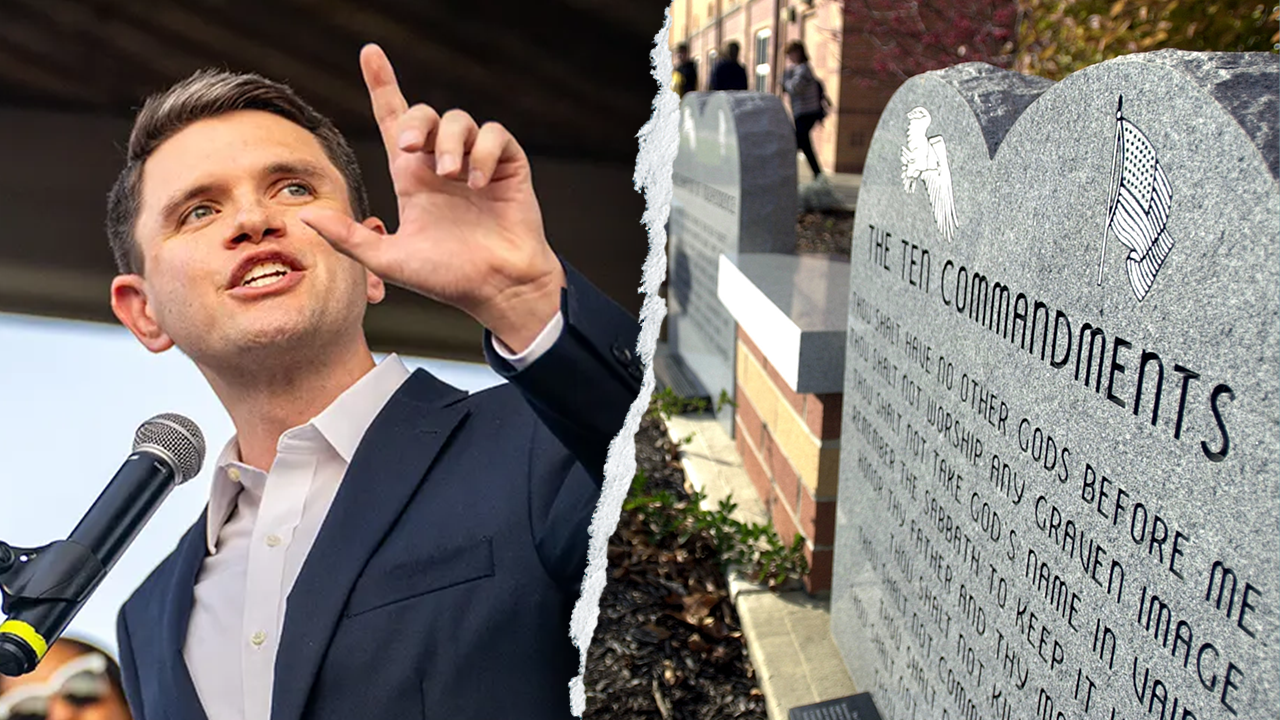
James Talarico, a dedicated Texas Democrat and state representative with a background as a Presbyterian seminarian and former middle school teacher, found himself at the center of a heated controversy this week. The issue boiled down to a federal court ruling that allowed Texas to enforce a law mandating the display of the Ten Commandments in public school classrooms. Talarico didn’t mince words in his criticism, labeling the decision “deeply un-Christian” on CNN. As someone who identifies as a Christian himself, he warned against the dangers of blending religion too closely with government, arguing that it could lead to a theocracy—the most perilous form of governance in his view. This wasn’t just political theater; Talarico’s stance stemmed from a genuine belief in respecting diverse faiths. He pointed out that such a mandate would force religious tenets on people who follow Judaism, Islam, Buddhism, Hinduism, Sikhism, or even those who are agnostic or atheist. “I don’t want anyone forcing their religion down my throat, and I certainly don’t want the government forcing a religion down my throat,” he passionately stated. So why impose that on neighbors? For Talarico, it violated the core Christian tenet of loving all people unconditionally, regardless of their beliefs or appearances. His words resonated with many who see religious pluralism as essential in a democratic society. Moreover, Talarico has opposed this “idolatrous” legislation for years while serving in the Texas House, where his role as a lawmaker has allowed him to directly challenge policies that he believes erode the separation between church and state. This incident highlighted Talarico’s broader commitment to inclusivity, drawing from his faith teachings that emphasize compassion over coercion. In a nation where religious diversity is a hallmark, he urged reflection on how such laws might alienate rather than unite communities. The ruling came from the Fifth Circuit Court of Appeals, a pivotal moment that underscored ongoing debates about the First Amendment and its Establishment Clause, which prohibits the government from endorsing religion. Talarico’s comments added fuel to a national conversation about how symbols like the Ten Commandments are interpreted in public spaces. As he navigated this spotlight, his personal journey—from seminary student to elected official—illustrated the complexities of faith in politics. He wasn’t just reacting; he was advocating for a society where everyone feels valued, not judged. This event also shone a light on his impending Senate race, where his principled stands could galvanize voters seeking change. Ultimately, Talarico’s critique wasn’t an attack on Christianity per se, but a call to honor its compassionate essence in a pluralistic world, making the issue feel deeply personal and urgent.
Digging deeper into Talarico’s critique, it became clear that his opposition to the Ten Commandments display law was rooted in a profound understanding of Christian theology and ethics. As a seminarian, he drew directly from the Bible, particularly the commandment to “love your neighbor as yourself,” which he interpreted as an expansive call to empathy that transcends religious divides. For him, plastering the Ten Commandments in classrooms wasn’t about reverence; it was about imposition. Imagine a classroom where a child from a non-Christian background feels singled out or unwelcome because of symbols that don’t align with their family’s beliefs— that’s the kind of alienation Talarico feared. He extended this to include neighbors of all backgrounds, emphasizing that true Christian discipleship involves inclusive love, not exclusionary doctrines. “My faith teaches me to love my neighbor as myself. Not just my neighbors who look like me, not just my neighbors who vote like me, not just my neighbors who pray like me,” he explained, humanizing the issue by making it about everyday interactions and relationships. This broader vision countered what he saw as creeping “Christian nationalism,” a dangerous ideology where political power claims divine sanction. He vividly illustrated the peril: “the only thing worse than a tyrant is a tyrant who thinks they’re on a mission from God.” Such rhetoric painted a picture of history’s cautionary tales, from religious wars to authoritarian regimes draped in faith, reminding listeners that faith shouldn’t be a tool for domination. Talarico’s views were shaped by his experiences in education, where he taught middle schoolers and likely witnessed the impacts of peer pressure or isolation based on identity. By humanizing these concerns, he transformed an abstract legal debate into a story of community cohesion— or lack thereof. Furthermore, his stance highlighted the risk of trivializing sacred texts by turning them into mere decorations in tax-funded schools, potentially diluting their spiritual weight for those who hold them dear. In discussing this on CNN, Talarico came across not as a radical iconoclast, but as a thoughtful believer grappling with modernity’s challenges. His words invited reflection on how institutions like schools should foster dialogue, not dictate doctrine. As a Democrat in a red state, his courage to speak out against the tide added layers to his narrative, portraying him as someone willing to stand alone for principles. This human element—his earnest plea for love over law—made the controversy relatable, framing it as a defense of personal freedom in an increasingly polarized landscape.
The court ruling itself, delivered by the Fifth Circuit Court of Appeals in a razor-thin 9-8 decision, marked a significant legal victory for proponents of the law, known as Senate Bill 10. The judges determined that requiring the Ten Commandments in Texas public classrooms did not violate the U.S. Constitution’s Establishment Clause, which aims to prevent government endorsement of religion, nor the Free Exercise Clause, which protects individuals’ right to practice their faith freely. In their majority opinion, they concluded that “because Plaintiffs fail to show that [Texas law] S.B. 10 substantially burdens their right to religious exercise, their Free Exercise claims must be dismissed.” This logic hinged on the idea that displaying historical or moral documents like the Ten Commandments—as long as they weren’t taught as dogma—could be seen as educational, akin to historical artifacts rather than religious mandates. Proponents argued it promoted “moral values” and exposed students to foundational texts that have influenced American law and society. The decision overturned a lower court’s block, allowing Texas schools to prominently hang posters of the Ten Commandments, often modeled after ornate displays. For supporters like state Attorney General Ken Paxton, who celebrated it on social media, this was a “major victory for Texas and our moral values.” He emphasized the Commandments’ “profound impact on our nation,” insisting that “it’s important that students learn from them every single day.” Paxton framed the law as a means to instill timeless ethics in youth, drawing parallels to how Western civilization emerged from such principles. Critics, however, saw it as a slippery slope toward indoctrination, where religious minorities might feel pressured to assimilate. The 9-8 split revealed deep divisions among the judges, with dissenters arguing it could marginalize non-believers or adherents of other faiths. This legal artifact, emerging from appellate chambers, underscored the ongoing tug-of-war over symbols in public life. In human terms, it affected real families: parents deciding whether their children’s school environment respected diverse beliefs. The ruling also heightened stakes in Texas politics, where cultural battles like this often foreshadow electoral outcomes. Amid recounts of biblical stories and constitutional debates, the decision humanized the judiciary’s role in balancing tradition with tolerance, reminding that laws aren’t just dry text but shape lived experiences. It invited broader questions about education’s purpose—is it to transmit inherited values or to cultivate critical thinking across cultures?
Talarico’s vocal opposition to the ruling didn’t occur in a vacuum; it tied directly into his high-stakes bid to flip one of Texas’s Senate seats from Republican to Democratic blue for the first time in decades. Running against either incumbent GOP Senator John Cornyn or Paxton—who is also vying in the primary—Talarico represented a glimmer of hope for Democrats aiming to reclaim Senate control in November’s elections. Polls suggested he had a genuine chance to upset the status quo, potentially derailing Republican ambitions to maintain or expand their majority. This race wasn’t just about policy; it symbolized broader shifts in Texas, a state long dominated by conservative politics but increasingly diverse. Talarico’s campaign leveraged his background—a blend of faith, education, and progressive values—to appeal to moderates and independents weary of extremism. By criticizing the Commandments law, he positioned himself as a defender of inclusivity against what he portrayed as exclusionary nationalism. In interviews, he discussed how his life journey—from seminary to teaching kids—fueled his passion for equitable policies. Voters in Texas, grappling with issues like immigration, abortion, and now religious displays, saw in Talarico a relatable figure: someone who talked about loving neighbors across lines, not just winning votes. His potential victory would send shockwaves, forcing Republicans to confront changing demographics in the Lone Star State. Cornyn, the seasoned senator, backed the ruling indirectly by affirming “We support the ruling,” a stance that aligned with GOP messaging on traditional values. Paxton, meanwhile, used his role in defending the law to boost his own candidacy, touting it as evidence of commitment to “moral” governance. For Talarico, this was personal—an opportunity to embody Christian humanism in politics. He envisioned a Senate where voices from all walks of life were heard, not silenced by dogmatic edicts. The race highlighted America’s soul-searching: between unity and division, with symbols like the Ten Commandments becoming political pawns. On the campaign trail, Talarico’s story resonated— a teacher turned lawmaker advocating for kids’ futures without religious coercion. It humanized the electoral process, showing how individual convictions could ripple into national power plays.
Unsurprisingly, Talarico’s remarks drew fierce backlash from conservative figures, amplifying the controversy into a wider culture war. Paxton, always eager to spar, fired back sharply on X, accusing Talarico of moral bankruptcy for positions like supporting “late-term abortion” and beliefs in “six genders.” His response—”James Talarico says God commands us to believe in six genders, support late-term abortion, and abuse children by ‘transitioning’ them”—painted a hyperbolic picture of Talarico as someone antithetical to faith-based values. This digital volley resonated with Paxton’s base, portraying the Democrat as a threat to core traditions. Meanwhile, Turning Point USA spokesman Andrew Kolvet mocked Talarico on X: “Imagine being a Christian who goes on CNN to condemn putting the Ten Commandments in schools. Imagine James Talarico.” Such jabs underscored how the debate had devolved into personal attacks, where differing views on faith and policy were weaponized. Kolvet’s post, shared widely, encapsulated the incredulity some felt toward Talarico’s stance, framing him as detached from mainstream Christianity. Cornyn’s camp, through a spokesperson, simply affirmed support for the ruling, avoiding direct confrontation but aligning with the conservative consensus. These reactions highlighted the polarized climate in Texas and beyond, where social media amplified divisions over symbols like the Ten Commandments. For Talarico, this wasn’t just criticism; it was evidence of the dangers he warned about. Paxton’s praise for the law, coupled with his digs at Talarico, exemplified how politicians leveraged such issues for electoral gain. Humanizing these exchanges revealed the toll on public discourse—friends and families divided over interpretations of morality. Paxton’s past scandals, including his recent runoff battle with Cornyn, added layers; critics questioned his own “moral values,” especially after Talarico quipped, “I’m not sure that Ken Paxton is in a place to lecture us on moral values.” The back-and-forth illustrated the human cost: reputations tarnished, trust eroded. Yet, it also sparked conversations about authenticity in politics, where genuine faith often got lost in partisan noise.
In his defense, Talarico doubled down, reinforcing his convictions with a clarity that invited deeper understanding. Responding to attacks, he reiterated, “Jesus taught us to love God and love neighbor, because there is no love of God without love of neighbor.” He expanded on this, humanizing his theology by sharing how his seminary studies shaped a worldview centered on compassion over coercion. To him, the separation of church and state wasn’t an attack on religion; it was a safeguard that allowed faith to thrive freely, preventing it from being corrupted by power. “When the church gets too cozy with political power, it loses its prophetic voice,” he warned, echoing historical examples of religious institutions entangled in tyranny. This perspective wasn’t radical; it was rooted in thinkers like James Madison, who championed such boundaries. In talking to Fox News Digital, Talarico emphasized his desire for a society where no one feels alienated by government-backed religion. His story resonated beyond politics, tapping into universal desires for respect and belonging. As the Senate race heated up, his stance bolstered his appeal as a principled outsider challenging entrenched norms. Paxton’s personal barbs, while stinging, paled against Talarico’s narrative of inclusive Christianity—one that embraces atheists and agnostics alike. The broader implications loomed: in an era of rising extremism, his words modeled how faith could bridge divides rather than deepen them. Voters tuning into this debate saw more than policy; they glimpsed ethics in action. Talarico’s endurance in the face of criticism showcased resilience, a trait honed from teaching and preaching. Ultimately, this episode humanized faith’s role in democracy, urging Americans to prioritize love over ideology, community over conformity. As Texas pondered its future, Talarico’s voice offered a hopeful alternative: unity through understanding, not uniformity through force. The legacy of this clash might well be a reminder that true morality flourishes not in mandates, but in mutual reverence.