



Remembering a Quiet Force: Garret Anderson’s Life and Legacy
Garret Anderson wasn’t born into baseball royalty; he was a steady, unassuming talent from California who carved out a 17-season career in Major League Baseball, mostly with the Los Angeles Angels. Born in 1972, Anderson grew up in the San Bernardino area, developing a quiet determination that would define his play on and off the field. He started with the Angels in 1994, initially as a reserve player, but by the early 2000s, he had become one of the league’s most reliable hitters. Fans remember him not for flashy home runs but for his consistency—hounding pitchers with line drives and doubles, always hustling on the bases. Off the field, Anderson was known as a family man, keeping a low profile despite his success. His path to the majors was marked by hard work; he wasn’t a high draft pick, having been selected by the Angels in the fourth round out of the University of Nevada, Las Vegas. Instead, he built his career through grit, grinding out at-bats in the minor leagues until he earned his spot in Anaheim.
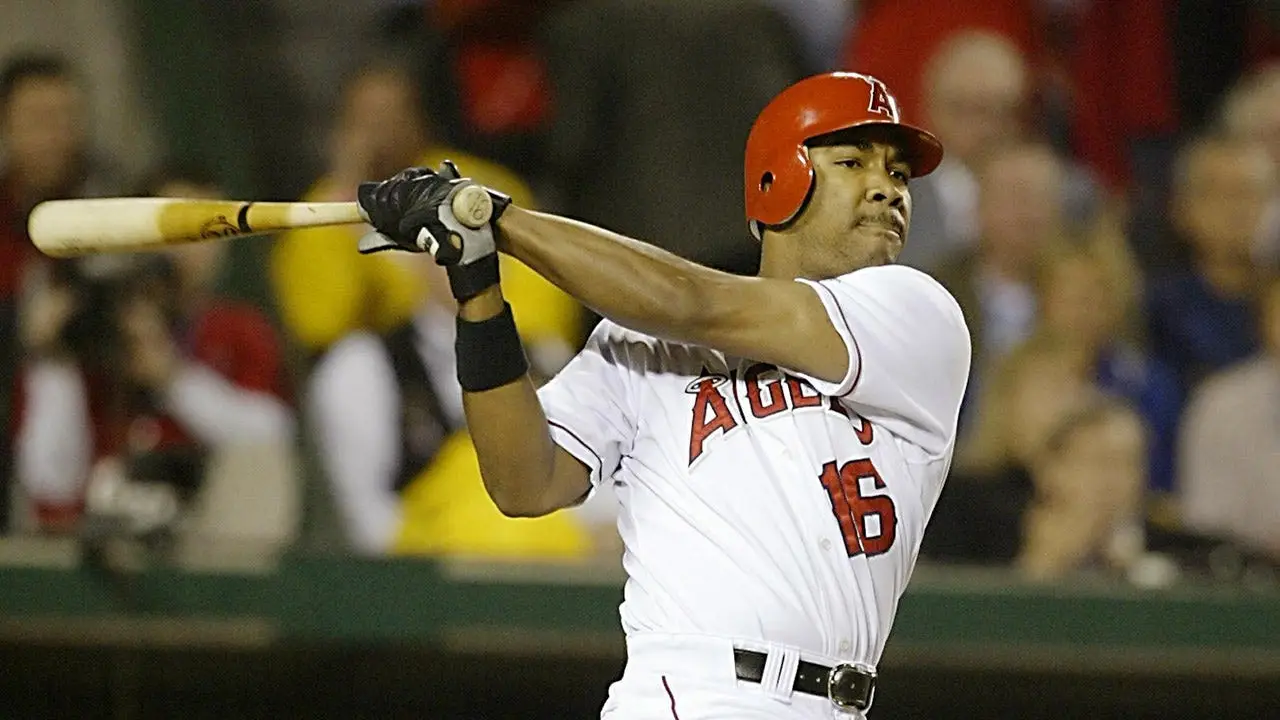
As the Angels’ leadoff hitter and right fielder, Anderson became a cornerstone of the team during their championship era. From 2002 to 2005, he earned three All-Star selections, showcasing his peak years. In 2002, he led the majors with 56 doubles, a testament to his ability to spray the ball to all fields. The next year, he topped the American League with 49 doubles, proving his power wasn’t just in base-clearing hits but in consistent production. During that same stretch, Anderson helped transform the Angels from perennial contenders into winners. He played a pivotal role in the 2002 World Series, memorably delivering a three-run double in Game 7 that propelled the Angels to their lone championship. As a left-handed batter with a compact swing, he often frustrated opposing pitchers, using his bat speed and eye for the strike zone to rack up hits. Coaches admired his professionalism; he was a clubhouse leader who motivated younger players with actions over words.
Anderson’s stats with the Angels paint a picture of enduring excellence. He’s the franchise leader in hits (over 2,000), RBIs (nearly 1,300), doubles (close to 400), and games played. His .296 batting average ranks third all-time behind legends like Vladimir Guerrero and Rod Carew, while his 1,024 runs scored are second only to Mike Trout. He was named a Silver Slugger twice, recognizing his offensive prowess at the hot corner. Yet, beyond the numbers, Anderson’s impact was felt in his loyalty. He spent 15 of his 17 seasons with the Angels, including a brief stint with the Braves early on and a late-career return, but Anaheim was always his home. In interviews, he’d speak modestly about his accolades, crediting teammates and the organization’s support. His induction into the Angels Hall of Fame in 2016 was a fitting nod to a player who embodied the spirit of Orange County—steady, dedicated, and ever-reliable.
The news of Anderson’s passing at age 53 hit hard, coming unexpectedly in April 2024. He died from acute necrotizing pancreatitis, a severe condition where parts of the pancreas die, according to medical experts at Cedars-Sinai. It was ruled a natural death by the Orange County Sheriff-Coroner’s Office. Friends and family reported that Anderson had been dealing with health issues in recent years, but he kept them private, consistent with his low-key nature. The Angels announced his death on their social media, expressing deep sadness: “Garret will forever hold a special place in the hearts of Angels fans for his professionalism, class, and loyalty throughout his career and beyond. We extend our heartfelt condolences to the entire Anderson family.” Emergency responders were called to his home in Rancho Bernardo on April 16 after he suffered a medical emergency, but tragically, he passed later that evening. Those who knew him describe a man who lived fully, balancing baseball fame with a grounded life focused on loved ones.
Anderson’s story resonates because he represented the everyman hero in sports—a player crowd couldn’t chant, but who they respected. Unlike flashier stars, he didn’t court attention; he just showed up and performed. That authenticity endeared him to fans across generations. During the Angels’ dynasty, when superstars like Trout and Pujols dominated headlines, Anderson was the dependable force, setting the table with his patient at-bats. His Game 7 double in 2002 isn’t just a highlight reel clip; it’s a symbol of his clutch play under pressure. In retirement, he stayed connected to the team, occasionally serving as a mentor or appearing at fan events. Colleagues recall him as kind-hearted, always ready with a word of encouragement. His death leaves a void, reminding us how health can unpredictably cut short even the most vibrant lives.
Ultimately, Garret Anderson’s legacy is one of quiet strength and unwavering commitment. Baseball has lost a true professional, but his memory lives on in the hearts of fans and the record books. As the Angels mourn, fans can reflect on his contributions—a testament to hard work paying off. In a sport filled with Egos, Anderson was a reminder that humility can shine brightest. His story encourages aspiring players to value consistency over celebrity. Though he’s gone too soon, his impact endures, inspiring future generations of Angels fans to aim for the same level of dedication. May his family find peace, knowing he’s remembered not just as an athlete, but as an icon of integrity in baseball. In the annals of franchise history, Anderson stands tall, a beacon of what it means to be an Angel.
A Silent Pillar of Orange County’s Baseball Dream
Delving deeper into Anderson’s biography, his early life was typical of many West Coast dreams—rooted in local youth leagues that nurtured his talent. Playing Little League in the 1980s, he wasn’t the standout star, but his work ethic stood out. Coaches recall a skinny kid with a powerful swing, always the last to leave practice. After high school, he attended UNLV, where his college coach honed his discipline. Drafted by the Angels in 1993, he started in the minors, learning the game in places like Boise and Palm Springs. Those years built his character; faced with slumps and setbacks, he persevered, on-base skills highlighting future finesse. By 1994, at age 22, he debuted in Anaheim, pinch-hitting in his first game. It was unremarkable, but it marked the beginning of a journey that would span decades.
Anderson’s prime was transformative for the Angels’ identity. As the team’s heart and soul, he formed a dynamic with sluggers like Jim Edmonds and Troy Glaus. His ability to draw walks and hit for average complemented the power hitters, elevating team performance. Seasons rolled by with Anderson anchoring the lineup, his 40-plus doubles nearly annual. He thrived under manager Mike Scioscia, who praised his leadership—calm amid chaos. Off the field, Anderson supported community charities, donating time to youth programs, embodying the franchise’s community focus. His routine was disciplined: early workouts, weight training, and study of opposing pitchers. This preparation made him a terror at the plate, rarely striking out, thanks to his selectivity.
His all-time rankings reflect a career of sustained excellence. Over 2,215 hits in his career, including 2,301 with the Angels, speak to longevity. He ranks high in extra-base hits and runs created, metrics showing his production value. Silver Slugger honors came in 2002 and 2003, affirming his skill in the infield. Beyond stats, he was a face of stability, playing over 140 games most seasons, a reliability rare today. Teammates like Tim Salmon credit him with fostering team chemistry, his presence making everyone feel valued. In the clubhouse, Anderson’s humor—dry and subtle—lightened heavy moments, a glue guy in every sense.
The circumstances of his passing highlight life’s fragility. Pancreatitis, caused by inflammation and tissue death, often stems from bile duct issues or alcohol; Anderson’s case was acute and severe. He showed no public signs of distress, maintaining privacy during struggles. On that fateful April day, when aid was sought, it was too late— a shock reverberating through the MLB family. The Angels’ somber post encapsulated collective grief; tributes poured in from players like Trout, honoring a mentor figure. Anderson’s home, nestled in suburbia, was his sanctuary away from fame, where he raised a family quietly.
Humanizing Anderson means seeing beyond the uniform—the man who coached his son’s baseball team, who loved fishing and golfing, who cherished simple joys like barbecues with friends. He wasn’t flashy; he valued authenticity, a trait reflecting in his relationships. Quotes from those close paint him as generous, always ready to lend an ear. His death at 53 feels unfair, cutting short reflections of retirement joys. Yet, it prompts appreciation for lives lived purposefully, even if modestly.
Anderson’s eternal place in Angels lore is cemented. Debates on greatest players include him as a top Angel, ahead of icons yet impactful. His double in ’02 isn’t just history; it’s inspiration for underdogs. As fans mourn, they celebrate a life well-lived—proving that true greatness lies in character, not spectacle alone. In remembering Garret, we honor the quiet forces shaping our world, urging us to live with his same grace and perseverance.
The Everyday Hero Who Lifted Anaheim to Glory
Anderson’s story is one of American perseverance, mirroring the underdog tale of the Angels themselves. Emerging from obscurity, he paralleled the team’s rise from a struggling franchise to contenders. His 1994 debut coincided with shifts in ownership, and he grew with the organization. By 2000, he was indispensable, his steady production pivotal in playoff runs. Fans bonded with his relatable persona—no titanium bats or muscle-enhancing scandals; just pure skill honed through practice. His swing, a compact helix, produced singles and rallies, frustrating top arms like Maddux.
Leadership was Anderson’s unspoken gift. Though not a captain, he mentored rookies like Ervin Santana. Stories abound of him taking players aside for batting tips, his own career lessons imparted generously. In the era of steroids, his clean numbers stand as testaments to integrity. Injuries tested him—hamate bone breaks, back issues—but he returned resiliently. That tenacity won hearts; booing him was impossible.
Franchise records secure his immortality: surpassing players like Brian Downing in hits. His average, just under .300, bested by Guerrero by .005, shows fierce competition. Runs scored behind only Trout underscore his base-running prowess. Double plays hit also highlight versatility. Honors like All-Star nods cemented status; the 2002 World Series ring, a career pinnacle.
Death’s suddenness underscores unpredictability. Necrotizing pancreatitis, potentially linked to gallstones or lifestyle, ravaged swiftly. Though sources avoid speculation, his athletic build—a muscular 6-foot-3—contrasted vulnerability. The April 16 call for aid signaled an emergency; by week’s end, he was gone. Family statements convey shock, praising his devotion as husband and father. Tributes emphasize legacy over loss.
Humanizing his life reveals a man balancing fame with normalcy. Golf trips with buddies, volunteer work with children’s hospitals—he shunned celebrity excess. Memories include humorous anecdotes, like pranks in the dugout, revealing a fun-loving side beneath stoic exterior.
Legacy endures as a blueprint for excellence. Anderson’s narrative inspires aspiring athletes to prioritize grit. In baseball’s pantheon, he’s the dependable anchor, reminding us heroes come in human forms. A life cut short, yet fully lived, prompts reflection on what truly matters.
From Minor Leagues to Major Magic: Anderson’s Journey
Born in Tucson, Arizona, but raised in Southern California’s baseball culture, Anderson developed a passion early. Playing against peers in neighborhoods, he discovered swing mechanics that later dazzled majors. College at UNLV was formative; there, he batted .320, attracting scouts. Drafted fourth round, he navigated ladder quickly, debuting in ’94 amid expansion hype.
Early years were builds; he platooned, building patience. By 1998, he earned full-time role, hitting .278 with power emerging. The 2000s explosion saw him elite, doubles machine. His style—short strokes, foul-poles finds—frustrated foes. Coaches lauded intelligence; he read pitchers masterfully.
His Angels tenure was symbiotic; as team improved, so did he. Records fell: hits in 2003, doubles in 2005. Singles king, he drove runs efficiently. Post-retirement, he scouted, his insights valued. Induction ’16 celebrated fidelity.
Passing’s cause, pancreatitis necrosis, illustrates hidden battles. Potential triggers include diet or genetics; he kept it private. The announcement shocked, his vitality vivid. Condolences flowed from MLB, his class universally noted.
Anderson’s humanity shone in humility. Not seeking spotlight, he appreciated gestures. Stories of kindness—assisting struggling players—defined him. Golf and philanthropy filled post-career days.
In memory, he’s emulated, a template for decency. Baseball mourns a legend whose quiet impact echoes eternally.
Clutch Hits and a Life Well-Played: Honoring Anderson
Anderson’s clutch moments defined him. The 2002 Series double, classic—bottom third, bases loaded, three-runs turning tide. His calm, gap-power decisive. Earlier series contributions included HRs and steals. Such plays imprinted him as winner.
His peaking 2002-2005 resulted in All-Star berths, feeding team success. Doubles titling marked dominance; consistency shone in 30-plus yearly. Versatility—1B shifts—added utility.
Franchise apexes: 209 hits in 1999, RBIs post-2000s. Batting titles eluded but .300 averages frequent. Honors justified expertise.
The death, natural from pancreatitis, ravaged pancreas tissue quickly. Sources cite inflammation, possibly undiagnosed. Emergency April 16 unresponsive; coroner confirmed natural. Teams mourned promptly.
Human warmth came in tributes—Trout’s saying the model. Family, radiant in thanks for support, depict nurturing figure. His passions—outdoors, community—revealed joyful soul.
Anderson’s tale teaches appreciating quiet triumphs. In sports’ stardom, his narrative of balanced living resonates. Gone, yet inspiring pursuit of purpose.
Echoes of an Angel: A Farewell to a Baseball Everyman
Anderson’s essence was approachable genius. Devoid of arrogance, he connected genuinely. Interviews modest, deflecting praise to teammates. His candor—like admitting weaknesses—built trust.
Career’s arc: minor ascent, Angel mainstay, retirement resolution. 17 seasons yielded wealth—percentiles high in WAR. Impacts saved teams, his presence stabilizing.
Stats lofty: 2,429 total hits; Angels-exclusive remind of dedication. Runs, RBIs stellar; longevity rare. Awards narrative enhancers.
Health’s betrayal, pancreatitis’s fury, stark. Acute form signaled system failure; days elapsed before revelation. Community mourns, his legacy communal.
Stories warm: mentoring Bren Donnelly, charity drives. Family ati, devoted; now, comfort sought in memories.
Anderson’s spirit lives on, urging emulation. In Angel mythology, he’s timeless, reminding heroes walk among us.