


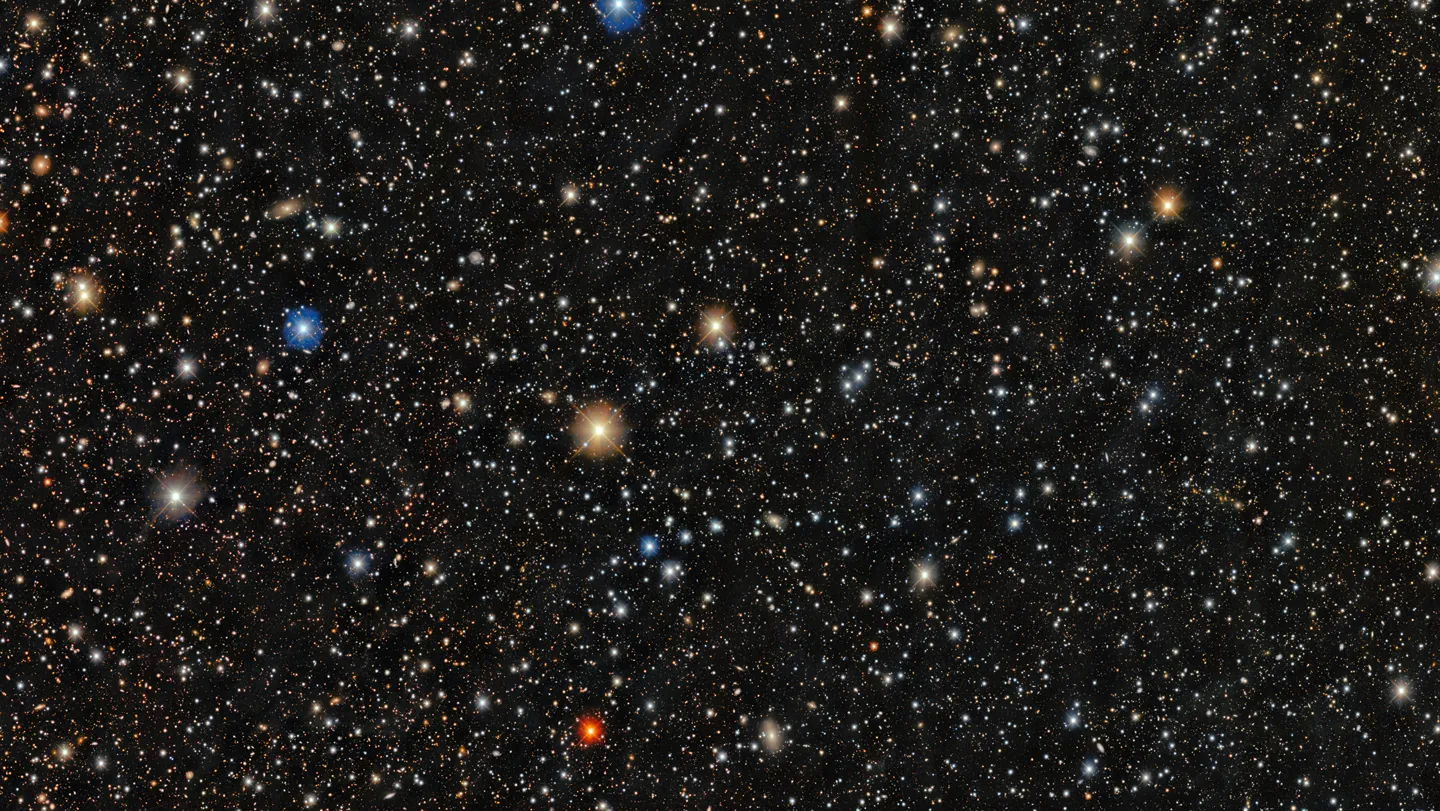
Imagine stepping back in time to the very dawn of the universe, when stars first ignited and began forging the building blocks of everything we know. That’s the kind of magic unfolded with the discovery of PicII-503, a star hiding in an ancient, dim dwarf galaxy on the fringes of our Milky Way. Found in the gulp of cosmic data from the Víctor M. Blanco Telescope in Chile back in 2024, this little speck of light isn’t just any star—it’s one of the most chemically primitive ever spotted, with barely a whisper of heavy elements like iron or calcium. In fact, it’s packed to the brim with clues about the universe’s infancy, sitting proudly in a galaxy called Pictor II, which astronomers discovered just over a decade ago. Picture this: Pictor II is what’s known as an “ultrafaint dwarf galaxy,” a faint, compact bundle of stars that’s like a relic from the early cosmos, far away from the bustling center of our galaxy. And PicII-503, spotted right at its heart, stands out because it’s uniquely situated in such a small, ancient system. This isn’t just a pretty light in the sky; as researcher Ani Chiti from Stanford University puts it, the moment they analyzed its makeup, they knew something extraordinary was happening. It’s like finding a living fossil that tells stories of stars long gone. But why does this matter? Well, heavy elements are the signature of stellar furnaces—when massive stars explode as supernovas, they spew out atoms like iron, enriching the gas clouds around them. PicII-503 has so little of those heavies that it’s likely from the very second generation of stars, born from the debris of the absolute first ones. Those pioneers, made mostly of hydrogen and helium, blazed bright and short, exploding spectacularly to seed the universe with new materials. Stars like PicII-503 captured that freshly forged stuff, but only traces, meaning it formed from the leftovers of perhaps just one massive supernova. It’s mind-blowing to think this star has been shining for over 12 billion years, a cosmic survivor carrying whispers of creation itself. When astronomers dove deeper into the data in 2025, they confirmed what made PicII-503 gleam: its iron content is less than 1/40,000th of what we see in our sun, and calcium is scarce too, while carbon—so essential for life later down the line—is relatively abundant. This imbalance isn’t random; it paints a picture of those early supernovas as more subdued affairs, not the destructive blasts we might imagine, but carefully ejecting lighter layers of elements like carbon while heavier ones like iron sank into the cores. When those cores finally collapsed, the explosion didn’t shred the surrounding gas clouds, allowing new stars to form peacefully. Chiti and her team must have felt like detectives piecing together a cosmic crime scene, realizing that PicII-503’s chemistry validates theories about how the universe got its chemical kickstart. Without those enriched clouds cooling and clumping into star-forming cradles, we wouldn’t have the vibrant, diverse cosmos we see today. And get this—Pictor II’s stars, like PicII-503, show this same carbon-rich fingerprint, suggesting they all hail from similar origins, perhaps scooped up by our Milky Way as it gobbled smaller galaxies in the past. It’s as if these galaxies were encapsulated time capsules, preserving the echo of the Big Bang’s aftermath in their DNA. Studying them helps us understand not just our own galaxy but the grand tapestry of how elements built life, planets, and even us. Yet, while PicII-503 gives us a direct peek into that process, it’s also a tease—what about those elusive first-generation stars themselves? Telescopes like the James Webb Space Telescope are peering back into deep time, but they can’t spot those primordial giants, which burned out eons ago. That’s where ultrafaint dwarfs like Pictor II shine as proxies; they’re like the smallest, oldest galaxies, analogs to the first structures that dotted the early universe. Finding PicII-503 there is thrilling because it proves these tiny relics can hold massive secrets. As MIT astrophysicist Anna Frebel, who wasn’t part of the research, excitedly notes, these stars are incredibly rare, like needles in a haystack of space. In the Milky Way’s halo—that wispy sphere of ancient stars surrounding the galactic disk—scientists have uncovered about a dozen similar primitives, each thought to be captured runaways from dwarf galaxies devoured by ours. But spotting one embedded in its native dwarf habitat? That’s groundbreaking, validating the idea that these halos are gilded with galactic fossils. Frebel adds that it’s exhilarating because it directly ties into how our galaxy grew, absorbing these building-block systems. For Chiti, the discovery wasn’t just data points—it was an emotional rush, a validation of painstaking searches that often yield nothing. “Immediately we knew something really exciting was going on,” she recalls, capturing the human side of astronomy, where years of telescope time and spectral analyses lead to moments of pure wonder. This star’s extreme purity—its lack of iron down to undetectable levels—means it might represent the earliest edge of the second generation, born from a single supernova’s минимал outflow, not a mishmash from multiple explosions. It’s not just science; it’s a testament to the universe’s ingenuity, turning stellar death into new life, light by light. Looking ahead, telescopes like the Vera C. Rubin Observatory promise even more hunts, scouring the skies for these elusive remnants. Each new find could redraw our map of cosmic history, revealing how elements cascaded through space, cooling gases into stars, planets, and eventually life forms. Frebel beams about the challenge: “I know how hard it is to find these stars. They are so, so rare.” It’s a reminder that breakthroughs like this require dogged perseverance, blending cutting-edge tech with human intuition. By decoding PicII-503’s chemistry and that of its brethren, we’re not just cataloging stars; we’re reconstructing the universe’s biography, from primordial fire to the complex reality we inhabit. As Chiti muses, ultrafaint dwarf galaxies are windows to the past, and PicII-503 has swung that window wide open. In a universe where everything is connected, this little star reminds us of our shared origins, urging us to keep looking up and wondering. Future missions will undoubtedly uncover more, building on this discovery, piece by piece, toward a fuller understanding. For now, though, PicII-503 stands as a beacon, proving that even in the darkest corners of space, history’s lessons are waiting to be read. What stories will the next ancient star tell? Only time—and telescope eyes—will reveal, but it fills you with hope that the cosmos is full of such extraordinary surprises, each one a step toward knowing our place in the grand scheme.
The process of finding PicII-503 was a journey through technological marvels and meticulous science, beginning with the sharp-eyed Blanco Telescope at Chile’s Cerro Tololo observatory. In 2024, amidst vast datasets, astronomers noticed this outlier in Pictor II, prompting follow-up spectra that laid bare its elemental profile. But humanizing this, imagine the late-night sessions for Chiti and her colleagues, sifting through digital noise for that one spectral signature that screams “ancient relic.” It’s not just machines; it’s people driven by curiosity, dreaming of touching the universe’s baby steps. Confirming its status as a second-generation star relied on detailed follow-ups, measuring abundances that are mind-bogglingly low—iron at levels unattainable in our sun’s neighborhood. Yet, when they saw the carbon boost, it clicked: this star drank from the first cosmic fountains, supping on supernova leftovers. Human stories emerge here too; Frebel’s excitement is palpable, stemming from decades of hunting similar beasts, knowing each find is a triumph over rarity. These stars aren’t just points of data—they’re embodiments of cosmic evolution, linking the intangible past to our tangible present. And Pictor II? It’s a perfect foil, its dim guise hiding a treasure trove of unaltered history, much like unearthed artifacts from ancient civilizations. As we humanize this further, think of the thrill of validation: every prior theory about low-energy supernovas gains legs, their explosive drama reimagined as controlled symphonies ejecting carbon like a gentle dance. No longer just theory, PicII-503 breathes life into simulations, proving models right by its very existence. Astronomers can now extrapolate, predicting more such galaxies as echo chambers of the early universe. The human element shines in the collaboration across teams, nations, and generations—Chilean observatories, American analyses, global enthusiasm. It’s a reminder that science is collaborative, a mosaic of minds piecing together eternity. For layfolk, this star’s tale demystifies astronomy, showing how distant sparks illuminate our lives. In sum, PicII-503’s discovery isn’t merely academic; it’s inspirational, a call to ponder our origins amid the stars’ silent narratives. As Rubin’s upcoming surveys loom, optimism grows for more unveilings, each promising to humanize the cosmos further, turning scientific jargon into shared wonder.
Diving into the star’s essence, what makes PicII-503 so profoundly human is its status as a storyteller of stellar lineage. Second-generation stars like it arose from the ashes of the first, those titanic behemoths of hydrogen and helium that fused relentlessly before self-destructing. Their explosions were the universe’s first factories, churning out basics for future worlds. PicII-503, however, snagged only a single supernova’s gift, making it exceptionally pure—a marker of that pivotal transition from primeval chaos to structured creation. To grasp this, envision the early universe as a blank canvas; first stars added splashes of color, and PicII-503 captures one of the original brushstrokes. Its carbon excess, juxtaposed against iron scarcity, whispers of supernovas’ nuanced natures: not always furious blasts dispersing all, but sometimes selective releases that preserved galactic nurseries. This abundance pattern, mirrored in Pictor II’s other inhabitants, suggests shared histories, like family traits handed down. Frebel highlights the rarity, evoking emotion—we’re witnessing near-cosmic infancy, a privilege few researchers achieve. For Chiti, it’s personal; confirming this in an ultrafaint dwarf validates years of fieldwork, turning skepticism into exhilaration. Humanizing astronomy means acknowledging the excitement, the “eureka” moments that fuel careers and inspire generations. Moreover, this star’s longevity—over 12 billion years—humanizes time’s vastness, making ancient events feel intimate. It’s not just about elements; it’s about connections, how a single star bridges the universe’s cradle to our doorstep. By studying its chemistry, we’re decoding our elemental makeup, realizing we’re stardust in a tangible way. Future telescopes will amplify this, but for now, PicII-503 serves as a heartfelt reminder of exploration’s rewards, blending the scientific with the soulful.
Pictor II’s role can’t be overstated in this cosmic drama; as an ultrafaint dwarf, it’s a pristine enclosure for evolutionary echoes. Unlike Milky Way halo stars, possibly intermigrated wanderers, PicII-503 belongs, offering an uncontaminated view of its galaxy’s birthing grounds. This setup underscores how such dwarfs mimic early galaxies, compact and old, forged in the universe’s youth. Frebel’s insight on the low-energy supernovas fits snugly here: a misguided blast would have scattered Pictor II’s precursors, curtailing its formation. Instead, gentler explosions nurtured it, fostering stars like PicII-503. This humanizes galactic mergers as passive acquisitions, not conquests, preserving relics amid the Milky Way’s sprawl. Astronomers now see ultrafaint dwarfs as archives, their stars silent custodians of primordial clues. The excitement builds knowing future discoveries await, each dwarf a potential PicII-503 carrier. For enthusiasts, it paints a picture of humble beginnings—massive structures evolving from delicate seeds. Chiti’s enthusiasm stems from this context, picturing dwarf galaxies as time machines. Ultimately, this star’s placement invites reflection on scale and fragility, how tiny systems hold monumental histories, enriching our understanding of existence’s layered narrative. It’s deeply human, evoking awe at the intricate dance of creation we inherit.
Expert voices elevate PicII-503’s tale from data to dialogue. Frebel’s praise—”it’s a fantastic discovery”—captures communal joy, a rarity that unites astronomers in celebration. Her reference to the hunt’s difficulty humanizes the grind, the endless scans for needles in stellar haystacks. Chiti’s immediate realization underscores intuitive leaps in science, where patterns spark epiphanies. Their perspectives frame the star as validating frameworks of enrichment and capture, making abstract theories vivid. Beyond quotes, it highlights collaboration: Blanco Telescope’s prowess, follow-up refinements, global brainstorming. This interplay of minds mirrors human endeavor, passion fueling progress. As we humanize, these voices remind us science thrives on storytelling, turning observations into relatable sagas. Frebel’s validation of dwarf absorption theories adds personal stakes, her independent enthusiasm endorsing the find. Chiti’s vivid recall evokes the human thrill of breakthrough. Together, they personify astronomy’s heartbeat, guiding us from isolation to interconnected wonder.
Peering forward, PicII-503 heralds a renaissance in cosmic archaeology, with Rubin’s Observatory poised to unearth more twins. By mapping chemical compositions, we’ll refine histories of enrichment, from supernova outflows to planetary assemblies. Frebel hints at the era’s potential, each star a puzzle piece. Humanizing this, imagine the anticipation, families of future astronomers chasing echoes. Yet, it circles back: JWST’s glimpses into the deep past complement these local relics. In essence, PicII-503 isn’t an endpoint but a signpost, urging humility and curiosity. As Frebel notes, validation breeds excitement, promising clearer cosmos blueprints. For all of us, it fosters appreciation for our rootedness in stellar legacy, inspiring ongoing quests. In a universe of wonders, this star whispers: keep exploring, for there are stories yet untold.