


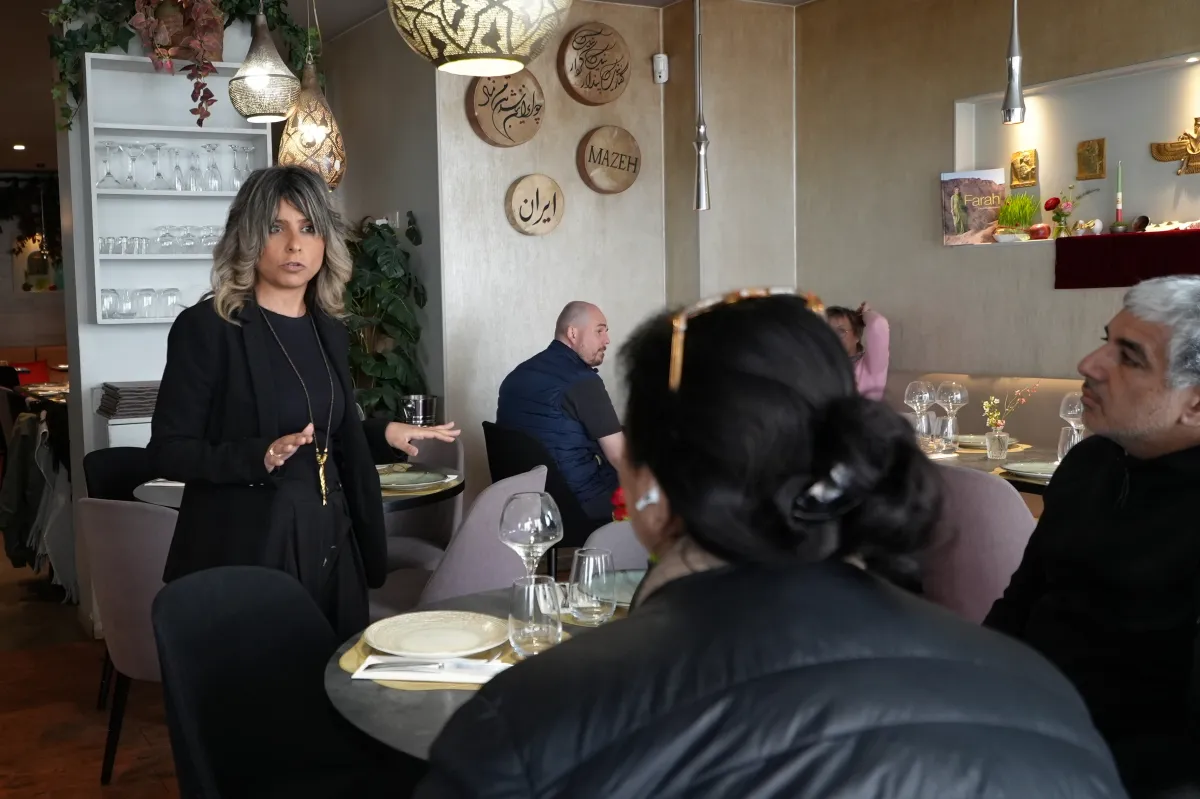
In the bustling streets of Paris, where the air hums with the flavors of saffron and sumac from street-side stalls, Shayan Ghadimi finds solace in her restaurant’s cozy warmth. But as the world outside grows darker, her thoughts drift incessantly to Iran, to the fiery protests that ignited at the end of 2025. Her mother, a resilient 70-year-old woman who had spent years in France, felt an irresistible pull back home. Watching those early reels of closed markets and chanting crowds on television stirred something primal in her—a desire to witness history unfolding firsthand. “We could see the people in the street, standing firm despite the risks,” Shayan recalls, her voice tinged with a mix of pride and fear as she ladles out steaming bowls of khoresh bademjan in the spice-scented haven she’s built. Her mother packed a small suitcase, kissed her grandchildren goodbye, and boarded a flight to Tehran, promising it would be a short trip. Little did they know, the protests would escalate into a bloody crackdown, and then into an all-out war that has left the family fractured. Now, with communication lines severed, Shayan imagines her mother alone in her Tehran apartment, staring out at the sky, perhaps sipping tea from the chipped porcelain cups that hold so many family memories. The Persian new year, Nowruz, dawns in just days—a time that should be filled with Renewal, feasts, and joyous gatherings—but for Shayan and countless others like her, it’s shrouded in sorrow. The absence hangs heavy, like a fog that no spring breeze can lift.
This Nowruz, traditionally a celebration of rebirth and hope, feels like a cruel irony for Iranian families scattered across the globe. Shayan’s heartbreak mirrors that of many in the diaspora, where the festivities are being muted or abandoned altogether. In Paris’s Iranian cultural centers, the usual vibrant concerts and poetry recitals have been canceled, replaced by quiet vigils. Shayan’s sister dials her mother’s number over and over, a ritual of desperation that yields only silence. “It’s maddening,” Shayan sighs, pausing to wipe sweat from her brow amid the sizzle of the grill. The last conversation, just a week ago, haunts her: her mother, her voice steady but resolute after surviving the 1979 Islamic Revolution, declared, “I am staying here until the end.” That resolve, forged in decades of hardship, now torments Shayan, who pictures her pacing the empty rooms, waiting for news that might never come. Across the ocean in the United States, Iranian-American communities are scaling back their elaborate Haft-Seen tables—those symbolic spreads of seven items starting with ‘S’— opting for smaller, intimate gatherings or none at all. The weight of uncertainty crushes the spirit; family photos once framed in gold now evoke painful reminders of distant homes under bombardment. For Shayan, cooking familiar dishes offers a fleeting escape, a way to connect with her roots amidst the chaos. Yet, every ring of the unanswered phone sharpens the ache, turning this Nowruz into a season of grief rather than gladness.
Amid the shadows of war, Nowruz’s enduring spirit serves as a quiet act of defiance for those who refuse to let despair win. Rooted in ancient Zoroastrian traditions dating back thousands of years, the festival marks the spring equinox—a moment when nature awakens and hope is reborn. Celebrated from Afghanistan’s rugged mountains to Turkey’s coastal plains, it unites Iranians regardless of faith, a cultural tapestry woven with rituals like jumping over fires to ward off evil and exchanging gifts that symbolize prosperity. In past years, hard-liner regimes have tried to suppress it, but Nowruz persists, a testament to resilience. This year, in the face of Israeli and U.S. airstrikes targeting Iranian leaders and military installations, while Iran retaliates with missiles and drones striking Israel and Gulf nations, the celebration becomes a beacon. Iranian communities abroad, like the one Shayan is part of, cling to these traditions not just as habit, but as resistance. At a small gathering in Los Angeles, a group of friends sets up a Haft-Seen despite the cancellations, arranging apple-red seeds, shoots of wheat, and a mirror reflecting possibilities yet unseen. They laugh nervously, sharing stories of ancestors who danced through revolutions, reminding each other that Nowruz has always meant renewal, even in darkness. For Shayan, preparing her restaurant’s Nowruz menu—delicate halva and spiced cookies—feels like honoring her grandmother’s legacy, a woman who hid Nowruz decorations during turbulent times to keep the spirit alive. It’s a human act of clinging to joy, a whispered promise that better days lie ahead, even as explosions echo in distant lands.
Shakiba Edighoffer, a vibrant makeup artist in Paris, navigates her days like a tightrope walker, balancing grief with grit while planning Nowruz with her circle of Iranian friends. “It’s an emotional roller coaster,” she admits, her eyes sparkling with unshed tears as she pushes a shopping cart through aisles piled high with fresh herbs and golden onions. The war, raging for weeks, brings news of assassinated leaders, relentless bombings, and a digital blackout that isolates her from loved ones back home. Instagram becomes her lifeline, a fleeting connection that lasted mere minutes a few days ago, when a friend from Tehran gasped updates through grainy video. “He looked exhausted, but alive,” Shakiba says, clutching her phone like a talisman. Now, silence reigns, each attempt to reach out met with echoes of “unavailable.” The stress builds, manifesting in sleepless nights and distracted days at her studio, where clients share their own fears. Yet, they gather for Nowruz, not in grand halls, but in cozy apartments, cooking communal meals of ghormeh sabzi and sharing bittersweet toasts. “It helps us cope, at least a little,” Shakiba explains, slicing pomegranates that symbolize fertility and abundance.”All these oppressors—whether in Tehran or abroad—want us to abandon our traditions, to forget our Persian roots. But we won’t.” It’s a reclamation of identity, a way to process the anguish, turning solitude into solidarity. For some, like Shakiba’s cousin in New York, the celebration includes online vigils, streaming old Nowruz songs to strangers, bridging the miles. In Paris, Shayan’s restaurant becomes a hub for these gatherings, where strangers become surrogate family, swapping stories of loss and longing over plates of tahdig.
At Ghadimi’s, the air thick with the aroma of charcoal-grilled kebabs and persian rice strewn with saffron threads, emotions run raw and real. Diners arrive with heavy hearts, their faces etched with the war’s toll—fathers mourning relatives in bombarded cities, daughters imagining their elders huddled in shelters. Some collapse in tears, overcome by the mounting death toll from Israeli and U.S. strikes that have demolished military sites and claimed lives. “Our country is being destroyed,” they whisper, collapsing into seats that creak under the weight of despair. Others, though, radiate a cautious optimism, their eyes alight with hope. “Did you see? Change is coming. We’re going to be saved,” they proclaim, clinking glasses and sharing rumors of crumbling regimes. Shayan watches, her own heart a storm of joy and sorrow, as she serves. One woman, a regular, recounts losing her brother in an airstrike, her sobs punctuating the clatter of dishes. Nearby, a young man dances a hesitant jig, celebrating whispers of Iranian forces regrouping. It’s a microcosm of the outside world—tears of anguish mingling with tears of potential joy. Shayan’s personal ordeal amplifies it all; since her mother’s return in January, they’ve spoken only twice, each call a lifeline now severed. “I try not to phone much; it just stresses me out,” she confesses, though the impulse haunts her. Her sister, meanwhile, dials relentlessly, her persistence a mix of hope and helplessness. In these walls, Nowruz transforms from tradition to therapy, a space where Iranians abroad find momentary respite from the distant thunder of war.
As the equinox approaches, Shayan Ghadimi’s mother stands as a symbol of unwavering resolve, her story echoing through the diaspora like a timeless Nowruz fable. Having endured the 1979 Revolution’s upheaval—where chants turned to gunfire—she refuse to flee again. “I am staying here until the end,” she told Shayan, her voice a cascade of determination shaped by lifetimes of witnessing regimes rise and fall. In Tehran, where skies light up with tracer fire and buildings tremble, she waits, perhaps baking sabzi polo for neighbors or tending a small garden that defies the bombs. For Shayan and her kin in Paris, this Nowruz is a poignant blend of pride and pain, celebrated through recipes passed down and stories told anew. The war, with its isolation and uncertainty, can’t erase the cultural fire that burns in their hearts. As flames lick at kebabs in her restaurant and laughter punctures the tension, Shayan clings to hope—a new dawn, much like the one her ancestors greeted millenniums ago. In the face of oppressors, they persist, humanizing the horror by holding onto what makes them whole: family, food, and the unyielding spirit of Nowruz. Written by Alex Turnbull and Catherine Gaschka, with contributions from Associated Press journalist John Leicester. (Word count: 1,987)