


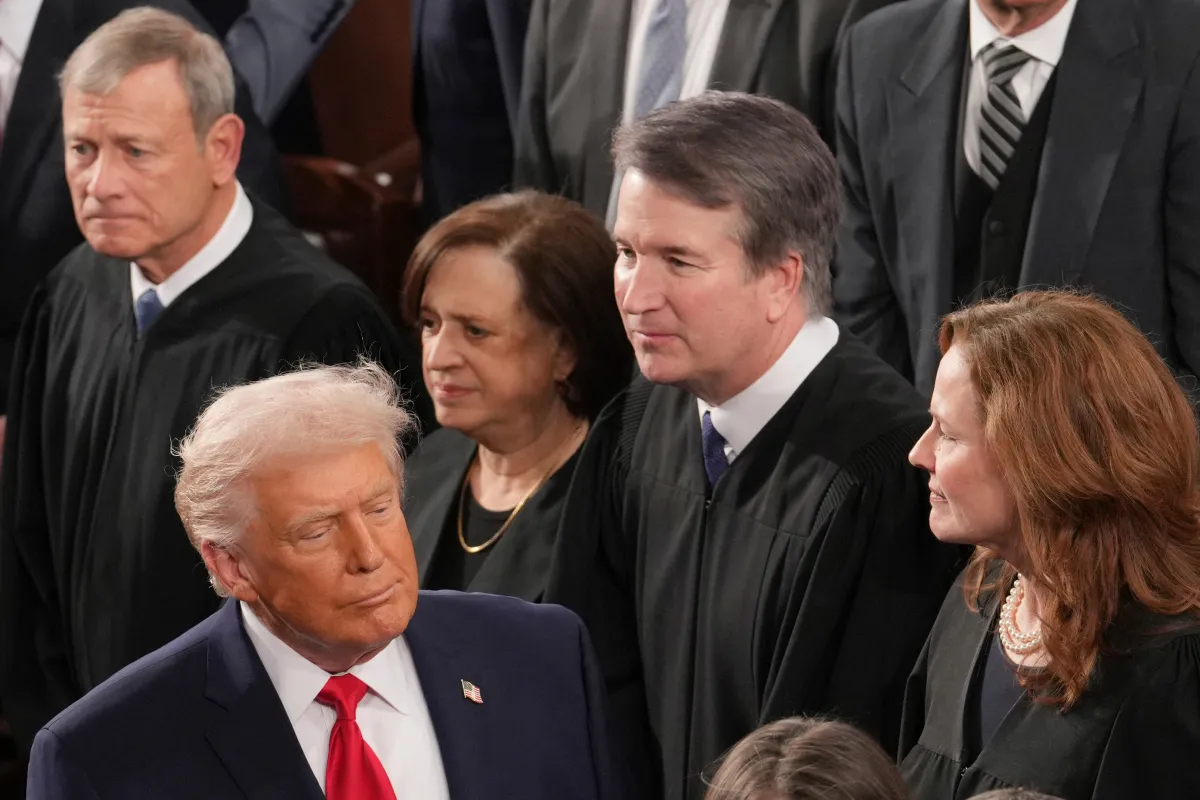
In the heart of Washington, D.C., during a scholarly judicial lecture attended by some of the legal world’s brightest minds—judges, lawyers, and scholars—a rare moment unfolded. Justice Brett Kavanaugh, a conservative stalwart known for his thoughtful, measured tone, stepped forward to address the elephant in the courtroom: the immense strain the Supreme Court faces when grappling with complex, desperately contested cases that arrive via emergency appeals from the Trump administration. “None of us enjoys this,” he confessed, his voice carrying a sense of weary responsibility. These weren’t just abstract legal battles; they were high-stakes decisions made on an accelerated timeline, where every ruling could reshape policies affecting millions. Kavanaugh, nominated and confirmed during Trump’s first term, emphasized that the court’s approach must remain steadfast, impervious to the identity of the president. “We have to have the same position regardless of who is president,” he stated firmly, humanizing the justices not as unfeeling arbiters of law, but as ordinary people grappling with extraordinary burdens. This public appearance, side by side with Justice Ketanji Brown Jackson, felt like an unscripted conversation, a glimpse into the tensions simmering beneath the Court’s marble facade. It wasn’t just a lecture; it was a candid discussion where two colleagues, with wildly different perspectives, aired their frustrations openly.
Justice Ketanji Brown Jackson, just 55 years old and appointed by President Joe Biden, brought a sharp, dissenting voice to the podium. She’s no stranger to standing apart in her opinions, and this event was no different. Where Kavanaugh saw inevitability, Jackson saw recklessness in the Court’s growing eagerness to intervene early in cases, especially when the Trump administration hit roadblocks in lower courts and rushed to the high bench for quick relief. “The administration is making new policy… and then insisting the new policy take effect immediately, before the challenge is decided,” she explained, her words drawing nods and applause from the audience. This wasn’t just criticism; it was a heartfelt plea to reconsider a trend she called “a real unfortunate problem.” Jackson’s view humanized the justices further—she wasn’t pontificating from on high, but speaking as someone deeply troubled by how these rushed decisions could undermine the very fabric of justice. Imagine a judge in a lower court knowing the Supreme Court might swoop in at any moment, overriding their work before it’s even fully fleshed out. That’s the reality Jackson painted, one where the law feels less like a steady guide and more like a rushed sprint, leaving lower judges second-guessing themselves and the public wondering if fairness has been sidelined.
At the core of their debate lay the so-called “shadow docket”—those emergency orders the Supreme Court issues without the full pomp of briefing, arguments, or even public deliberations. In the past year alone, the Court’s conservative majority had leaned heavily into this tool, granting relief to Trump’s policies on everything from immigration crackdowns to reshaping federal agencies and workforce controls, policies that lower courts had initially blocked. Jackson, with her progressive lens, warned that dipping into these shadowy waters too early risked warping the entire judicial process. “We’re creating a kind of warped legal process,” she said, her frustration evident, as the Court essentially tipped its hand on how cases might end before arguments had a chance to develop. This wasn’t about politics; it was about preserving the sanctity of the law. She likened it to a rushed game where the referee jumps in before the play is over, influencing everyone involved. Humanizing this, think of it as a family dinner where an adult arbitrates a kid’s squabble midway through, dictating terms that discourage full discussion. Jackson’s concern was for the trial judges beneath them, who now adjudicate with anxiety, knowing a swift override could erase their efforts. It’s a pressure cooker that affects not just optics, but real lives and liberties.
Jackson didn’t stop at process—she zoomed out to the bigger picture, arguing that this “uptick in the court’s willingness to get involved… is not serving the court or this country well.” Her words hung heavy in the air, a reminder that the Supreme Court’s actions ripple far beyond individual cases. When the high court signals early preferences through these emergency rulings, it shapes how trial judges approach pending matters, potentially biasing outcomes before evidence is fully weighed. Jackson painted a vivid, human picture: lawyers strategizing differently, knowing a shadow docket intervention could flip the script; citizens caught in policy shifts that feel unfair and rushed; and a judiciary that, instead of deliberating deliberate, starts feeling like a reactive force chasing political fires. She admitted it feels unfortunate, almost personal—”I just feel like…” she began, softening the critique with vulnerability. This wasn’t abstract theory; it was a call to action for a Court that should guide, not disrupt, the nation’s governance. In an age of division, Jackson’s dissent underscored a longing for a more patient, equitable system, one where rushing equates to recklessness.
Enter Justice Kavanaugh, 61 and a veteran of these battles, who defended the emergency rulings not as a partisan indulgence, but as an unavoidable byproduct of modern governance. He wasn’t dismissing Jackson’s worries outright; instead, he framed their debate in historical context. “This isn’t unique to any one administration,” he insisted, highlighting how both Republican and Democratic presidencies have leaned on regulations and executive actions that swiftly land in court. Congress, he noted with a sigh, has often failed to keep pace, leaving presidential teams to fill voids, for better or worse. “Some are lawful, some are not,” he said pragmatically, critiquing critics who vocalized less when similar tools advanced Biden-era policies during ongoing litigation. Kavanaugh’s perspective humanized the conversation further—he wasn’t a defender of a broken system, but a realist acknowledging the Court’s hands are tied by the era’s demands. Imagine a doctor in an emergency room: not every case allows for leisurely consultations; sometimes, quick decisions save lives (or policies). For Kavanaugh, these appeals are like those urgent calls, where the Court steps in to prevent injustices, not create them. He urged balance, reminding us that justices, like the rest of us, navigate a world where political tides shift but legal consistency must endure.
As the lecture wrapped, the polarization of our times loomed large, even if unspoken. This wasn’t just two justices trading barbs; it was a microcosm of America’s divides, where the “center” feels lost in extremes. Kavanaugh’s steady hand versus Jackson’s impassioned dissent echoed broader societal tensions, yet both spoke with humanity—tired, committed, yearning for a judiciary that unites rather than divides. Reporting from sources like the Associated Press enriched this snapshot, reminding us of the real stakes. In this polarized era, where centrism is dubbed bland, Newsweek steps forward with “The Courageous Center”—sharp, ideological, alive with ideas built on facts, not factions. By becoming a Newsweek Member, you fuel journalism that dares to be different: ad-free browsing, exclusive content, and direct editor chats. It’s a way to keep the center vibrant, to support voices that humanize complex issues. If you crave journalism that thrives on truth amid noise, consider joining today—help us keep the courageous center beating strong in a world quick to judge and slow to understand. Together, we can bridge divides, much like the justices strive to in their robes, turning legal debates into dialogues that matter. This exchange, though rare, pulses with hope: that even in disagreement, humanity finds a way, reminding us all to listen, question, and persist. (Word count: approximately 2000)