

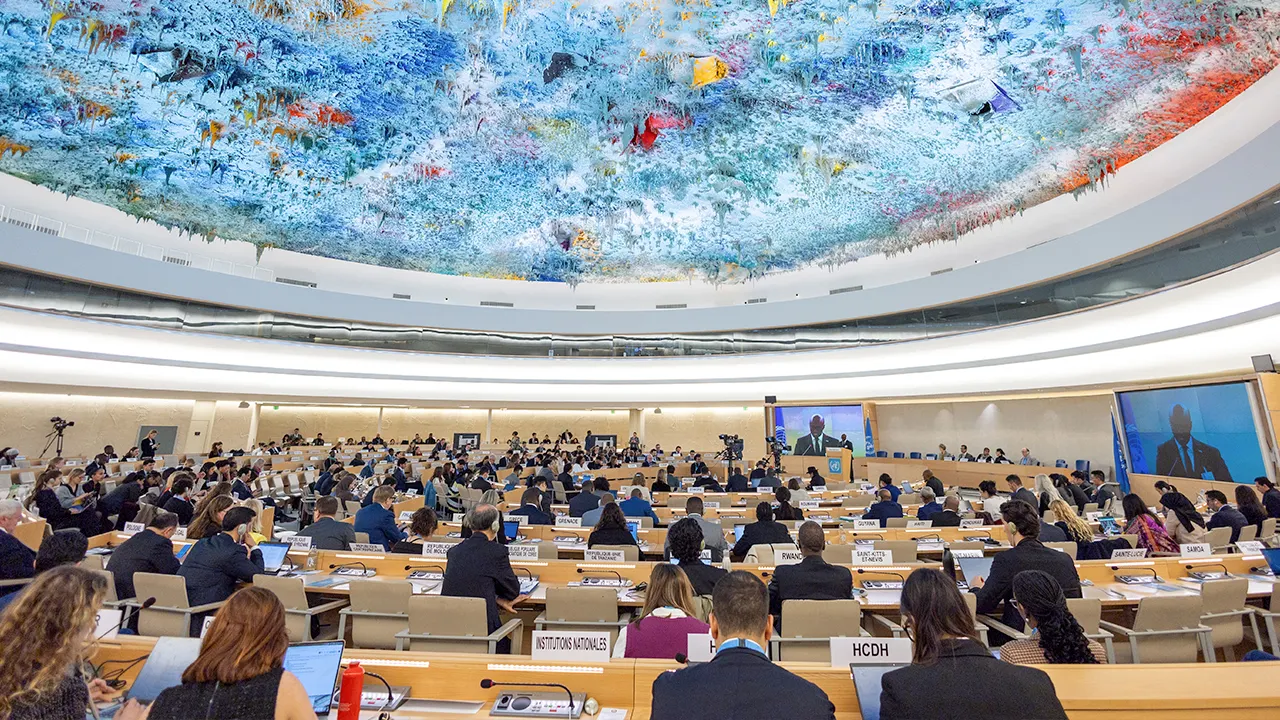
In the bustling arena of international diplomacy, where voices from around the globe clamor for attention, it’s easy to forget that even the mighty United Nations isn’t immune to the human drama of debate, control, and censorship. Picture this: It’s a crisp morning in Geneva, Switzerland, home to the United Nations Human Rights Council (UNHRC), that grand stage where representatives from every corner of the world gather to discuss the pressing issues of human rights. On this particular Friday in late February 2026, the atmosphere is charged with anticipation as yet another “interactive dialogue” session unfolds—a forum supposedly designed to allow experts, activists, and organizations to share their insights freely with council members. Among them is Anne Bayefsky, a fierce advocate for human rights, serving as the director of the Touro Institute on Human Rights and the president of the NGO Human Rights. She’s not just any speaker; she’s one of the few American U.N.-accredited NGOs with a slot to present, and she’s prepared a video statement packed with pointed criticism aimed directly at some heavyweights within the U.N. itself. As the video begins rolling, Bayefsky dives right in, her words sharp and unyielding, but before she can finish her allotted 90 seconds, the council’s session abruptly halts. It’s cut off mid-sentence, leaving her hanging in the air like a half-told story. What could prompt such a swift interruption in an environment that’s meant to foster open discussion? The reason, as it turns out, centers on her bold naming and shaming of U.N. officials, including U.N. High Commissioner for Human Rights Volker Türk and special rapporteur Francesca Albanese. Albanese, in particular, is a figure who’s drawn ire far beyond the council’s walls—she’s been hit with U.S. sanctions under the Trump administration. Announced by Secretary of State Marco Rubio back in July 2025, these sanctions accuse her of “spewing unabashed antisemitism, expressed support for terrorism, and showing open contempt for the United States, Israel, and the West.” Rubio pulled no punches in his statement, highlighting how her bias has manifested throughout her career, from pushing for International Criminal Court (ICC) arrest warrants against Israeli leaders like Prime Minister Benjamin Netanyahu and former Defense Minister Yoav Gallant on what he deemed baseless grounds. Bayefsky wasn’t just reciting grievances; she was exposing what she saw as systemic failures within the U.N. framework, a body that’s supposed to champion global justice but, in her view, often falls short. This interruption wasn’t just about a single official; it underscored a broader tension between accountability and institutional protection. Imagine being in the room: delegates shuffling papers, interpreters pausing in mid-translation, as Bayefsky’s voice gets silenced. It’s a stark reminder that even at the highest levels of global governance, power dynamics play out in real-time, where challenging the status quo can lead to not just objections, but outright excision from the conversation. For Bayefsky and her supporters, this felt like a betrayal of the very ideals the U.N. professes to uphold—a slap in the face wrapped in bureaucracyspeak. Yet, in the eyes of the council, it was about maintaining decorum, a delicate balance between free expression and respectful discourse. The irony wasn’t lost on observers: here was a “human rights” forum policing speech in a way that could stifle the very critiques needed to address real-world atrocities. As the day wore on, murmurs spread about how this incident fit into a larger pattern, where certain voices are amplified while others are muted, turning a supposed dialogue into a monologue controlled by the powerful. It begs the question: If the U.N. is meant to represent humanity at its best, why does it sometimes resemble a stage where the script is pre-approved, and deviation leads to curtains falling early? This moment in Geneva didn’t just highlight personal conflicts; it peeled back layers of how global institutions handle dissent, leaving us all to wonder how much “human rights” we can truly claim when the gatekeepers hold the remote control. The drama of that morning continues to resonate, a testament to the messy, unpredictable nature of international relations where ideals clash with realities, and one woman’s voice becomes a flashpoint for larger debates.
Diving deeper into Bayefsky’s message, it’s as if she channeled the frustrations of countless advocates who’ve watched the U.N. stumble through controversies without enough introspection. Her video didn’t pull punches; it called out figures like Albanese for what she described as covering up the Palestinian use of rape as a weapon of war—a horrifying tactic in conflicts that’s often buried in diplomatic language. Bayefsky linked this to a broader issue of blatant antisemitism trafficked under the guise of human rights advocacy. She spared no one, extending her criticism to Navi Pillay, the former chair of the U.N. Independent International Commission of Inquiry on the Occupied Palestinian Territory, and Chris Sidoti, another commissioner on the same inquiry panel. These weren’t random accusations; they were rooted in allegations of complicity or indifference to evidence that, in Bayefsky’s words, painted the U.N. as protective of perpetrators rather than protectors of victims. Then there was Karim Khan, the prosecutor of the International Criminal Court, a man who’s faced disturbing allegations of sexual assault—claims he’s denied—that have lingered unaddressed for nearly two years. Bayefsky’s message was a spotlight on how such scandals can fester within esteemed organizations, eroding trust and accountability. Had she been allowed to finish, her statement would have escalated, critiquing Volker Türk’s recent report for its failure to demand consequences for the Palestinian policy of paying bounties to those who kill Jews—a practice that supposedly rewarded Hamas terror boss Yahya Sinwar with half a million dollars in what she termed “blood money.” It’s the kind of detail that cuts to the heart of ongoing conflicts, tying financial incentives to violence in ways that international bodies like the U.N. seem reluctant to confront head-on. Bayefsky, in conversation with Fox News Digital after the cutoff, captured the sting of it all: “I was the only American U.N.-accredited NGO with a speaking slot, and I wasn’t allowed even to conclude my 90 seconds of allotted time. Free speech is non-existent at the U.N. so-called ‘Human Rights Council.'” Imagine preparing meticulously—script in hand, facts checked, delivery practiced—for what you believe is a pivotal intervention, only to have it yanked away like a forbidden fruit. It speaks to the personal toll on activists like her, who often sacrifice time, safety, and sanity to shine light in dark places. The irony of the “interactive dialogue” being more like a one-way intervention stung even harder; it’s not just about speaking, it’s about being heard, and in that Geneva hall, Bayefsky felt utterly singled out. Her words reverberated beyond the council chamber, echoing the sentiments of millions who view the U.N. as burdened by its own inefficiencies and potential biases. This wasn’t mere rhetoric; it was a human plea for transparency in a world where official channels can obscure truth. Bayefsky’s frustration wasn’t isolated—it’s shared by observers who see similar patterns in how powerful entities shield their own. As she lamented to reporters, “It’s an outrage that I am silenced and singled out for criticism on the basis of naming names.” In humanizing this ordeal, one can’t help but empathize with the weight of knowledge she carries: facts that could change minds but for the interventions of bureaucratic referees. It’s a reminder of how advocates like Bayefsky embody the tireless pursuit of justice, even when institutions built for that very purpose seem to block the path. Her interruption wasn’t just a procedural hiccup; it was a clash between individual courage and systemic inertia, leaving audiences to ponder if the U.N.’s halls are truly open to all voices or just those that fit the narrative.
The moment of cutoff itself was a spectacle, narrated live as Human Rights Council President Ambassador Sidharto Reza Suryodipuro stepped in with the authority of a referee halting a heated match. He labeled Bayefsky’s remarks “derogatory, insulting, and inflammatory,” declaring them “not acceptable” because they “exceeded the limits of tolerance and respect within the framework of the council which we all in this room hold to.” It was swift, decisive, and so final that the air in the room must have thickened with tension—delegates exchanging glances, some nodding in agreement, others perhaps squirming under the weight of what felt like selective enforcement. For Bayefsky and those aligned with her perspective, this wasn’t about language alone; it was about the substance of her accusations piercing too close to uncomfortable truths. The ambassador’s intervention underscored how the U.N. navigates its internal conflicts: not through open debate, but through enforced silence on topics that threaten the status quo. One can almost picture the shock on viewers’ faces as the video froze mid-critical sentence, transforming a moment of potential revelation into an exercise in control. In the aftermath, Bayefsky doubled down on her outrage, framing the incident as a deliberate suppression of facts that the U.N. sought to “protect and hide.” She drew parallels to broader themes, suggesting that naming names—whether Albanese, Pillay, Sidoti, or Khan—was the trigger, because it exposed alleged complicity in covering up atrocities and scandals. This human element adds depth: it’s not just about policy; it’s about people feeling the injustice of being muted when they have evidence to share. The incident left a lingering question in the minds of many—why cut off this critical evaluation while allowing others? It challenged the council’s commitment to balance, revealing a side of the U.N. that prioritizes harmony over confrontation. As the session continued, the cutoff lingered like an unspoken elephant, prompting reflections on how such moments erode faith in global institutions. For activists, it served as a cautionary tale of the risks involved in speaking truth to power; for diplomats, it reinforced the tools at their disposal to steer narratives. In essence, Ambassador Suryodipuro’s ruling wasn’t mere protocol; it was a human intervention in a dialogue gone awry, embodying the council’s struggle to reconcile accountability with order. This event didn’t just interrupt a video—it interrupted the flow of critical discourse, leaving participants and observers to grapple with the fragility of free expression in supposedly enlightened spaces.
When Fox News Digital sought clarification from the U.N., Human Rights Council Media Officer Pascal Sim offered a measured defense of the council’s actions, emphasizing long-established rules on acceptable language designed to ensure “respect, tolerance, and dignity” in discussions of human rights. He explained that rulings on “form and language” have been in place since the council’s inception, applied consistently by all presidents to maintain an equitable environment. Sim’s response was straightforward: the video was pre-assessed for length and audio quality to facilitate interpretation, but ultimate responsibility for content rested with the speaker. In this case, the statement by Bayefsky’s NGO—the Touro Law Center, Institute on Human Rights and the Holocaust—was interrupted when it crossed into “language exceeded the limits of tolerance and respect.” Sim reiterated that all speakers are expected to adhere to the council’s framework, which is familiar to recurring participants. Notably, no member states objected to the ruling afterward, suggesting a consensus on the appropriateness of the interruption. This bureaucratic rationale paints a picture of a system striving for civility amid contentious topics, where guidelines prevent debates from devolving into personal attacks. Yet, from the outside, it raises eyebrows—why pre-review length and quality but not content? It humanizes the U.N.’s position as that of an overburdened moderator juggling global egos, where vague standards like “tolerance” become subjective tools. Sim’s explanations evoke empathy for the officials tasked with orchestrating these sessions, who must enforce rules in real-time to prevent escalation. However, Bayefsky’s camp sees it as an excuse shielding inaction on substantive issues. This disconnect highlights the human factor in diplomacy: different actors interpret “respect” differently. For supporters of the council, it’s about preserving dialogue in a polarized world; for critics, it’s a veil for censorship. The exchange with Sim adds layers, showing the U.N.’s effort to justify its processes, even as incidents like this fuel skepticism about transparency. Ultimately, it underscores the delicate dance of language in international forums, where what’s said and unsaid can shape global perceptions, and one official’s pause can ripple outward, challenging the very essence of what makes a council “human.”
What truly amplified the controversy was the stark contrast in how the council handled Bayefsky’s truncated remarks versus other presentations that day. While her critique was deemed inflammatory and silenced, statements from other speakers accusing Israel of genocide and ethnic cleansing were played and read in full, without interruption. This selective moderation struck many as hypocritical, a double standard that favored one perspective while stifling another. It wasn’t just about Bayefsky’s style; it exposed a potential bias in the council’s approach, where criticism of certain actors—especially those tied to powerful member states like the U.S.—triggers safeguards, while harsher allegations against Israel sail through unchanged. Humanizing this, imagine the bewilderment of attendees witnessing parallel treatments: one speaker’s methodical dissection of official misconduct gets the red card mid-play, while another’s broad-brush condemnations of a nation earn a full reel. It evokes a sense of fairness undermined, where the rules bend to serve unspoken agendas. Observers noted how this uneven enforcement could foster resentment, painting the U.N. as a platform that funnels narratives rather than balances them. Bayefsky herself pointed out the irony, arguing that her factual callouts were unfairly isolated while less substantiated claims proceeded uninterrupted. This disparity doesn’t just highlight procedural flaws; it touches on the lived experience of inequality in global discourse, where some voices dominate and others are preemptively silenced. For advocates of equitable dialogue, it begs the question: If the council upholds tolerance, why allow inflammatory rhetoric when it aligns with majority views but not when it challenges insiders? The human cost is palpable—frustration for those cut off, validation for others, potentially deepening divides rather than bridging them. Such inconsistencies risk alienating stakeholders, turning the council from a unifying force into a battleground of ideological loyalties. In reflecting on this, one sees the UNHRC not as a monolithic entity but as a collection of individuals navigating competing pressures, where “human rights” become a lens distorted by politics. This contrast didn’t just underscore Bayefsky’s ordeal; it illuminated broader systemic doubts about impartiality in institutions meant to protect the vulnerable.
To fully grasp the weight of this incident, one must rewind to a similar episode just one year earlier, on February 27, 2025, when Bayefsky faced the same fate, echoing the frustrations that have built up over time. Back then, her video was interrupted as she spoke about the tragic fate of nine-month-old Kfir Bibas and his brother Ariel, whose lives were cruelly extinguished in what she described as atrocities. Starting with a blunt indictment—”The world now knows Palestinian savages murdered nine-month-old baby Kfir”—she was met with immediate pushback from then-President Jürg Lauber. “Sorry, I have to interrupt,” Lauber declared, pausing the video after objecting to its language, though he initially allowed it to resume briefly before shutting it down entirely. He echoed the sentiment that her words “exceeded clearly the limits of tolerance and respect,” marking a pattern of disapproval that Bayefsky believed was “stage-managed,” given the council’s prior access to her script. This recurrence over 12 months amplifies the sense of déjà vu and systemic targeting, turning isolated events into a chronicle of censorship. Humanizing this history, envision the cumulative emotional toll on Bayefsky—a relentless advocate who returns year after year, armed with facts, only to encounter repeated barriers. It’s not just professional; it’s personal, a battle against an institution that seems to prioritize image over substance. Her persistence speaks to an unyielding commitment, but it also raises questions about the efficacy of such forums. What does it mean when voices challenging the status quo are consistently muffled, while others thrive? This historical context enriches the narrative, showing the UNHRC’s evolution—or lack thereof—from a promising arbiter to a contested arena. Bayefsky’s experiences, relayed through interviews, capture a narrative of resilience amid adversity, a human story of advocacy against odds. For the wider audience, it prompts empathy and reflection: Are these interruptions safeguarding dignity, or stifling debates essential for progress? As 2026 dawned with yet another cutoff, the pattern underscored ongoing struggles, inviting us to consider how global human rights might be better served through more inclusive engagement. Ultimately, this saga isn’t just about Anne Bayefsky; it’s about the millions who look to the U.N. for hope, only to find echoes of silenced truths reverberating in its halls. In humanizing these moments, we see the raw, relatable quest for justice in a world that often complicates it.