




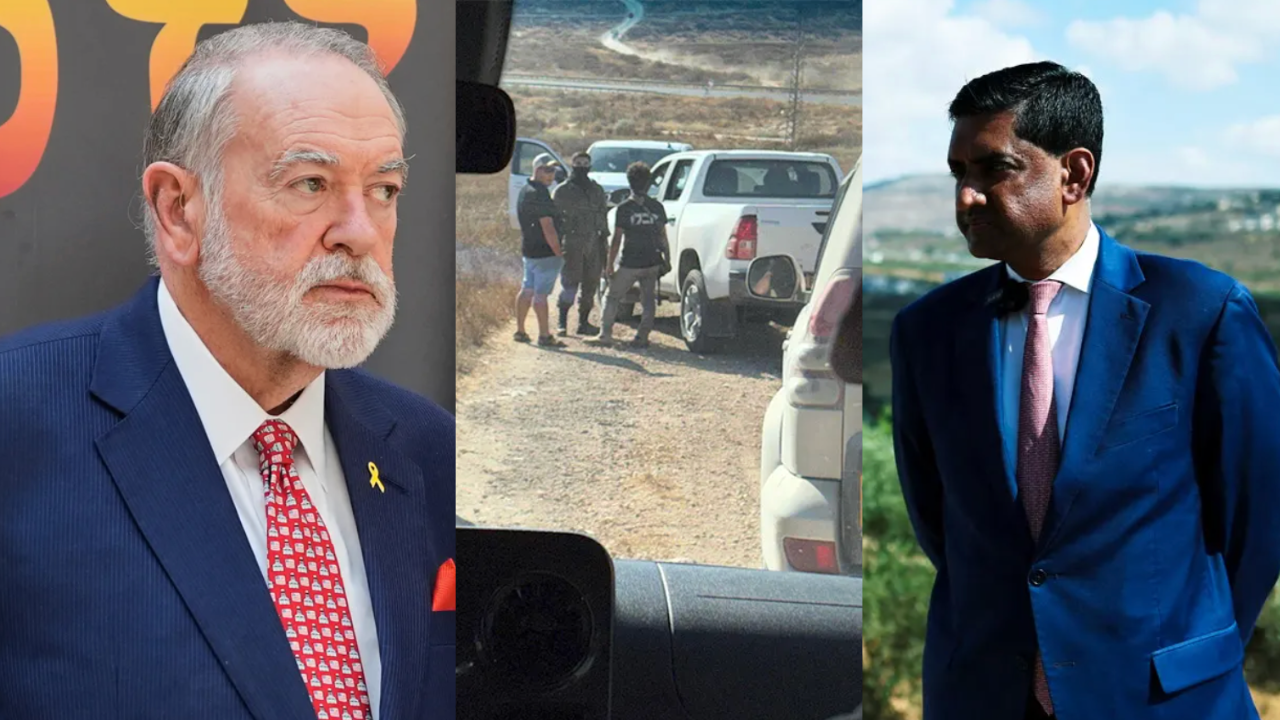
A sharp diplomatic and political feud has erupted following a recent trip to the West Bank by U.S. Representative Ro Khanna, a California Democrat. On Tuesday, U.S. Ambassador to Israel Mike Huckabee publicly accused Khanna of fabricating claims regarding his communication with the American Embassy in Jerusalem. The controversy began last week when Khanna, visiting the biblical heartland of Judea and Samaria, reported that his delegation was aggressively detained at gunpoint by Israeli settlers. Opponents quickly dismissed the trip as a highly coordinated, self-serving political stunt designed to raise his profile ahead of a potential 2028 presidential run, rather than a genuine fact-finding mission. Huckabee took to social media to firmly reject Khanna’s version of events, stating unequivocally that the embassy had no prior knowledge of the congressional visit and would have warned the delegation against entering a restricted zone.
In response to the mounting criticism, Khanna stood by his account during an interview with Fox News Digital, insisting his team had indeed notified the Israeli government and was in constant communication with Deputy Chief of Mission David Brownstein during the incident. He described a tense 75-minute ordeal where extremist settlers allegedly blocked their van on a single-lane road, brandished an M4 rifle, and kicked their tires. Khanna demanded that the settlers be prosecuted and called for an investigation into the compliance of Israel Defense Forces (IDF) soldiers, who he claimed sided with the settlers. He emphasized that the purpose of his self-financed, three-day, Palestinian-led tour was to understand the Palestinian perspective after having visited Israel three times previously. Khanna argued that no American passport holder should be subjected to such treatment simply for wanting to hear both sides of the conflict.
The narrative surrounding the detention, however, has been fiercely contested by Israeli officials, independent analysts, and video evidence. Eitan Fischberger, an Israeli Middle East analyst, shared footage on social media that he claimed debunked Khanna’s allegations of a violent encounter, calling the release of the video by Khanna’s own activist team a “self-own.” Furthermore, the IDF released a statement clarifying that soldiers responded to reports of foreign nationals entering what was initially believed to be a closed military zone, compounded by reports of Israeli civilians blocking the road. According to the IDF, the military quickly dispersed the civilian blockade, confirmed there was no security threat, and allowed the delegation to proceed within minutes without any physical violence. They noted the armed individual at the scene was an IDF soldier on leave, and emphasized that the entire incident could have been avoided had Khanna coordinated his diplomacy in advance.
The fallout from the trip has also exposed deep fractures within the Democratic Party. Fellow Democratic Representative Josh Gottheimer of New Jersey launched a scathing critique of Khanna, calling his journey “appalling” for ignoring opportunities to meet with survivors and hostages of the October 7 Hamas terrorist attacks. Gottheimer accused Khanna of riding an “anti-Zionist wave” to create a campaign cameo for a future presidential bid. Khanna defended his record, pointing out his prior meetings with Israeli hostage families, but remained firm that this specific trip was dedicated solely to exploring the West Bank. When questioned about his broader stance on the region, Khanna reiterated his condemnation of Hamas as a terrorist organization and affirmed Israel’s right to exist. However, he stopped short of labeling the Hamas charter or the October 7 massacre as “genocidal,” choosing instead to describe them as acts of violent antisemitism.
From Jerusalem, diplomatic and security analysts viewed the incident as a calculated provocation. Yechiel Leiter, Israel’s Ambassador to the United States, released a detailed statement explaining that Khanna was explicitly offered comprehensive logistical and security coordination by the Israeli government, which he chose to ignore. Leiter accused the congressman of bypassing standard diplomatic channels to deliberately generate an anti-Israel media frenzy, weaponizing terms like “apartheid” and “genocide” to appeal to his political base. Despite the fierce exchange of words, Khanna indicated he has reached out to Leiter’s office to accept an invitation to meet, expressing a desire to turn the controversial incident into a constructive dialogue regarding the daily lives of ordinary Palestinians.
As the dust settles, experts warn that the episode reflects a broader, worrying trend in American political campaigns. Dan Diker, president of the Jerusalem Center for Security and Foreign Affairs, remarked that Israel has increasingly become a battleground for domestic U.S. politics. He argued that the progressive flank of the Democratic Party is increasingly utilizing “Israel cancellation” and shifting legitimacy away from democratic allies toward entities like the PLO to win over progressive voters. According to Diker, using highly sensitive foreign policy arenas for personal political theater distracts from critical global security threats, including Iran’s state-sponsored regional terrorism and its ongoing attempts to destabilize the global economy.