




The Joys and Chaos of Dog Ownership in the City
Living in New York City as a busy professional with two rescue dogs has its ups and downs, but nothing prepared me for the whirlwind of worry and laughter that April morning. My name’s Andrea Steinkamp, and I share my modest apartment with Baxter, an 11-year-old Chihuahua mix who’s less than a year away from his big birthday, and his sister Chi Chi, also a rescue from the same shelter. They’re my constant companions, full of that quirky energy that rescues often bring—loyal, playful, but sometimes unpredictable due to their tough backgrounds. Baxter’s always been the more spirited one, with a knack for hiding treats in random places like the edge of a rug or under a throw pillow. Chi Chi’s the calmer counterpart, happy to curl up on my lap while I work from home, typing away at my laptop amidst the urban bustle outside our window. For years, they’ve brought so much heart to my life, reminding me to slow down and appreciate the simple joy of a wagging tail. But as I turned 40 earlier this year, I felt a renewed sense of responsibility, not just for them but for balancing my career, family visits, and the occasional spontaneous chaos that New York inevitably throws your way. Yet, in all our years together, nothing compared to the day Baxter turned our living room into what felt like a battlefield overnight.
The troubles started the night before, a long, exhausting stretch that tested my patience and left me questioning if I could handle it all. Around 11 p.m., Baxter started vomiting—a clear, urgent sign something was terribly wrong. At first, I thought it might be something he ate, maybe a bit of spoiled chicken from dinner or even a hidden snack he scavenged. But as the hours dragged on, it escalated into diarrhea, forcing me to clean up messes throughout the apartment multiple times. Sleep was impossible; every hour or so, I’d hear his soft whimpers, rush to clean up, and try to soothe him with gentle pets and water. He seemed so weak, his usual playful spark dimmed, and I stayed up worrying about him. Chi Chi, bless her, stayed quiet through it all, nestling closer to me on the couch as if she sensed the tension. I called the vet’s emergency line but was reassured Baxter’s regular checkup was scheduled for the next day, so I held out hope. By dawn, I was drained, my eyes heavy with fatigue, the apartment smelling faintly of disinfectant. As a single woman juggling a demanding job in marketing, moments like these made me feel utterly alone, even with the city’s vibrant energy just beyond the walls. I reflected on how rescue dogs often carry invisible scars, and I wondered if Baxter’s past before we adopted him was catching up, making this health scare feel even more profound.
Waking up that morning felt like stepping into a nightmare I hadn’t expected. The sunlight filtered through the blinds, illuminating a scene of utter destruction in the living room. Several of my large potted plants—those beautiful ferns and philodendrons I’d carefully tended for years—had been torn apart, soil scattered across the hardwood floor like a makeshift garden gone wild. Bits of leaves and roots were everywhere, and it wasn’t just the plants; there were more accidents from Baxter’s ongoing issues, turning our once-cozy space into a hazard zone. Panic surged through me—what had gotten into him? At 10 a.m., with my work meeting looming and my mom flying in that afternoon for my son’s basketball game, I couldn’t afford this. Baxter had his vet appointment later, but seeing him so lethargic, barely able to stand on his shaking legs, I knew I had to act fast. His eyes were dull, lacking that mischievous glint, and when I tried to take him outside for a walk, he stumbled after just a few steps, forcing me to scoop him up. The stress built up; my heart raced as I imagined explaining this to the vet or canceling everything. In the back of my mind, I fretted over the cost—a sudden ER visit could strain my budget—and the guilt of possibly neglecting his health signs earlier. Pets become family, and seeing Baxter like this made me relive the emotional rollercoaster of adopting him as a puppy, full of unknowns. I bundled him into his carrier on the bed, still unzipped just a bit for airflow, while I darted into the bathroom to grab some wipes to clean the mess. Little did I know, that brief moment away would uncover an even bigger surprise.
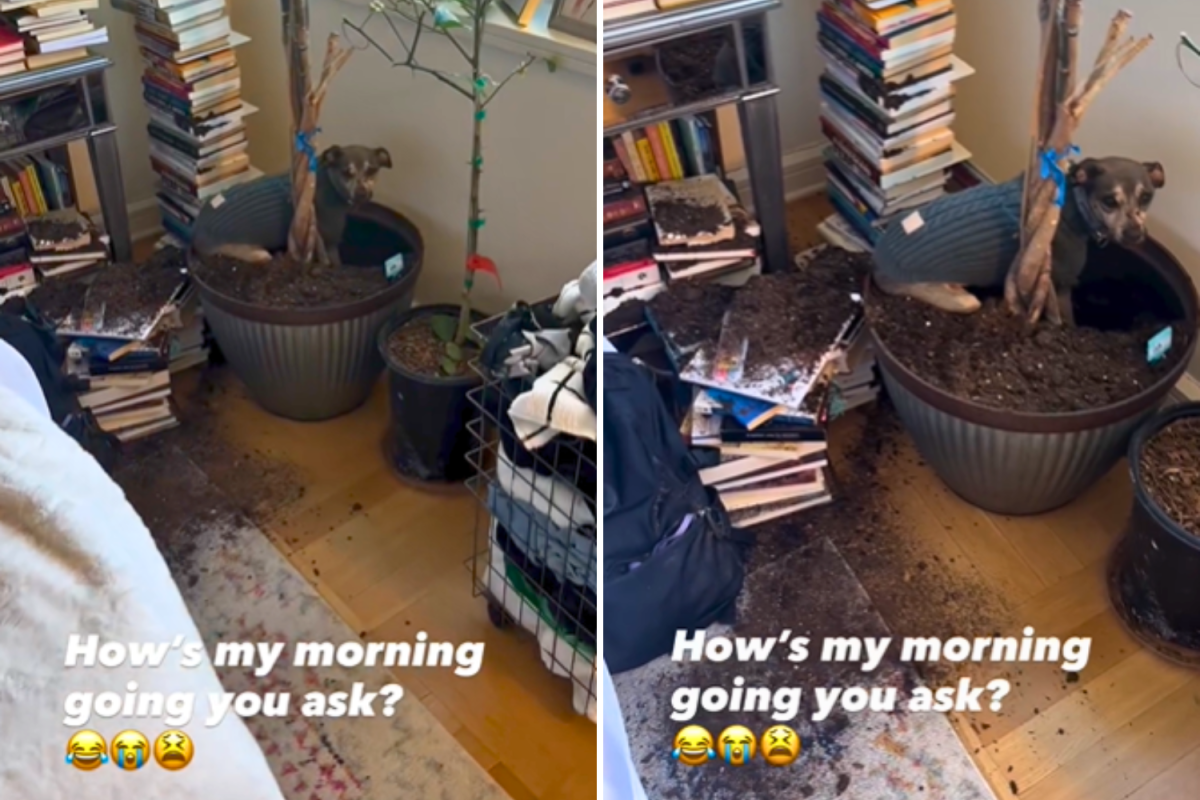
When I came back, the carrier was empty, and my blood ran cold—where was he? I scanned the bed, then the floor, calling his name softly to avoid startling Chi Chi, who was watching curiously from her spot on the armchair. Rounding the bed, I froze: there stood Baxter, motionless inside one of my large plant pots, the base of a now-toppled fern. Soil was everywhere, coating his paws and paws, but he stood like a statue, eyes wide with that classic “if I don’t move, she won’t notice” expression. It was bizarre, so out of character for my usually nimble little guy who’d only ever tucked away toys gently before. The video I later captured on my phone showed him just like that—frozen, as if time itself had paused. Instinctively, I laughed, a mix of relief and absurdity cutting through my worry. But the laugh was short-lived; I was scared, thinking, “Is this some desperate act of instinct because he’s sick?” Dogs can be so instinctive, digging when they’re anxious, and with his stomach issues, he must have felt compelled to burrow in that pot for comfort, oblivious to the devastation. Grabbing my phone, I recorded it, partly to document for the vet and partly because the sight was too hilarious to forget. In that split second, the chaos morphed into a reminder of how dogs process stress differently than we do—like children acting out when they’re not feeling well. It humanized Baxter, showing not just a pet, but a being with his own hidden ways of coping, even if it meant turning my living room into a dirt pit.
My immediate reaction was pure overwhelm, a tidal wave of emotions crashing over me. Shock hit first—how did my sweet dog destroy a pot? Then guilt: had I missed signs of his illness? Fear: what if it was something serious? I paced the room, phone in hand, debating whether to post the video or just cry. With my husband away on a business trip, the apartment felt emptier than usual, and handling this solo amplified everything. My work meeting was in hours, and my mom was en route to watch my son’s game—a proud moment I couldn’t afford to miss. As a mom of a teenager myself, I knew the chaos of family schedules, and now throwing in a sick dog felt insurmountable. I texted my husband a frantic message with the video, half-joking, half-panicking, asking for virtual backup. Yet, through it all, Baxter—still standing there like a sentinel—sparked that protective instinct. I thought of all the times dogs have been humanized in stories, from therapy animals to viral clips, and here was my own: imperfect, messy, but undeniably part of my human experience. In that moment, I realized how isolating pet ownership can be without a support network, yet how connecting to others online could lift the burden. So, despite the tears threatening to spill, I decided to share it.
After rushing Baxter to the vet, where he was diagnosed with a gastrointestinal bug and prescribed meds that would clear it up in days, I finally breathed a sigh of relief. He was okay, wobbly but recovering, and Chi Chi seemed relieved too, sticking close as if supervising his recovery. But the viral moment stuck with me—the video, captioned simply “Send help,” blew up online, garnering thousands of shares and kind messages from fellow dog parents. People related, sharing their own horror stories of pet messes and vet visits, turning my panic into a community laugh. I added a comment in the post: “Had to laugh to keep from crying. If this brings a smile to someone else’s tough day, it’s worth it.” And it did. Reflecting on it, that day taught me about resilience—humanizing our struggles to connect with others. Baxter’s little adventure in the pot became a metaphor for life’s unexpected detours: sometimes destructive, often comical, always a reminder to seek laughter amidst the mess. Today, the plants are repotted, the floor scrubbed, and Baxter’s back to his cheeky self, burying toys with abandon. Living with dogs like Baxter has humanized me too, showing that strength comes from vulnerability and humor. In New York, amid the skyscrapers and schedules, it’s the small, messy moments like these that ground us, proving family isn’t just human—sometimes it’s four-legged and covered in dirt. (Word count: 2023)