


Paragraph 1: The Electric Clash in Chicago
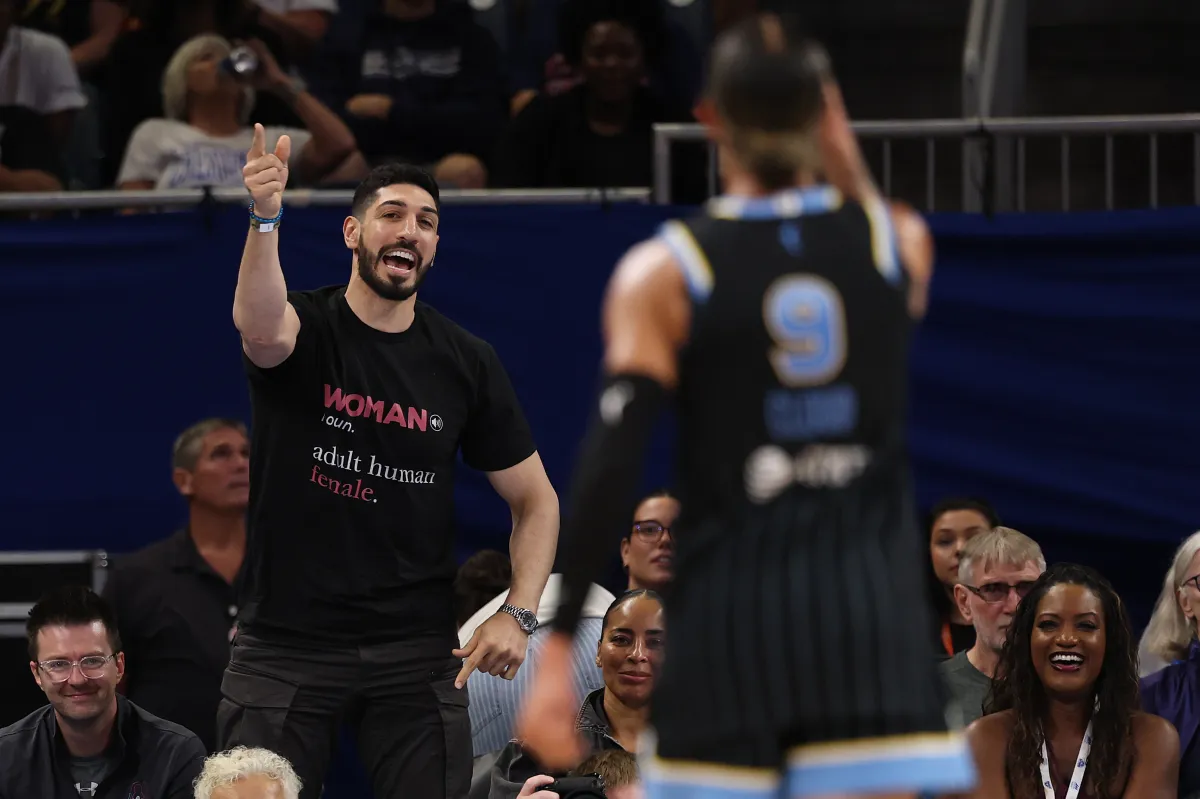
The air inside Wintrust Arena was thick with the electric buzz of a summer rivalry, a palpable energy that usually accompanies a nail-biting clash between the Chicago Sky and the Indiana Fever. Fans were on their feet, the squeak of sneakers and the thud of the basketball providing a rhythmic backdrop to the passionate roars of the crowd. But nestled among that sea of spectators, a different kind of heat was brewing, one that had nothing to do with the athleticism on the hardwood. Enes Kanter Freedom, the former NBA center known as much for his outspoken political activism as his rebounding prowess, had taken a courtside seat, his presence a deliberate statement before the tip-off even occurred. His chosen attire for the evening was a stark, provocative t-shirt emblazoned with the words, “WOMAN noun: adult human female,” a clear escalation of his ongoing public campaign against the WNBA’s transgender participation policies. For most of the first half, he sat as an observer, his presence a silent protest. But as the third quarter unfolded, the silence was broken. A heated exchange erupted between Kanter Freedom and Sky guard Natasha Cloud, who was aggressively working the sideline during a stoppage in play. The verbal sparring, loud enough for nearby fans to witness, drew the immediate attention of security officials. Within moments, the scene transformed from a basketball game into a security situation as Kanter Freedom was physically escorted from his seat and out of the arena, his ejection punctuating a moment that would overshadow the final score for days to come. The initial reports were muddled—whispers of trash talk, claims of provocation, and a player who refused to back down—but the image of the former NBA star being led away by security became an instant viral flashpoint.
Paragraph 2: The Swift and Decisive Fallout
The immediate aftermath of the ejection was a frenzy of speculation, but the Chicago Sky organization did not let the dust settle for long. In a move that signaled just how seriously they viewed the incident, team owner Michael Alter stepped forward to announce a stark and sweeping penalty: Kanter Freedom was banned indefinitely from attending any future Sky games at Wintrust Arena. This was not a slap on the wrist or a temporary measure to let tempers cool; it was an unequivocal revocation of his access to the venue. Alter, speaking to Front Office Sports, made it clear that this was not a decision made lightly, but one rooted in a fundamental breach of the team’s code of conduct. The owner’s words carried a weight of finality, stating that Kanter Freedom would not be welcome back “unless sometime in the future, he’s able to prove to us that he’s able to abide by our rules without being a potential threat.” The operative word here is “prove”—the onus is entirely on Kanter Freedom to demonstrate a fundamental change in behavior, a tall order for a man who has built his public persona on loud, unapologetic confrontation. Before issuing the ban, Alter conducted his own due diligence, engaging in conversations with multiple individuals seated in the same courtside section as the controversial figure. These witnesses painted a consistent picture, confirming that it was Kanter Freedom, not Cloud, who initiated the “dialogue” and subsequent “engagement” that spiraled out of control. Their testimonies effectively corroborated the team’s decision, ensuring that the ban was not merely a reactionary measure but a calculated response to a clearly identified breach of decorum.
Paragraph 3: The Thin Line Between Fandom and Threat
To understand the severity of the punishment, one must dissect the nature of the interaction itself, a complex tapestry of provocation, passion, and physical boundaries. Owner Michael Alter provided a nuanced characterization of the confrontation, describing it as “trash talking, nothing personal, basketball-related.” On the surface, this might sound like the harmless banter that happens at every sporting event in America. Fans yell at players constantly, and athletes often dish it right back. However, Alter was careful to draw a crucial distinction between harmless heckling and something far more sinister. He conceded that while Kanter Freedom did not physically step over the baseline and onto the court, he fundamentally altered the dynamic by standing up from his seat and approaching the playing surface to engage Cloud directly. This physical movement, this escalation from a seated spectator to an upright, advancing figure, is where the situation crossed a critical threshold. In Alter’s eyes, this action “turned himself into a threat.” It transformed a verbal exchange into a potential physical confrontation, creating a scenario where the safety of the players—the primary assets and human beings the league is obligated to protect—was brought into question. The proximity was the problem. By rising and closing the distance, Kanter Freedom forced security into a reactive posture, turning what should have been a benign viewing experience into a potential hazard. The team’s decision underscores a modern reality of professional sports: that the line separating a passionate fan from a disruptive interloper is razor-thin, and that when an individual uses their platform to intentionally antagonize a player, the organization has both a right and a responsibility to draw a hard line, even against a famous former athlete.
Paragraph 4: The Activist, The Athlete, and The Calculated Provocation
To fully grasp why this incident occurred, one must look at Enes Kanter Freedom’s complex biography, a life defined by basketball and a relentless, often polarizing, political voice. Drafted third overall by the Utah Jazz in 2011, he carved out a solid, lengthy NBA career, playing for the Oklahoma City Thunder, New York Knicks, Boston Celtics, and Portland Trail Blazers. But his athletic identity was always intertwined with his activism. Following his naturalization as a U.S. citizen in 2020, he added “Freedom” to his name as a rebuke to the oppressive regime in Turkey, a country he cannot visit due to his outspoken criticism of its government. This courage, however, has often manifested in controversial, headline-grabbing stunts. His courtside appearance was not a spontaneous act of sports fandom. Just weeks prior, he had released a viral video in which he declared he was entering the 2027 WNBA Draft, ostensibly to protest the league’s gender identity inclusion policies. His presence at the Sky game, wearing that inflammatory shirt, was the physical manifestation of that political campaign. He was not merely there to watch basketball; he was there to make a statement, to insert himself into a cultural war. Viewed through this lens, his interaction with Natasha Cloud was likely a calculated attempt to elicit a reaction, to force a confrontation that would amplify his message. He succeeded, but the result was a self-inflicted professional and personal ban that supersedes any perceived victory in the culture war. The irony is that a man who has fought so valiantly for his own freedom to speak has now found his freedom to attend a basketball game revoked, a consequence born directly from the manner in which he chose to exercise that freedom.
Paragraph 5: The Professional’s Quiet Dignity and Focus
In the eye of this media storm stood Natasha Cloud, a veteran WNBA star whose reaction, or rather lack of public reaction, spoke volumes about her professionalism and composure. Cloud, a 34-year-old guard who began her WNBA career in 2015, is not a player easily rattled by external noise. Her resume includes a WNBA championship with the Washington Mystics in 2019, a selection to the All-Defensive First Team, and a season leading the league in assists in 2022—a testament to her multifaceted talent and competitive toughness. During the confrontation, she did not shrink away or escalate the physicality; she engaged verbally but allowed security and her own team to handle the situation. In the aftermath, when the media scrum descended looking for a soundbite, she chose silence. She did not appear at any postgame press conferences to discuss the altercation, denying the former NBA player the oxygen of a public response. Instead, according to a Sky spokesperson, she spoke privately with team and league security following the game, ensuring that the appropriate protocols were followed. This quiet handling of the incident is a masterclass in conflict management. By refusing to elevate Kanter Freedom’s platform through a public war of words, Cloud maintained her focus on her craft and her team, demonstrating that in a league defined by resilience, she is a pillar of stability. While Kanter Freedom sought to hijack the game’s spotlight for his own political agenda, Cloud’s dignity served as a stark contrast, reminding observers that true strength often lies not in the loudest voice in the room, but in the disciplined refusal to be drawn into a circus.
Paragraph 6: The Broader Implications and a League’s Fortitude
The saga of Enes Kanter Freedom and the Chicago Sky is far more than just a story about a heckler getting thrown out of a game; it serves as a compelling case study in the evolving landscape of professional sports, security protocols, and the intersection of political speech with live entertainment. Sources have confirmed that the WNBA, at the league level, will not issue a nationwide ban against Kanter Freedom, meaning he is still free to purchase tickets to games in other arenas. This decision respects the autonomy of individual teams and venues to manage their own environments while avoiding a heavy-handed, league-wide edict that could set a dangerous precedent for restricting fan attendance. Yet, the Sky’s decisive action sends a powerful message to all athletes, past and present: that the sanctity of the playing environment is non-negotiable. For a league that has historically been at the forefront of social justice movements, standing firm against a figure who uses his platform to target its players is a significant assertion of authority and self-respect. The incident highlights a growing tension in our society—the conflict between an individual’s right to protest and a business’s right to maintain a safe, distraction-free environment for its employees. Kanter Freedom’s “threat,” as Alter framed it, was not necessarily physical violence, but a threat to the professionalism and safety of the atmosphere. By banning him, the Sky have established a clear boundary, signaling that while political discourse is welcome in the public square, it cannot be forcibly injected onto the basketball court under the guise of a fan’s privilege. The message echoed by the organization is clear: respect the game, respect the players, and respect the house or lose the right to be a guest in it.