





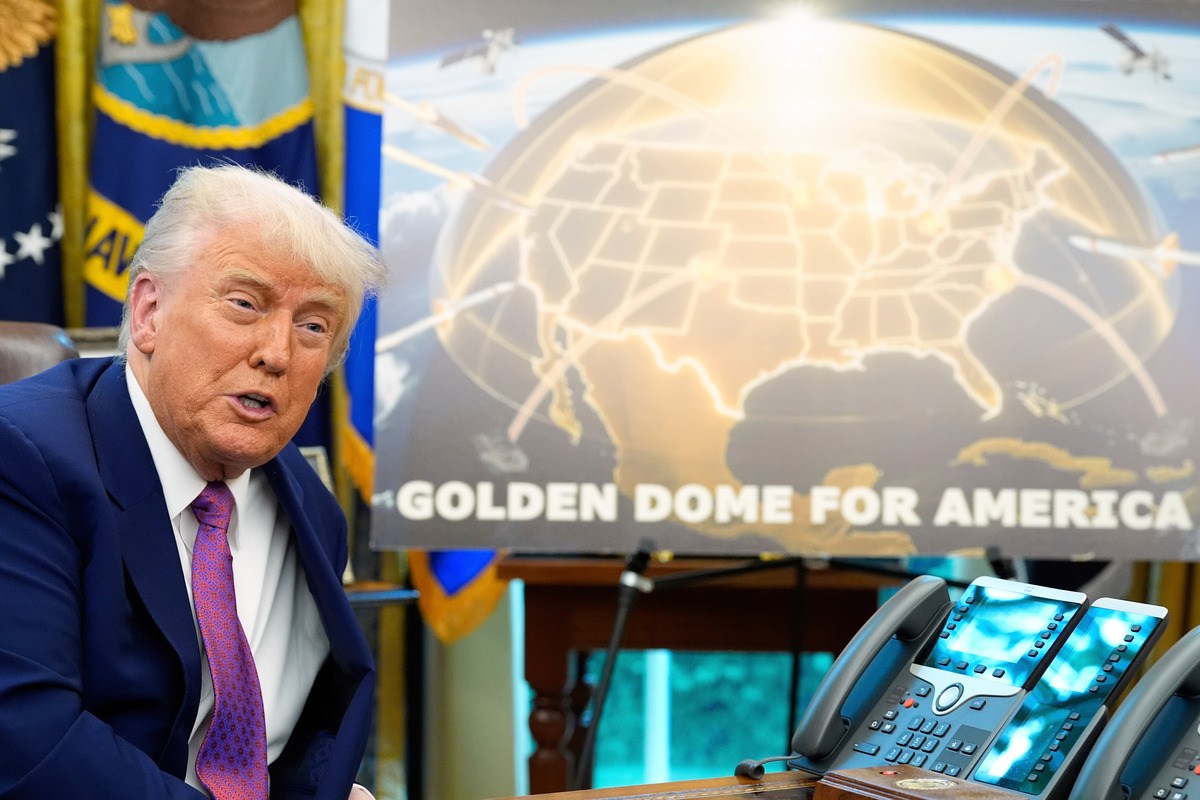
At a crowded diplomatic table in Geneva, a senior Russian official chose his words very carefully. Gennady Gatilov, Russia’s ambassador to the United Nations, said the world has reached a turning point: the idea of war in space is no longer science fiction, but a planning assumption. His warning, carried by Russian state news agency Tass, was blunt. The risks of turning outer space into an arena of armed confrontation have ceased to be hypothetical, he said, and the consequences would be devastating for all of humanity. The spark for that warning is the Golden Dome, the missile defense project championed by President Donald Trump. The concept is ambitious: a layered shield that would use space-based sensors and orbital interceptors to shoot down enemy missiles on their way to American soil. It is a departure from past systems, which relied more on ground-based batteries and radar. Putting weapons in orbit has long been a political and military taboo. Since the earliest days of the space age, satellites have been used for espionage, communication, navigation, and early warning—critical jobs, but nonviolent ones. The Golden Dome turns that understanding on its head. Instead of keeping space a sanctuary, Washington would be placing weapons above the planet, ready to fire. Moscow and Beijing are suspicious, to put it mildly. Russian President Vladimir Putin and Chinese President Xi Jinping jointly declared in May that the Golden Dome is an obvious threat to strategic stability. North Korea chimed in, saying the program reeks of self-righteousness and arrogance. From the administration’s perspective, all this criticism misses the point. The United States faces potential adversaries—Russia, China, and others—with growing arsenals of hypersonic and intercontinental ballistic missiles that can travel at speeds greater than five times the speed of sound. Defending the homeland, the argument goes, requires shooting bullets with bullets in space. But the warnings are hard to ignore. For Gatilov and other skeptics, the Golden Dome may be more than an expensive shield; it may be the opening of a new chapter in an arms race, one that no one has yet figured out how to stop.
To understand why the Golden Dome is so polarizing, it helps to look at both the promise and the price tag. Trump has said the technology is now ready. He has invoked the memory of President Ronald Reagan’s Strategic Defense Initiative, better known as Star Wars, which envisioned lasers in space to neutralize Soviet missiles. That program was never completed, but the dream never died. Now, decades later, a generation of entrepreneurs and defense engineers believe they can actually build the shield. The White House argues that the United States has no choice. Enemy countries, especially Russia and China, are pouring money into hypersonic weapons and advanced ballistic missiles, sometimes with speeds over Mach 5. American and NATO development of those weapons has lagged, leaving a vulnerability for homeland defense. The Golden Dome is meant to fill that gap. Instead of relying solely on ground interceptors, it would put an early-warning layer in space and then use orbiting kill vehicles to destroy incoming threats. Yet the engineering and financial challenges are enormous. The Congressional Budget Office, the nonpartisan budget watchdog for Congress, recently estimated the program would cost around $1.2 trillion over the next two decades—far more than the $175 billion initially allocated. And the space-based components alone would account for up to 70 percent of acquisition costs and about 60 percent of the overall bill. To put that in human terms, the projected price tag is larger than the entire annual budget for many nations. But cost is not the only concern. The CBO also assessed whether the shield would actually work. In a report issued in May, it concluded that the Golden Dome could probably handle a small-scale assault, perhaps something like a limited North Korean launch. It would be overwhelmed, however, by a full-scale coordinated attack from a major power like Russia or China. That sobering conclusion undercuts the central selling point: that the system will protect all Americans, all the time. Still, the project is moving forward. Dozens of companies are competing for contracts. Lockheed Martin and Northrop Grumman, both defense giants with decades of experience, are among the front-runners. The U.S. Space Force says it expects to demonstrate an initial capability by 2028. For supporters, that is a breakthrough. For critics, it is a recipe for committing trillions of taxpayer dollars to a system that may be outdated the moment it is finished—and may, by provoking Russia and China, make the world less safe rather than more.
One of the most striking aspects of the Golden Dome is how much remains unknown, even at the highest levels of American government. David Mosher, a senior official with the Congressional Budget Office, said in late May that his agency had not been able to get briefings from the Pentagon team overseeing the program, despite requesting updates. “I know nothing about what they’re actually building,” Mosher admitted at the Brookings Institution. For a project of this size, that is astonishing. It is as if a homeowner agreed to a million-dollar renovation and then discovered the contractor would not provide detailed blueprints. The Pentagon’s secrecy may reflect the sensitivity of missile defense technology, but it also feeds anxiety among lawmakers who must authorize massive spending. Senator Jeff Merkley, an Oregon Democrat, and three other Democratic colleagues have gone further, warning that the Golden Dome would be detrimental to U.S. and global security because it could ignite a nuclear arms race with Russia and China. To them, the program is not just a defense project; it is a provocation that will push adversaries to build more missiles and more countermeasures, making the world more perilous. There are also serious unresolved questions about what the shield can actually do. Space-based interceptors would need to distinguish incoming warheads from decoys, coordinate with ground radar and satellites, and operate autonomously in the chaos of an attack. Every stage of that mission is extremely difficult. Then there is the question of cost-effectiveness. Missiles used in an attack are often far cheaper than the interceptors that have to shoot them down. This is a familiar problem for militaries around the world. During recent operations in the Middle East, the United States spent heavily to intercept drones and missiles launched by Iranian-aligned forces. Some adversaries have learned that a $20,000 drone can force a multi-million-dollar response. The Golden Dome is supposed to focus on ballistic missiles and hypersonic weapons, but the Pentagon’s own National Defense Strategy, released in January, says it wants a “specific focus on options to cost-effectively defeat large missile barrages and other advanced aerial attacks.” Those words are easy to write, but extremely hard to execute in the real world. For all the political spin, the program is still in its early stages, and the path from concept to reality is littered with technical hurdles, budget battles, and strategic uncertainty.
The Golden Dome also raises questions that have less to do with rockets and more to do with geography and alliances. The system is intended to cover the continental United States, Alaska, and Hawaii. But what about Canada? Washington has opened talks with Ottawa about placing Canada under the Golden Dome’s umbrella, and it has made clear that doing so would cost Canada tens of billions of dollars. This creates a strange paradox. For generations, the United States and Canada have jointly defended North America through the North American Aerospace Defense Command, known as NORAD. The commander of NORAD is an American, and the deputy is Canadian. The two militaries monitor the skies together, and for long-range missile threats, their operations are deeply interconnected. It is very difficult to see how a comprehensive shield over the United States could be built without some kind of Canadian cooperation, since warning radars and intercept sites in northern Canada could be vital to detecting and engaging missiles that cross the Arctic. Yet requiring Canada to pay billions for coverage would test the politics of the relationship in a new way. Then there is the drone problem. The Golden Dome’s plan focuses on ballistic missiles and hypersonic vehicles, but the recent experience of the U.S. military in the Middle East has shown how quickly drone swarms can overwhelm defenses. Since the conflict with Iran intensified, American forces have intercepted hundreds of unmanned aerial vehicles, many of them relatively inexpensive compared to the high-priced interceptors used to destroy them. The Golden Dome does not appear to be designed for that kind of threat. At best, it may have some capacity to track and kill certain aerial vehicles; at worst, it could leave American bases and cities vulnerable to attacks that come not from space, but from low-flying, low-cost drones launched by non-state actors or regional powers. The Pentagon insists it is thinking about this. The National Defense Strategy mentions the need to defeat large missile barrages and “other advanced aerial attacks,” suggesting that defense planners know the Pentagon has to broaden its thinking. But no one has yet explained exactly how the expensive space-based layer will handle a swarm of cheap drones, or a mix of drones and missiles aimed at different targets at the same time. This is not merely a technical question; it is a strategic one. The Golden Dome is being sold as a new type of shield for the American homeland, but the threats it faces are changing faster than the program can adapt.
Stepping back, the larger danger may be the message the Golden Dome sends to the rest of the world. For decades, superpowers have competed in space, but they have generally avoided putting weapons in orbit. That restraint is exactly what the Russian envoy claims is at risk. Once the United States places armed interceptors in space, it becomes much easier for Russia, China, and other nations to justify doing the same. They might develop their own space-based weapons, or more likely, they will build anti-satellite systems designed to destroy the U.S. constellation. The result could be a hair-trigger environment, where a single malfunction, a miscalculated radar return, or a cyberattack could start a conflict nobody intended. The Cold War created a comparable dynamic on Earth. Both sides built thousands of nuclear warheads, and the world survived, in part, because each side knew a devastating response was inevitable. But space is different. The environment is more fragile, and the consequences of a single strike on a satellite could cascade into debris fields that damage all satellites, including those of the country that launched the attack. This is not an abstract fear. One collision or interception in orbit can create tens of thousands of pieces of shrapnel, traveling at speeds of many kilometers per second. There is no way to clean them up. In a sense, space warfare is self-destructive: the very conditions that make space useful—clear orbits, predictable paths, functioning satellites—could be destroyed in a matter of hours. That may be why Russia and China have offered a more political objection. They see the Golden Dome as an attempt by Washington to achieve a kind of global dominance, to protect itself from retaliation while keeping its own ability to strike anywhere. Putin and Xi called it an obvious threat to strategic stability because, in their view, it erodes the doctrine of mutual assured destruction that has kept great powers from fighting each other directly for decades. If the United States can block a missile strike, then the nuclear balance shifts. Russia and China might become more aggressive, not because they want war, but because they fear losing the leverage that comes from being able to threaten retaliation. Whether those fears are realistic or just rhetoric, they are powerful forces in world politics. The Golden Dome is not simply a defense program; it is a statement of intent. And statements of intent are often interpreted differently than the speaker intended.
In the end, the Golden Dome is a story about hope and fear, technology and trust. To its supporters, it represents a technological leap that could finally make good on the old dream of defending the homeland from missile attack. They imagine a future in which American children do not have to live under the shadow of an attack from Russia, China, or a rogue state. To its critics, the program is a hallucination—an unaffordable, unproven, and potentially destabilizing project that will not deliver the promised security and will likely make the world more dangerous. The debate is not just about dollars; it is about what kind of world we want to inhabit. Do we want a world in which space remains a quiet zone, where satellites do their vital work without being shot at? Or do we accept that the next war could begin with satellites flashing into flames above our heads? There is no easy answer. The United States has a right—some would say an obligation—to defend its citizens from emerging missile threats. Yet the words of Gennady Gatilov linger: “Its consequences will be devastating for all of humanity.” That is a warning from a rival, so it should be filtered accordingly. But it is not only rivals who are worried. American lawmakers, policy experts, and even the nonpartisan Congressional Budget Office have raised serious doubts. The program’s costs are staggering, its timeline is uncertain, and its capacity to defeat a full-scale attack is doubtful. The Space Force promises an initial capability by 2028, but “initial” is a slippery word. What happens after that, no one can say with confidence. In the meantime, the United States is committed to pushing ahead, and the world is watching. The hope is that a successful Golden Dome will deter attack and make war less likely. The fear is that by putting weapons in space, we will start a race that cannot be won, and that the next generation will inherit not a shield, but a battlefield. The golden age of space exploration may be giving way to a more dangerous era—one in which the ultimate high ground becomes just another front line.