





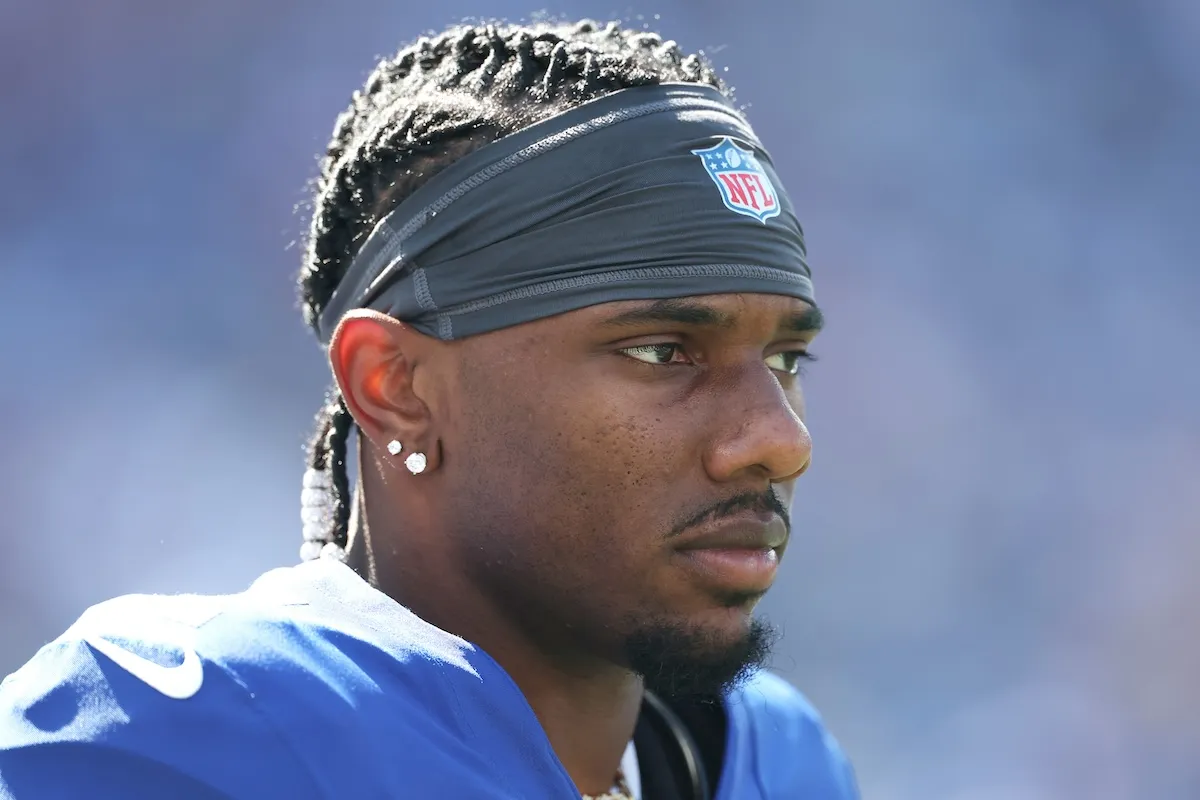
In the whirlwind world of professional football, where dreams are built on lightning-fast plays and unbreakable determination, Malik Nabers emerged as a beacon of hope for the New York Giants in 2024. Bursting onto the NFL scene at just 21 years old fresh from LSU, he wasn’t just another wide receiver—he was the electric spark the Giants desperately needed to reignite their faltering offense. Picture this: a young man straight out of college, speed blurring past defenders, catching passes that seemed impossible, and lighting up scoreboards. By his rookie year, Nabers had transformed the Giants’ rebuild into something exciting, becoming the team’s top target and a nightmare for opposing defenses. Fans across New York started buzzing with excitement, imagining championships and glory. But football is a cruel game, balancing euphoria with heartache, and for Nabers, the dream hit a brutal wall. On September 28, 2025, during a pivotal game, a devastating ACL tear coupled with a meniscus injury tore through his knee, slashing his season short. Suddenly, questions loomed large: Would this explosive playmaker ever return to form? Could he reclaim the explosiveness that made him untouchable? In that moment, Nabers’ promising story took a turn, leaving fans and teammates wondering if the Giants’ centerpiece was forever altered.
Before the injury shattered everything, Nabers had painted a picture of pure dominance on the field. As a rookie in 2024, he hauled in an astonishing 109 receptions out of 170 targets—the second-highest in the NFL—racking up 1,204 yards and seven touchdowns. Imagine him gliding through zones, his route-running sharp as a tack, and his chemistry with quarterbacks turning into poetry in motion. He wasn’t just collecting stats; he was the heartbeat of the offense, drawing double coverage and creating opportunities for everyone around him. Teammates spoke of his infectious energy in the locker room, his smile bright even after grueling practices, and the way he’d celebrate each catch like it was the first. In training camp, Nabers showed glimpses of greatness, pushing through drills with a hunger that hinted at superstardom. When the season kicked off, he carried that momentum, becoming the engine of the Giants’ attack. In 2025, just three games in, he amassed 251 yards and two scores on 16 catches, including a jaw-dropping 167-yard outburst against the Cowboys in Week 2. Paired with rookie quarterback Jaxson Dart, Nabers seemed to synch up effortlessly, their connection blossoming like a well-timed touchdown pass. Off the field, Nabers was the guy who mentored younger players, sharing stories of his college days at LSU, where he turned heads with records in receiving yards and touchdowns. He embodied the hope of a franchise, a kid from nowhere making New York feel alive again through sheer willpower and talent.
The injury on that fateful September evening changed Nabers’ trajectory overnight. One wrong step, a sudden pop, and he was on the ground, clutching his knee, waves of pain etching across his face. Medics rushed in, and in the blink of an eye, his sophomore season evaporated. For a player like Nabers, known for his elusiveness and burst—qualities that come from nimble cuts and explosive accelerations—an ACL tear strikes at the core of what makes him unstoppable. The meniscus damage added another layer of complexity, raising immediate concerns about his availability for 2026 and whether he’d fully regain that edge. Fans watching from their couches felt the sting, remembering how he’d dazzled just moments before. Teammates huddled around, offering support, but the reality was stark: surgeries, rehab, and months of uncertainty lay ahead. Nabers, ever the fighter, posted on social media about staying positive, dedicating videos to his recovery, but the road ahead looked daunting. Football demands resilience, and this setback tested Nabers’ spirit, forcing him to confront the fragility of his body against the game’s relentless fury. Would he emerge stronger, or would this be the blow that dims his star?
Just as whispers of doubt began to swirl, a flicker of hope arrived in the form of an updated injury report ahead of the Giants’ OTAs. Reports revealed that Nabers had undergone a second knee procedure multiple weeks ago, a targeted surgery to excise stubborn scar tissue causing stiffness. Internally dubbed a “cleanup,” this arthroscopic intervention wasn’t a setback—it was a proactive step, and crucially, it wasn’t expected to derail his original recovery schedule. For those in the know, it painted Nabers as a diligent patient, working tirelessly behind the scenes to return at full throttle. The Giants’ medical staff, meticulous and experienced, had been monitoring his progress closely, and this minor tweak demonstrated their commitment to his long-term health. Nabers himself remained upbeat, sharing glimpses of his rehab routines on video, pumping weights and visualizing comebacks. It was a reminder that even superstars face these hurdles, turning what could be a narrative of decline into one of perseverance. Fans, already invested in his journey, latched onto this news as a sign that the Malik energy might be back sooner than feared.
Diving deeper into the medical side, scar tissue buildup—known as arthrofibrosis—is a common hurdle in ACL recoveries, especially after the combined tear and meniscus repair Nabers endured. Imagine layers of fibrous tissue forming where smooth cartilage should glide, restricting motion and dulling that explosive athleticism that defines receivers like him. Surgeons often intervene with a minimally invasive scope to clear it out, restoring flexibility and accelerating the healing process. For Nabers, this procedure was precisely such a clean-up, aimed at banishing stiffness without prolonging downtime. Timing played a key role here; his initial surgery back in late October 2025 put him about six-and-a-half months into recovery—a pivotal point where players shift from basic rehab to high-intensity football drills, like sharp cuts and quick changes in direction. If scar tissue had been hampering that progression, this intervention could actually fast-track his readiness for the regular season, rather than hinder it. Historically, ACL returns for skilled players like Nabers aren’t straight lines; they zig-zag, requiring nine to twelve months for a comeback, and often an extra year to recapture full form. Yet, with this procedure, optimism prevailed, showing that modern medicine and dedicated care can rewrite even the toughest sports scripts.
Looking ahead, the Giants’ 2026 offseason loomed as a new chapter for Nabers and the team. OTAs kicked off on May 19, stretching through June 4 with sessions scattered across those dates—May 19-21, 27-29, and June 1-4—providing structured workouts to rebuild strength and synchronicity. Players rehabbing from injuries like Nabers often use these as litmus tests, easing back into team drills under the watchful eyes of coaches. Mandatory minicamp followed on June 8-10, a critical milestone where injured stars must demonstrate progress to secure roster spots and build confidence. Training camp, though not yet announced, was slated for late July, marking the final ramp-up before the season opener. For Nabers, these dates represented milestones in his comeback story, a personal challenge to prove that stubbornness and skill could overcome adversity. Teammates cheered on the sidelines, and fans tuned in, hoping to see that familiar burst return. As the NFL buzzed with predictions and new content—think Kyler Murray’s QB battles or Netflix’s added flicks—the Giants prepared for a year where Nabers could redefine what resilience means. In the end, football rewards the relentless, and Nabers, with his human spirit intact, seemed poised to soar again. (Word count: 2012)