


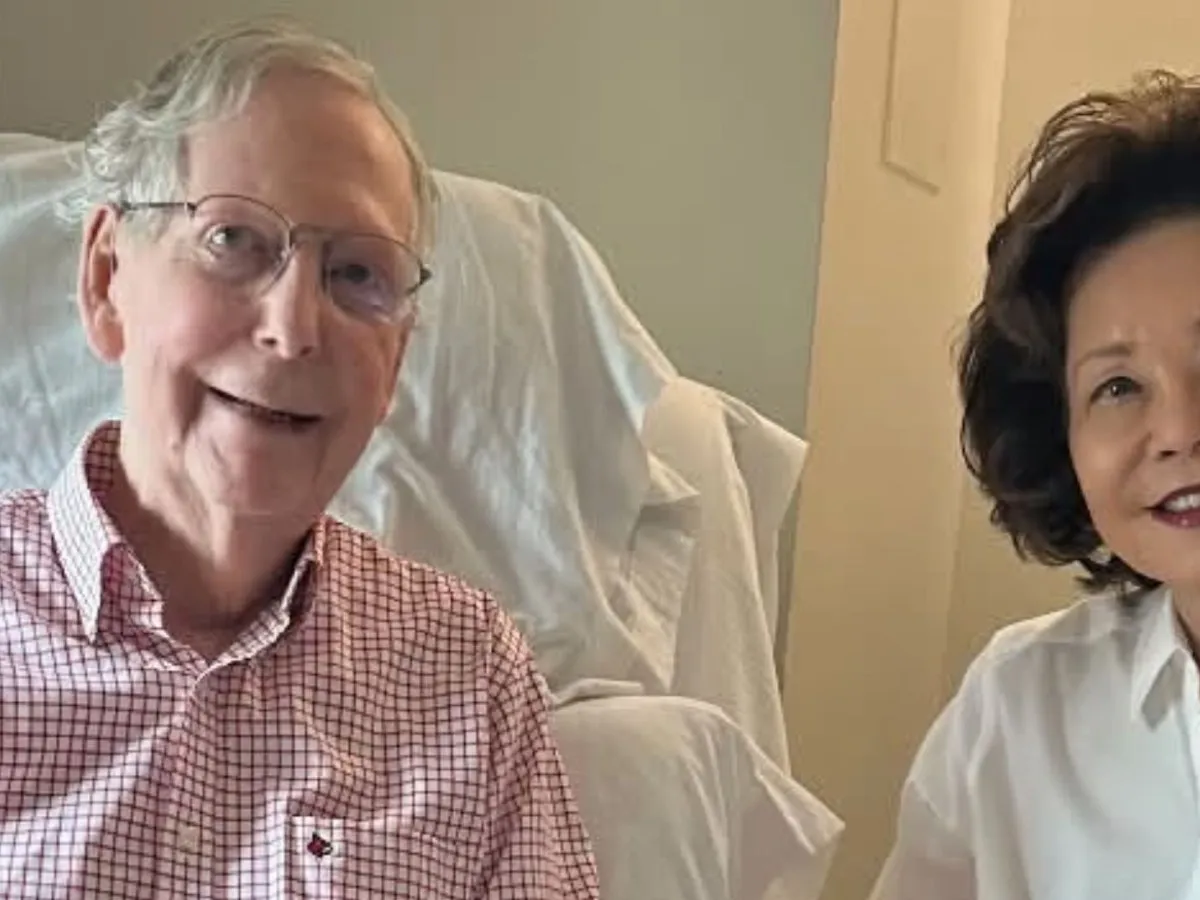
After a prolonged and worrisome silence surrounding his health, 84-year-old Senator Mitch McConnell recently reached out to the public by sharing a photograph on Facebook. The image, which depicts the Kentucky Republican sitting in a hospital chair alongside his wife, Elaine, was intended to quiet the mounting rumors about his condition following a weeks-long hospitalization that began on June 14. In his post, McConnell explained that his extended stay was the result of a fall compounded by a mild case of pneumonia. Rather than reassuring the public, however, the photograph has ignited a firestorm of skepticism across social media, with numerous users suggesting the image is actually an artificial intelligence creation designed to mask a much more dire health crisis.
The digital skepticism quickly intensified on the platform X, formerly Twitter, where users began meticulously analyzing the visual elements of the photo. Critics pointed out several details they deemed highly suspicious, particularly the newspaper McConnell is holding—which appeared to be a sports section from a July 2026 edition of the Washington Post—and what looked like an unnatural shift in skin tone near his left wrist. Prominent political figures and activists, including former Idaho gubernatorial candidate Mark Fitzpatrick and far-right commentator Laura Loomer, openly questioned the blurriness of the print and the overall authenticity of the scene, claiming that McConnell’s staff had resorted to using an altered image to deceive the public.
This wave of conspiracy theories has also swept up McConnell’s political allies, who have faced intense backlash simply for claiming to have spoken with him. Republican strategist Scott Jennings, a close associate of the senator, became a target of online hostility after posting updates on McConnell’s recovery, with some internet users even baselessly suggesting that the veteran lawmaker had passed away. Jennings later defended his credibility on social media, emphasizing his honesty in the face of widespread public cynicism, but the episode highlights a profound and growing trust deficit between political figures and a highly skeptical electorate.
In his personal update, McConnell sought to provide context for his recovery by addressing his lifelong physical vulnerabilities. He reminded his followers that surviving childhood polio had left him with permanent mobility challenges that have naturally become more difficult to manage with age. He cleared up several rumors by confirming that his medical team found no evidence of broken bones, strokes, heart attacks, or tumors, though he did admit to being briefly unconscious after the fall. While his stay was prolonged by a subsequent bout of pneumonia, McConnell expressed optimism about his transition to a rehabilitation center, where he is currently working to regain his strength.
The debate over the image’s authenticity also prompted users to consult various AI tools, which yielded surprisingly contradictory assessments. When initially questioned by social media users, Elon Musk’s AI assistant, Grok, pointed out subtle inconsistencies in the newspaper’s text and McConnell’s wrist, suggesting the photo bore classic hallmarks of AI generation. However, when later queried directly by reporters, Grok reversed its stance, noting that because the image came from McConnell’s official account and bypassed Facebook’s automated detection systems, it was highly likely to be a legitimate photograph rather than a digital fabrication.
To further clarify the situation, technical evaluations were sought from other advanced AI platforms like Microsoft’s Copilot, which ultimately favored the authenticity of the photograph. Analysts noted that the lighting, shadows, and natural folds of the fabrics in the room appeared completely consistent with a real-world setting, lacking the telltale distortions—such as extra digits or warped facial features—often associated with AI-generated art. While experts acknowledge that extreme digital compression can make real text look suspiciously blurry, the consensus among technical tools suggests the controversial image is a genuine photograph of a recovering statesman, even as the public remains fiercely divided in an era of deep digital distrust.