


Ivanka Trump’s Literary Journey of 2025: Books That Shaped Her Year
As 2025 draws to a close, Ivanka Trump, co-founder of Planet Harvest and daughter of President Donald Trump, has shared an intimate glimpse into her intellectual life by revealing her favorite books of the year. Taking to social media, she curated a thoughtful collection of 17 works that she says “shaped” her throughout the year. “Each one shifted my perspective, some softly, others profoundly,” she wrote with characteristic reflection. “Some I return to again and again, not just for insight, but for alignment.” This literary window offers a fascinating perspective on the former First Daughter’s current interests, spanning from historical fiction to ancient philosophy, showcasing a range that might surprise those who view her primarily through a political lens.
At the top of her list sits Kristin Hannah’s historical fiction masterpiece “The Women,” which Trump praised for its portrayal of “courage, resilience and sisterhood set against war.” Her commentary reveals an appreciation for narratives that center women in historical contexts, noting that the novel “restores women to the center of history and reminds us that some of the bravest acts of service are in the shadows.” Another notable inclusion is Homer’s “The Odyssey,” which Trump revisits annually alongside her children’s school assignments. This year, she’s reading the epic with her daughter Arabella, appreciating how it “honors the long arc of adventure: trials, temptation, wonder and the resolve it takes to press on.” These choices reflect not only her personal literary tastes but also her commitment to engaging with her children’s education through shared reading experiences.
Trump’s list ventures into philosophical territory with selections like Daniel Quinn’s “Ishmael,” which she described as “a quiet, radical dialogue that questions our definition of ‘civilized’ and asks what we’ve traded away to sustain it.” Rick Rubin’s “The Creative Act” appears as “a meditation on perceiving the world as art in motion and on discipline not as constraint, but as devotion,” while Dr. Edith Eger’s “The Choice” offers “proof that even in profound darkness, freedom is an inner decision.” Josh Waitzkin’s “The Art of Learning” explores “mastery through presence and the beauty of deliberate practice,” and Richard Bach’s fable “Jonathan Livingston Seagull” is praised as a metaphorical work “for those unwilling to live within borrowed limits.” These selections reveal Trump’s interest in works that challenge conventional thinking and offer alternative perspectives on human potential and creativity.
Modern wisdom blends with historical philosophy in Trump’s selections. She includes “The Almanack of Naval Ravikant” by Eric Jorgenson, praising how Ravikant “offers clarity on wealth, wisdom and happiness.” Will and Ariel Durant’s “The Lessons of History” reminds her that “perspective is the rarest form of wisdom,” offering “a sweeping distillation of centuries of human civilization” that reduces complex forces to “their enduring patterns.” Joseph Campbell’s “The Power of Myth” appears as “a luminous exploration of how our private lives echo timeless myths,” while Bertrand Russell’s “A History of Western Philosophy” is described as an “intellectual pilgrimage through the architecture of human thought.” These choices suggest Trump values works that distill complex ideas into accessible wisdom and connect individual experience to broader historical and mythological contexts.
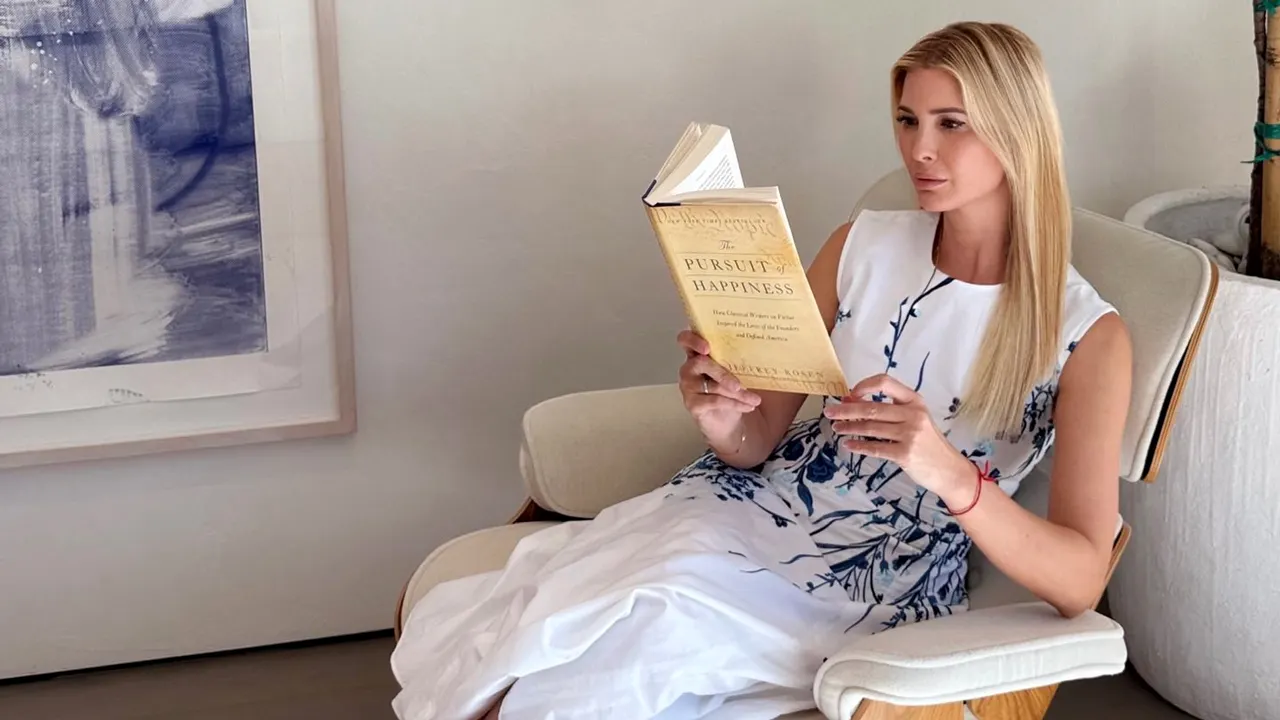
As America approaches its 250th anniversary, Trump highlights Jeffrey Rosen’s “The Pursuit of Happiness,” calling it “a reminder that our Founders saw happiness as a pursuit rooted in virtue and discipline.” Simon Jacobson’s “Toward a Meaningful Life” earns mention for its insight that “purpose is found not in ambition, but in faith and service.” These selections reflect Trump’s interest in works that explore the foundations of American values and the deeper meaning of a purposeful life beyond material or professional success. Her interest in these themes suggests a contemplative side that may not always be visible in her public persona, revealing how she reconciles American ideals with personal faith and service.
Trump concludes her list by sharing four books that permanently reside on her nightstand: Marcus Aurelius’ “Meditations,” Eckhart Tolle’s “Stillness Speaks,” “A Poem for Every Night of the Year” edited by Allie Esiri, and Coleman Barks’ “The Essential Rumi.” These constant companions represent a fascinating blend of ancient stoic philosophy, contemporary spiritual teaching, daily poetry, and mystical wisdom from the Islamic tradition. The diversity of these nightstand staples reveals a woman who finds value in multiple wisdom traditions and turns to these varied sources for regular inspiration and reflection. Far from the political image often associated with the Trump family, Ivanka’s reading list paints a portrait of someone engaged in a thoughtful exploration of history, philosophy, creativity, and spirituality—suggesting that behind her public roles as businesswoman and presidential daughter lies a contemplative reader seeking wisdom across centuries and traditions.