

Indiana’s Redistricting Battle: House Republicans Propose Controversial Map
In a bold political move that has captured national attention, Indiana House Republicans unveiled a new congressional map on Monday, thrusting the state into the center of America’s intensifying redistricting battles. The proposal comes despite previous statements from state Senate President Pro Tem Rodric Bray indicating insufficient support among Republican senators to advance redistricting efforts. This dramatic turn of events has transformed Indiana into a key battleground in the nationwide struggle for congressional control, with significant implications for both local representation and the national balance of power as the 2026 midterms approach. The high-stakes maneuvering has even drawn the attention of former President Donald Trump, who has been actively pressuring Republican-led states to redraw their maps in ways that could strengthen GOP control of the House.
The newly proposed map represents a significant potential shift in Indiana’s political landscape, as it could theoretically give Republicans an advantage in all nine of the state’s congressional districts. This would potentially net the party two additional seats currently held by Democrats. Perhaps most controversially, the draft map significantly alters Democratic strongholds, particularly by dividing Marion County—home to Indianapolis and a significant Democratic voting bloc—into four separate districts. This strategy would effectively dilute Democratic voting strength, particularly impacting districts currently represented by Democrats Frank Mrvan and André Carson. The technical approach of “cracking” concentrated Democratic voters across multiple Republican-leaning districts exemplifies the partisan strategy that has become increasingly common in redistricting battles nationwide, raising questions about fair representation and democratic principles.
The timing and context of this redistricting push reveal the complex political calculations at play. The introduction of the map follows months of mounting pressure from Trump and his allies, who are strategically targeting Republican-controlled states to redraw congressional maps that might protect and expand the GOP’s narrow House majority ahead of the 2026 midterm elections. This represents part of a broader national strategy to secure partisan advantage through redistricting rather than policy competition. Meanwhile, Senate President Bray has expressed ongoing reservations about the effort, previously noting insufficient support among GOP senators and questioning whether redistricting would actually guarantee Republican gains. This internal Republican divide highlights the uncertain political calculations and competing priorities within the party, even as external pressure mounts.
Local reaction to the proposed map has been swift and divided along partisan lines. Indiana House Democrats immediately criticized the effort on social media, arguing, “This won’t make life more affordable. Most Hoosiers will tell you that the government does little for them. How does a new map make government more efficient? It doesn’t.” They further warned that “Hoosiers will be worse off with these maps,” encouraging constituents to contact their representatives about the proposal. This response underscores the fundamental tension in redistricting debates between partisan advantage and the interests of citizens. Meanwhile, Bray’s recent statement that “the issue of redrawing Indiana’s congressional maps mid-cycle has received a lot of attention and is causing strife here in our state” acknowledges the contentious nature of the process while committing the Senate to make “a final decision” on any House proposal in early December.
The human impact of these technical map-drawing exercises should not be overlooked. For ordinary Indiana voters, particularly those in communities like Indianapolis that would be split between multiple districts, the proposed changes could significantly alter their congressional representation and potentially dilute their collective voting power. While supporters might argue that new maps better reflect population changes or geographic considerations, critics see a transparent attempt to secure partisan advantage at the expense of voter influence. Beyond the immediate partisan implications, the redistricting battle raises fundamental questions about democratic representation and whether voters should choose their representatives or representatives should choose their voters. For residents of affected communities, the outcome will determine whose interests are prioritized in Washington for years to come.
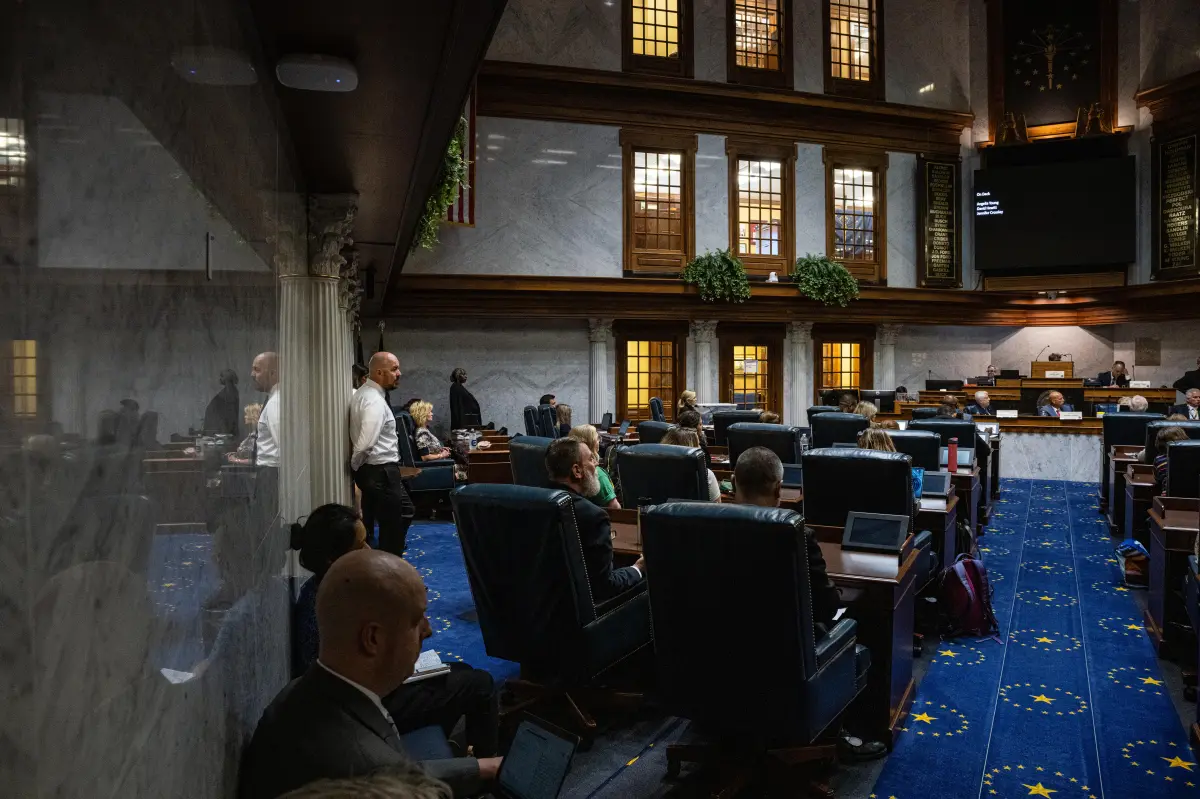
The path forward remains uncertain as the Indiana House prepares to vote on the new congressional map. If passed, the measure will move to the state Senate, which has scheduled a session for December 8th to make a “final decision” on any redistricting proposal. The outcome hinges on complex political calculations, internal party dynamics, and potentially national pressure. Whatever decision Indiana ultimately reaches, the intense focus on redistricting illustrates how technical boundary-drawing has become a central battleground in American democracy. As both parties seek every possible advantage in the narrowly divided House, ordinary citizens are left to question whether their votes truly matter in a system where district lines can be redrawn to predetermine electoral outcomes. The resolution of Indiana’s redistricting battle will not only shape the state’s political landscape but also contribute to the broader national conversation about representation, fairness, and the future of American democracy.