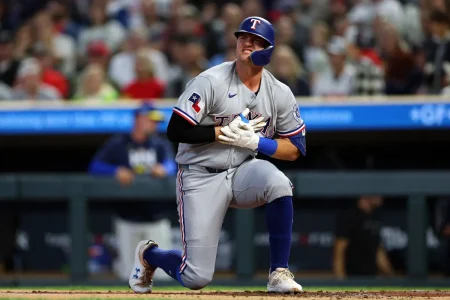






Jaxson Dart’s entry into the NFL as a rookie quarterback for the New York Giants wasn’t just about high-flying passes and game-winning drives; it was a brutal immersion into the unforgiving physicality of professional football. Last season, at just 22 years old, Dart discovered firsthand how vulnerable a quarterback can be in the league’s trenches, where players aren’t just throwing footballs but battling for survival against defenders who hit like freight trains. The once-celebrated prospect from Ole Miss, known for his arm strength and poise, found himself picking himself up off the turf more than he ever imagined. Picture a young man, eyes wide with a mix of determination and disbelief, as he navigates the chaos of Sunday afternoons, where every snap feels like a potential turning point in his career. Dart’s resilience shone through, but the toll was evident—he suffered a concussion in November and underwent no fewer than five concussion evaluations over a 10-game stretch, per ESPN. These weren’t minor setbacks; they were reminders of the NFL’s darker side, where one misstep could sideline a player’s dreams for weeks or longer. As fans watched from their couches, cheering for their favorite underdog, Dart embodied the spirit of perseverance, pushing through the pain to keep the Giants in contention despite an overall disappointing 4-13 record. His journey wasn’t just about stats; it was about adapting to a world where football’s glamour hides a reality of bodily harm, forcing him to confront questions about when enough is enough in a sport that demands everything from its stars. Still, Dart’s experience highlighted the stark contrast between college’s relative civility and the NFL’s aura of controlled violence, where even the most talented signal-callers must learn to protect themselves or risk becoming cautionary tales etched in highlight reels gone wrong.
The turning point for many came on December 1, when Dart took a particularly vicious hit from the New England Patriots’ defense, a moment that left fans gasping and raised eyebrows about his safety in such a high-stakes environment. Rubbing his helmet as he got back up, Dart shrugged off the questions afterward, offering a candid glimpse into the mindset that sees football not as a peril but as an inevitable thrill. “I understand the question, but this is football,” he said, his voice steady despite the throbbing in his head. “I’m going to get hit if I’m in the pocket or outside the pocket. I feel like I played this way my whole entire life. It shouldn’t be any shocker to anybody if you followed along with my career. We’re not playing soccer out here. You’re going to get hit. Things happen. It’s just part of the game.” These words painted Dart as the quintessential tough guy, unapologetically embracing the physical pounding as part of his identity, harkening back to his days juking defenders on high school fields or dodging linemen in the SEC. Yet, beneath the bravado lay a deeper truth: repeated concussions weren’t just bumps—they were red flags signaling long-term risks like chronic traumatic encephalopathy (CTE), a sobering specter looming over players’ post-career lives. Dart’s response wasn’t defiance for defiance’s sake; it was a defense mechanism, a way to reclaim agency in a game that strips it away with every crunching tackle. His running back, Cam Skattebo, echoed this sentiment to Rich Eisen in March, calling protection an absolute necessity for the offense, underscoring how Dart’s playstyle not only thrived on contact but also necessitated a fortress around him to avoid turning from hero to statistic. As the season wore on, this philosophy became a rallying cry, reminding everyone that in football, pain is currency, traded daily for the glory of gridiron glory, and Dart was all in, helmet to helmet.
Heading into the 2026 season, the Giants vowed to shield their young quarterback better, turning their No. 5 and No. 10 overall picks into bulwarks against the league’s brutality. With John Harbaugh at the helm as their new head coach—fresh off cementing the Baltimore Ravens as a dynasty of physical dominance for 18 years—the team aimed to infuse a similar identity into New York: big, bad, and unafraid to impose their will. Harbaugh, known for his no-nonsense approach and barbecue anecdotes, brought a playbook centered on mauling opponents rather than outsmarting them, regenerating the Giants’ roster with players who matched that mold. The departure of lineman Dexter Lawrence to the Bengals via trade netted the extra pick, paving the way for additions that promised to rewrite the Giants’ narrative from cellar dwellers to contenders. It was a strategic pivot, acknowledging that Dart’s talent alone wasn’t enough; he needed brethren who could absorb the blows so he could sling passes without fear. This draft class felt like a reclamation, a message to the NFL that the Giants weren’t bowing to adversity but bending it to their will, crafting a team where the emphasis on physicality mirrored Harbaugh’s Ravens tenure, where lines were drawn deep in the mud and every win was earned through sweat-soaked grit. For Dart, it meant evolving not as a bystander to the bashing but as the protected centerpiece, his rookie lessons forging a resolve to lead without breaking, surrounded by a wall of warriors ready to take the hits he once did.
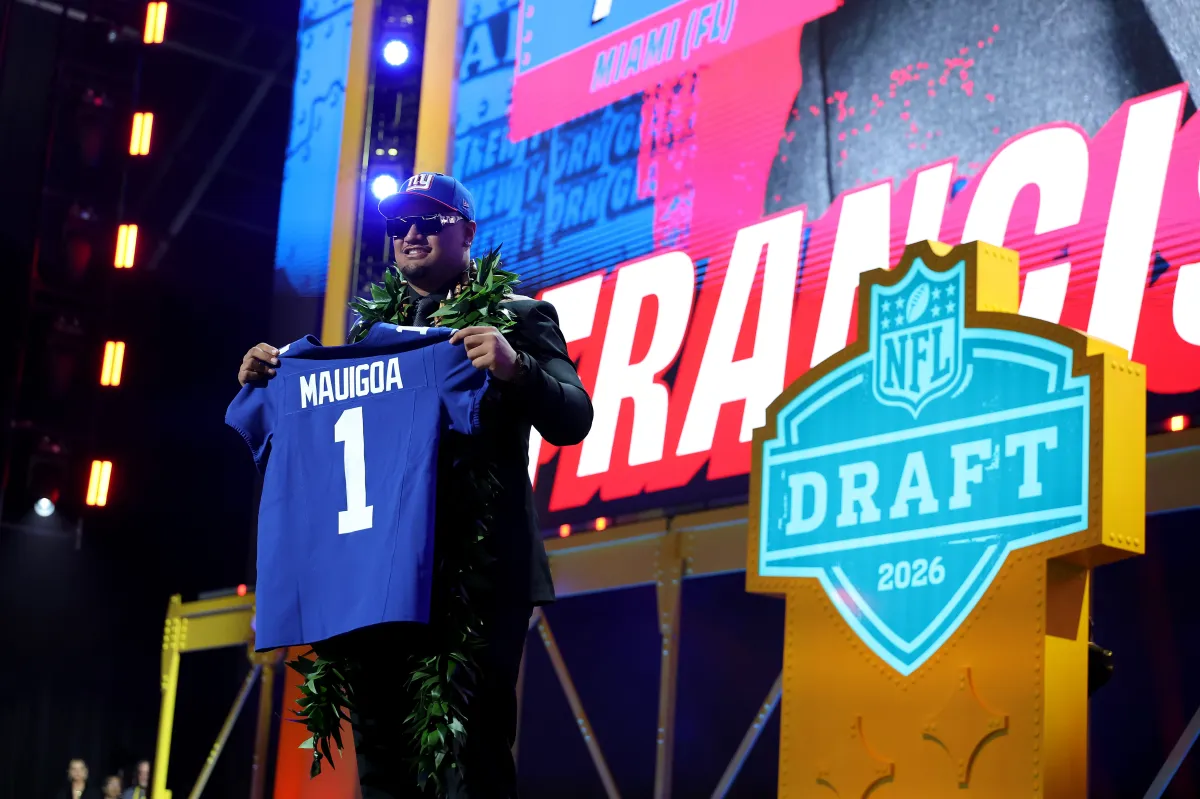
Central to this transformation was the selection of Francis Mauigoa, a former Miami offensive lineman plucked 10th overall on April 23, whose roaring passion quickly became the stuff of Giants lore. Mauigoa, a mountainous figure with a presence that commands attention, didn’t just step onto the draft stage; he exploded onto it, his eyes fiery with allegiance. “I’ll die by this [expletive], man,” he declared to ESPN’s Laura Rutledge, his voice breaking through the hushed auditorium, “I’m ready to die for you, man. I know a lot of things has happened, bro, but I’m ready to die for you, bro.” These weren’t hollow words—they were a vow, a hyperbole that captured the raw emotion of a man whose journey from South Florida to the NFL spotlight was paved with sacrifice and unyielding loyalty. At 6-foot-4 and 358 pounds, Mauigoa embodied the Giants’ new ethos: a blocker who doesn’t just protect but lives for the quarterback’s success, turning the offensive line into an impenetrable fortress. His willingness to “die” for Dart wasn’t just bravado; it resonated as a bridge between the anonymity of college and the spotlight of pro stardom, promising to shield his pocket like a human shield against the onslaught. For Giants fans, starved for passion after years of mediocrity, Mauigoa’s declaration ignited hope, tying into Harbaugh’s vision of a team where intangibles like toughness transcend talent, forging bonds stronger than any playbook. It humanized the draft process, reminding everyone that beneath the suits and scripts lay real men with real stakes, investing not just careers but hearts into a franchise desperate for revival.
The ripple effects of Mauigoa’s intensity reached beyond the locker room, surfacing even off the field among the Giants’ inner circle. At the glitzy Kentucky Derby on Saturday, amidst the sea of mint julep-sipping elites and thoroughbred pomp, Jaxson Dart and his girlfriend, Marissa Ayers, fielded questions about the lineman’s dramatic pledge, their laughter and mutual glances painting a picture of youthful enthusiasm amid the odds. “I’m pumped,” Dart told Sports Illustrated, the excitement bubbling in his voice as he recalled watching the draft unfold on TV, jaws dropping at the audacity of it all. Ayers chimed in with infectious energy, interrupting to add, “We were looking back and forth at each other, like, ‘Did he just say that?'” It was a moment of pure, unguarded joy, two twenty-somethings navigating fame’s whirlwind, where NFL hype intersects with personal life, turning intense football declarations into shared giggles. Dart elaborated, “He fired me up. He fired me up. But that’s exactly what you want. That’s the kind of player that I want to play for, and I think that he’s an amazing addition for our team. Just his physicality, his toughness, all of his intangibles that he brings to the table, it’s gonna be awesome for us.” Their exchange humanized Dart beyond the bruises and touchdowns, revealing a side often obscured by pads and plays: a guy in love, building a life with the woman who knows him best, finding inspiration in Mauigoa’s words as they echo in their conversations. The Derby backdrop, with its pageantry and page-turning drama, underscored how football’s passion bleeds into everyday moments, fostering connections that strengthen the team’s fabric, much like the unbreakable ties Harbaugh preaches.
As the Giants gears up to unleash this formidable lineup, the synergy between Arrowhead-bound leadership and relentless recruits hints at a rebirth, one where physicality isn’t just a tactic but a testament to overcoming past struggles. Backing Dart, whose rookie trials forged him like tempered steel, is Mauigoa, whose fervor now arms him with a mental edge, ready to endure slams for his QB’s sake. Reese, picked fifth, adds another layer of defensive ferocity, transforming the roster into a cohesive unit mirroring Harbaugh’s Ravens legacy of iron will. For Dart, Marcous Ayers—Marissa’s supportive presence—grounds him off the field, a reminder that resilience extends beyond the gridiron. The 2026 season looms as a crucible, where past concussions are lessons, not lamentations, propelling a narrative of redemption. Giants faithful, scarred by recent lean seasons, pin their hopes on this tableau of tenacity, envisioning squads dominating through sheer force. It’s a tantalizing visage of resurgence, where every hit fortifies instead of hinders, crafting epics from trials. In the end, football’s essence—raw, unyielding humanity—fuels this saga, binding players in purpose beyond wins. This isn’t merely a team evolving; it’s a brotherhood emerging, poised to redefine dominance.
Reflecting on the Giants’ trajectory, from Dart’s dizzying debut to Mauigoa’s impassioned oath, reveals a tapestry of grit weaving vulnerability with vigor. The franchise, once teetering on irrelevance, now pulsates with potential under Harbaugh’s stewardship, his ethos of mental and physical robustness infusing every decision. Dart’s concussion saga, punctuated by defiant declarations, wasn’t defeat but catalyst, awakening a protective fervor that draft picks like Mauigoa embody. Reese’s stifling presence amplifies defenses, creating harmonies of havoc that assail opponents relentlessly. Ayers’ commentary at the Derby adds poignant levity, humanizing stars amidst stardom’s swirl. Collectively, this ensemble transcends gridiron bounds, symbolizing triumphs over adversaries both external and internal. As 2026 beckons, anticipation builds for symphonies of power, where bruises bloom into badges of honor. The Giants aren’t simply playing football; they’re forging legends, inviting fans to join a communion of courage. In this odyssey, each plume of turf signals rebirth, challenging norms and inspiring dreams. Ultimately, the narrative eclipses games—it’s about indomitable spirits rallying against odds, etching timeless tales in NFL annals. Dart’s arc, from concussed rookie to shielded sovereign, epitomizes evolution, promising eras of ecstasy for the canyon blue faithful. This chapter, rich with emotion and endurance, heralds a resurgent reign, where football’s fury fuels fervor, uniting hearts in triumph’s embrace.