




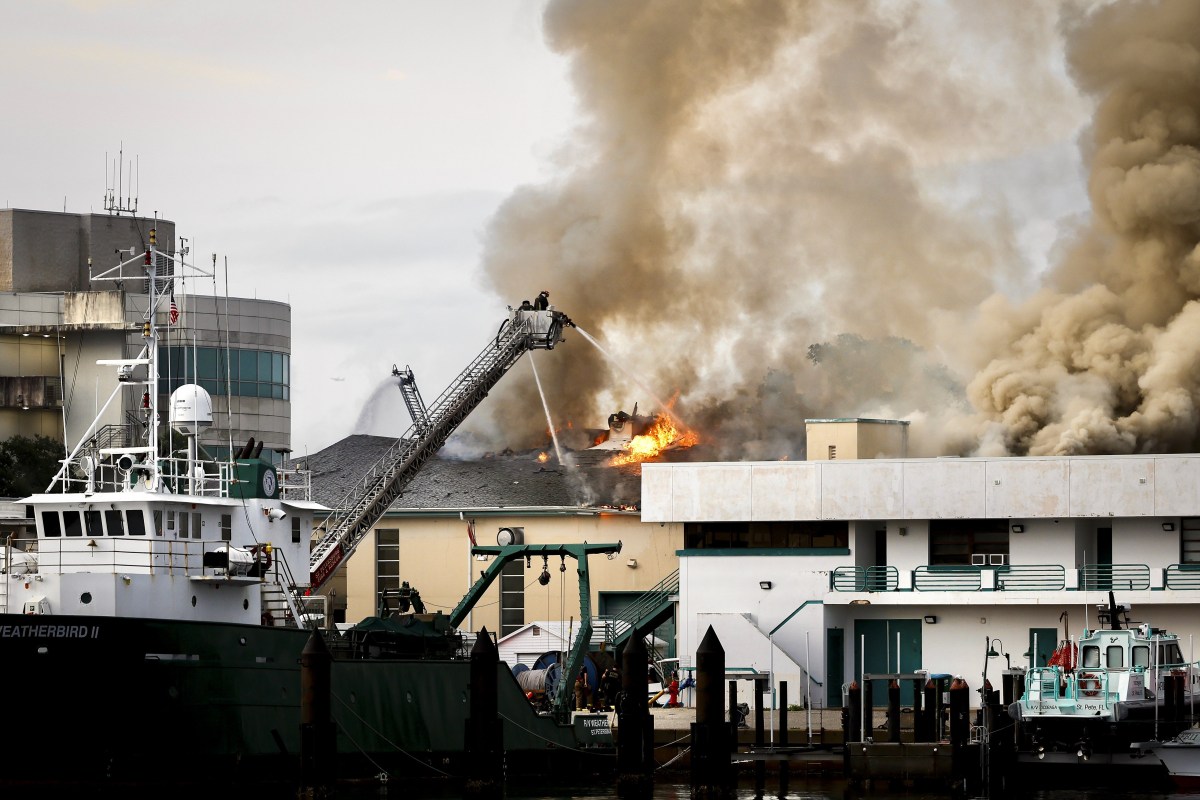
On a crisp Saturday evening in St. Petersburg, Florida, the University of South Florida’s St. Petersburg campus was thrust into unexpected chaos when a two-alarm fire erupted at the venerable Marine Science Laboratory (MSL) building. This historic structure, which has stood as a beacon of scientific inquiry for over eight decades, suddenly became a stage for billowing gray plumes of smoke that twisted skyward like defiant ghosts escaping the confines of old brick and mortar. Imagine the scene: students wrapping up late-afternoon lab sessions, perhaps marveling over samples of marine life harvested from the nearby Gulf waters, completely unaware that their routine world was about to flip. The fire, whose origins were shrouded in mystery at that moment, spoke volumes about the fragility of human endeavors against the whims of nature or machinery. As flames licked at the building’s weathered facade, painted in hues that have witnessed countless tides and scholarly discoveries, it felt as if time itself was folding in on this quiet corner of academia. Residents in nearby neighborhoods caught glimpses of the spectacle from their windows, some clutching phones to call loved ones—a stark reminder that even in insulated pockets of learning, emergencies can carve deep emotional scars. The 80-plus-year-old edifice, a repository of oceanographic secrets and tales of expeditions past, now faced its greatest peril, forcing everyone to confront how thin the veneer of normalcy truly is. Firefighters from St. Petersburg Fire Rescue arrived within minutes, their sirens piercing the twilight air, while USF police and other responders mobilized with the precision of a well-rehearsed ritual. For those who’d spent years in laboratories filled with the hum of pumps and the scent of saltwater, this wasn’t just a building—it was a sanctuary of knowledge, a place where breakthroughs in marine biology had unfolded under fluorescent lights. Parents imagining their children amidst such danger, faculty members racing across campus with hearts pounding—each person felt the weight of what could be lost: research into climate change impacts on coral reefs, studies on invasive species threatening local ecosystems. As smoke obscured the sunset, one could almost hear the whispers of past storms and floods that the building had weathered, now compounded by this human-made or accidental inferno. The evacuation, ordered swiftly and decisively, saw more than just occupants fleeing; it symbolized a collective exhale of relief mixed with dread at the unknown. No injuries were mercifully reported, a sliver of grace in an otherwise harrowing evening that spared lives even as it claimed spaces. Representatives from the university and St. Peterburg Fire Rescue reiterated this fact repeatedly through social media and announcements, emphasizing that while the flames raged, humanity prevailed intact. It’s heartening to think of the teamwork that enabled such an outcome—staff ushering vulnerable researchers and students out with calm urgency, neighbors offering water to weary onlookers, all while the air filled with acrid heat that stung the eyes and lungs. In a brief statement shared late that night, the university urged the community to steer clear of the area, framing it as a temporary setback in the grand tapestry of educational pursuit. “Please continue to avoid the area and follow all emergency guidance,” they wrote, their words carrying the warmth of concern for those who might jeopardize themselves in curiosity’s name. This wasn’t just protocol; it was a plea for unity, reminding everyone that safety is a communal thread. For researchers whose livelihoods hinged on the building’s equipment—mass spectrometers analyzing plankton populations or aquariums nurturing endangered species—the closure until further notice felt like a personal loss, akin to pausing a life’s passion. Yet, the affirmation that no one was hurt underscored a profound empathy: in moments of crisis, human connection trumps physical devastation. I can picture the relief washing over families as they received texts from their scholars safe at home, turning the night from nightmare to miracle. Expanding on the event, a spokesperson from USF confirmed to 10 Tampa Bay News that the blaze was indeed confined to the Marine Science Labs building, a hub of interdisciplinary marvels where oceanographers and biologists collided in pursuit of unraveling the sea’s mysteries. The structure, with its vintage architecture blending colonial elegance and functional lab spaces, had become more than walls—it was a living archive of coastal conservation efforts, from tracking sea turtle migrations to modeling the effects of rising sea levels on Florida’s shores. On that fateful Saturday, as smoke poured outward like a dragon’s breath, the scientific community grappled with the irony: a place dedicated to studying fiery natural phenomena through controlled experiments now facing literal fire of its own making. Conversations in surrounding offices would surely buzz with hypotheticals—was it an electrical fault born from outdated wiring, a chemical mishap in a reactor tank, or perhaps something as mundane as a discarded cigarette igniting forgotten paperwork? Each possibility evoked human stories: the lab assistant who’d forgotten to turn off a heater post-experiment, the professor who’d pushed deadlines into evening hours, unaware of perils. This humanization of the disaster transformed it from a mere news bite into a relatable tale of fallibility. For students like Jamie, a marine biology major who’d spent countless nights there dissecting fish samples, retreating to the building felt like retreating from a tempest; now, they watched from afar, fearing delays in their thesis on algal blooms. Faculty voices echoed sentiments of resilience, recalling how similar incidents in academia had often birthed stronger protocols, fostering a sense of shared vulnerability. The confirmation brought clarity, yet it invited speculation, painting a vivid picture of an institution’s pulse quickening under duress.
As the night deepened, the cause of the fire remained shrouded in investigation, a testament to the methodical patience of emergency responders who understood that rushing answers could perpetuate harm. Saturday night’s uncertainty lingered like mist over the bay, with experts from St. Petersburg Fire Rescue and USF Police sifting through charred remnants, supported by forensic teams equipped with tools that peeled back the layers of the inferno. It’s compelling to imagine the dedicated investigators—perhaps a fire marshal with decades of experience, poring over patterns of burn marks, correlating with electrical logs or eyewitness accounts, all while envisioning the “what ifs” that haunt their profession. For the public, this phase stirred a cocktail of emotions: frustration at delayed knowledge, empathy for those affected, and a genuine throbbing concern for the environment, as the lab housed not just data but live specimens that might have been imperiled. Hypothetical narratives swirled—had a power surge from outdated infrastructure sparked the chaos, mirroring broader issues of aging facilities in educational budgets? Or was it an accidental chemical reaction gone awry, highlighting the risks inherent in pioneering research? Each theory humanized the event further, drawing parallels to everyday mishaps: the forgotten coffee maker that ignited a kitchen or the overloaded outlet in a home office. Researchers, like Dr. Elena Vasquez, whose studies on deep-sea vents depended on the lab’s resources, expressed muted anxiety, their words evoking the human cost—delayed publications, scholarships on hold, dreams momentarily suspended. This wasn’t just a building burn; it was a disruption to progress against global challenges like ocean acidification. As investigations continued, community support flowed in, from alumni donations for temporary labs to online forums buzzing with encouragement, underscoring that humanity’s fires, both literal and figurative, forge stronger bonds. Even in speculation, there was hope, as each clue brought a step closer to prevention, transforming a scary episode into a lesson learned.
By Sunday morning, with the smoldering remains under guard, the incident began to weave itself into the broader narrative of St. Petersburg’s resilient spirit, a city where waterfront wonders and academic ambition converge. News crews from outlets like 10 Tampa Bay News captured the aftermath, their lenses framing plumes that had by then subsided into memory, yet the human element lingered in interviews with weary evacuees sharing breathless accounts. One can empathize with the volunteers who organized impromptu support stations nearby, offering blankets and hot meals to those displaced, embodying the kindness that emerges post-crisis. For the university community, impact assessments were underway: How might this affect upcoming student experiments, or the partnerships with local marine sanctuaries? Students reflected on the fragility of their passions, some penning heartfelt blogs about the building’s role in their journeys, turning loss into motivation. In this human tapestry, figures like Dr. Marcus Reed, a longtime oceanographer, spoke of phoenixes rising—perhaps this adversity would catalyze upgrades, infusing the rebuilt space with modern fire-safety features while preserving its historic charm. Emails circulated among staff, fusing sorrow with solidarity, as departments brainstormed temporary solutions like off-site research pods or virtual simulations. The news from AP added layers, connecting this local flare-up to national conversations on campus safety, prompting nationwide inquiries. No longer just a fire report, it became a story of endurance, where individuals—from freshmen explorers to seasoned professors—reaffirmed their commitment to science’s endless cycles. As days passed, updates promised the building’s return, fostering optimism that this chapter would end not in ashes, but in wisdom, with the marine sciences charting even bolder courses ahead.