

Paragraph 1: The Unlikely Spectacle and Its Instigator
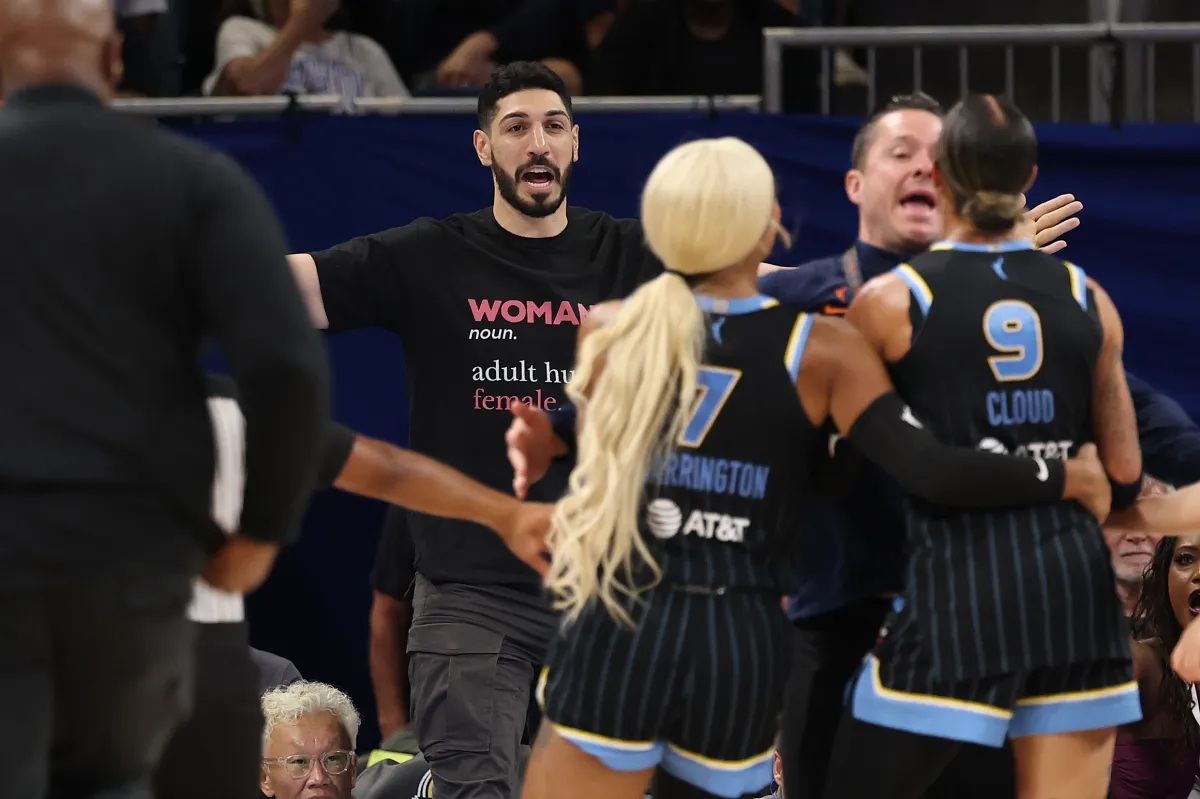
The collision of professional sports, culture wars, and a singular, provocative personality created a spectacle on a recent Sunday afternoon that transcended the basketball court itself. At the heart of it was Enes Kanter Freedom, a 34-year-old former NBA player known for his outspoken political activism and his recent, eyebrow-raising declaration that he planned to enter the 2027 WNBA draft. This announcement was not a solitary act of whimsy but a calculated response to comments made by Indiana Fever guard Sophie Cunningham, who had voiced her opposition to allowing transgender athletes to participate in girls’ and women’s sports. By positioning himself for a potential spot on a professional women’s roster, Kanter Freedom aimed to ignite a conversation—some would say provoke a firestorm—about the very definition of womanhood in sports. The spectacle reached its peak when Kanter Freedom attended a regular-season game between the Fever and the Chicago Sky, sitting courtside in a location that ensured maximum visibility. His choice of attire was no accident; it was a walking manifesto, with his shirt bearing the unmistakable and loaded assertion: “WOMAN noun: adult human female.” The slogan, a favorite of a certain feminist faction and a rallying cry for those opposed to transgender inclusion in sports, instantly transformed the athlete into a living emblem of a fiercely contested debate. He was no longer just a spectator but an agent of controversy, planted in the heart of the very league he wished to join, with his presence announcing that his declaration was not a fleeting provocation but a sustained campaign.
This wasn’t merely about a man seeking a roster spot for the sake of playing the game. His stated intention was far more nuanced, a political protest disguised as an application. He was positioning himself as a sort of human grift, a modern-day abolitionist, his declared desire to join the WNBA perfectly fired from an extension of his self-proclaimed mission to “protect” women’s sports. To Kanter Freedom and his supporters, the inclusion of transgender women in sports represents a fundamental violation of female athletes’ safety and fairness. His presence at the game was not as a fan or a legitimate prospect but as a provocateur, a disruption agent to the fragile peace of the athletic contest. To the players and a large swath of the sporting public, however, his presence was an unwelcome intrusion of politics into a business that was, and is, sorely needed in the face of constant threats. This calculated performance, from the draft announcement to the game, was a definitive, if polarizing, move in a high-stakes game of cultural chess, promising to be a story that would resonate far beyond the final score.
Paragraph 2: The Atmosphere Ignites at the Game
The energy in the arena was already electric, a charged atmosphere fitting a high-profile matchup between the Indiana Fever and the Chicago Sky. But the presence of Enes Kanter Freedom had introduced another energy into the mix, a current of tension that would linger alongside every play. The jeers of the crowd reacting to his mere presence would have been audible amidst the support, as his decision to sit courtside placed him in the very epicenter of the entire atmosphere. It was a target, an act of singular refusal to melt into the background of the crowd. The game itself—the basketball, the swift movement of athletic bodies, the strategies unfolding on the court—provided a counterpoint to the attention he was drawing. It was a contest where the players’ skills and their hard-earned, uncomplicated athleticism were the central focus for many, a stark contrast to the ideological battle that was brewing in the stands as the first half unfolded.
Eventually, the quiet threat of a confrontation grew into a loud, visceral reality. As a timeout in the third quarter, with Tash Cloud of Chicago Sky, a guard known for her intense defensive play and the fervor on her shoulder, took it upon herself to confront the disruption eating away at the game’s core. Witnesses described it as Cloud shouting at Kanter Freedom with biting, heated words as she stalked toward his seat. He stood up, meeting the sudden aggression, his bulky frame coming into a complete contrast with the athletes’ lithe and powerful forms. The Jewish coach’s expression began to be replaced by the spectators’ raw, unfiltered emotion. What had been a simmering tension exploded into a full-blown spectacle, one that had been set up as a direct missile, and Kanter Freedom, still a physically imposing professional athlete, was no longer a provocateur holding a sign but an active participant in a volatile standoff on the sidelines.
Paragraph 3: An Ejection and a Social Media Firestorm
It only took a matter of seconds for the drama to reach its zenith. Security personnel, trained to diffuse these situations, reacted immediately, a neutral force in a confrontation filled with tension. They intervened between a former professional athlete and a current pro, and in a scant few moments, it was clear that Kanter Freedom was the one to sacrifice for the good of the game. He was escorted from the sidelines, out of the arena, in the middle of a frantic third quarter, as the fever for the actual sport’s conclusion. The immediate result was an expulsion, a powerful rebuke to the controversial figure’s intrusion into a world where he was unwanted. It was a decision that drove a wedge of relief and concern. The game itself could proceed in a semblance of normalcy, but the the huge disruption had been what unfolded. They had collaborated to create a memory even before the final buzzer.
But for Kanter Freedom, the ejecting was not a defeat. It was an opportunity for an instant rhetorical victory, to solidify his narrative for his millions of followers. His immediate reaction was a statement on social media, crafted for maximum virality: “I just got kicked out of a @WNBA game for supporting WOMEN! Let that sink in, AMERICA!” He was using the expulsion as proof that his stance was under attack, a red badge of courage in the culture war. The platform became a battlefield where his supporters would rally, framing the ejection as an act of martyrdom, a demonstration that their movement, too, is being silenced. The fact that he was pulled from an arena for the woman who disagreed with him became a headline in itself, a conclusion that created its own story. With the referee’s decision rack up, his own country, and the constant thread of a viral hours-long tirade, this was no longer just a sports story, but a required flashpoint for the entire culture.
The interjection also came with a ripple effect on the team dynamics, specifically for Tash Cloud. She chose not to speak to the media after the game, meeting instead with a meeting of her team’s brass and WNBA security. This silence was clearly intentional, sketched to avoid handing a microphone to anyone to turn the whole evening into a contest. Sky head coach Tyler Marsh later tried to contain the damage, explaining Cloud’s physical absence must be treated as a word that was in the third-person: “I talked to the team and Tash didn’t want to feel like she was a distraction. I told her she wasn’t.” Marsh was drawing a line in the sand. He went on to frame Cloud’s role as an avenging protector, a player who is a shield not just for her teammates but also for the sanctity of women’s sports, her entire identity as an adult human female being a core. He positioned her in the debate, saying, “She’s passionate and she’s passionate about the things she believes in and she’s passionate about her teammates, and we’re passionate about her.” Marsh’s language, suggesting that Tash protects “people that need to be protected,” subtly cast her as a literal guardian against the perceived outsiders who would do harm to her profession.
Paragraph 4: The League’s Massive Problem of Interpretation
The incident at the game became a mirror for the central policy question that has fundamentally unsettled the WNBA. The league’s rule book states: “only players who are women are eligible to play in the WNBA.” At first glance, that seems clear. Yet, in the 21st-century context, that wording became an open invitation for a dramatic, urgent power struggle over the meaning of “woman.” Does it refer, in the strictest terms, to a person whose sex assigned at birth was female, or does it extend the opportunity to anyone who self-identifies as female? This is the kernel of the entire conflict, one that seems to be a microcosm of a broader societal fight. Kanter Freedom’s T-shirt was only a visceral, stark representation of the same question, a difference of emphasis that has split the country. The WNBA’s leaders, impervious, had been thrust into the position of having to interpret this, to find a definition in legal and policy language that holds within a league that the gender of its players is often its most sacred element.
The news stored in the immediate aftermath was that WNBA team presidents had hastily convened a meeting to address the continued issue of eligibility rules for transgender athletes. This was the official body’s direct response to the incident orchestrated by Kanter Freedom in Indianapolis—a sign that his politics, his very entrance into a room, could force a change in governance. The league was now publicly wrestling with the ambiguity of its own constitution, pulled between the advocacy of groups who argue for the inclusion of transgender women and the loud, often ugly, demand from a more conservative, vulnerable section to protect Title IX-female sports from what they call a biological threat. An official statement on gender eligibility rules is projected ahead of the next season. This decision, packaged as a clarity measure, will likely have a devastating impact on the sports landscape, because the potential for legal briefs and sponsor advisories will hang over it as it is being crafted.
The choice before the league is a kind of a nightmare scenario, caught between two opposing, existential concerns. One suggestion is that embracing transgender athletes is a defender of the inclusive, forward-thinking spirit of a women’s league, but is often a risky position in the court of public opinion. It invites the flood of a sustained, expensive, and coordinated legal campaign from the conservative right. The other, a more extreme stance, that reiterates that only those assigned female at birth can compete, is legally safer for now but invites a massive humanitarian and commercial controversy, being a stunning alien opposite for the progressive fanbase that the WNBA relies upon. By the same certain outcome, a handful of athletes are likely to be alienated, and the season will be more of a cultural battleground for the prism of the conflict. The league’s reality gives a frame to the very fight that Kanter Freedom wanted to force, making the end resolution a desperate one, one that has no exact precedent to follow.
Paragraph 5: The Cultural Divide and Beyond the Court
The wasn’t just about the game; it was a warning that the weaponization of a person’s presence can alter the entire pulse is away from the sport. The official Peter’s dissent reminded the world that a player is not on the roster and cannot control the outcome of the actual game. The star of the show was the political chess; the controversy is a stand-in for a referendum on the times. The splash of the former NBA player had his priorities set; he was there to take a stand, and he had no intention of letting a fresh dunk or foul change what he was going to say. The reaction to the game has in interpret a level of physical proof that sports that day had become a stage for what they deeply believed was an existential fight over sex. The sports world, with its deep-seated gender split, is turning into a litmus, and the live turf was the game.
The irony of the whole episode is that protestors, like Kanter Freedom, who uses his own male athletic past to highlight the supposed contradiction of the league is not an accident. He himself is a 34-year-old man, in great physical shape, who’s gone to a WNBA court to “apply” for the female roster, taking up someone’s potential spot, all to make a political statement. The move was a mightier iron because it burns on the uncomfortable truth that the WNBA and its future is a battleground of public opinions that the other side uses as a testing ground. His attempts, and the resulting fallout, was a demonstration of how the ideas of “fairness” and “biological truth” are being thrown like a pick-and-roll, in a lever to drive modern sports, transforming the athletes into cultural pallets for politicians and public figures.
What we saw was a bit of explicit fascism, which is about to be a normal theme of their contests from now on. The Kaht’s event will be a cracked mirror for the “for women” to see a distorted version of what are they are fighting for. It is not just about trans inclusion; it is the fight for who is allowed to define what meant to be a woman in public, and set the boundaries in the sacred, sports-stake environment. It is a fight about authority, about who has the authorization to speak for the women they are attempting to shield. The view of Tash Cloud protects her life, WNBA security a person who is empowered, vibes peace with the energy of the game. But a Kanter Shed once to talk the “actual truth” has even being ejected from the arena. The region has become an unforgiving arena for a soundbite, not a real conversation, and those in the crosshairs are caught in a permanent spotlight.
Paragraph 6: A Cultural Crossroads in Twilight Logic
The events of “that” evening have become a microcosm, a very condensed lesson of the culture wars in modern America. There are those who see it as a necessary, ugly, and unpalatable first step towards acknowledging a “biological reality” in athletic spaces, a stand against a movement that they believe has gone off the rails. They came out of the stadium seeing Enes Kanter’s ejection as a symbolic martyrdom—a man who was punished for daring to voice a belief that they hold close to their hearts. He took two actions to force a discussion, and for a community that feels righteously silenced, being forced out is the perfect story of a “truth-teller”. On the other side, there is a powerful, proud coalition of people who denounces his presence in the stadium, his stunt, and his posture as not an act of valor, but of blatant, delegitimizing, and hateful pretending as an intervention. They saw him as a bad-faith actor who was using the platform of women’s sports to fuel a fear, not as a man who wished to hoist the league on its level.
The legacy, going forward, is not likely to be about the outcome of what the Fever encountered over the Sky, but rather, the game that was the defining visual, the details of which will be narrated in a thousand articles of the night the controversy lost. It will continue to be a point of a reference for the next year that it has ended up being framed as a haranguing contrast between the face of the old-world way of play and the new face of global politics. The WNBA and its executives have now on a clear path that must respond to the demands of smothering pressures and turn into a document. The outcome of that deliberation will be as important as any game or that league title. It will draw future lines in the sand, deciding who is set to play and who will be relegated to the stands. The question, still unanswered, is, “What is a woman?” and in the league’s core, professional sports need an official interpretation, the first move in this brand-new era. The ripple of this story, kicked from a powerful center’s bad moment of uniformed shout, was rath, a perfect example of another era that is hurting to be born or tired to give up.
With the Kansas in the rearview, they see of a world that has changed. There has been a line drawn in the arena, but the outcome is far from settled. It is not about who earned the foul or the bracket. We are perched in the epicenter of a huge, directional shift in the definitions of his policy. Sports has just become one unifying language, but it’s of now a weapon, a tool of the would-be narrative, a social parasite. The most was drawn — not just to physically sit someone in a blur of a blonde, but also a gigantic line through the fabric of the sport. The one night at a WNBA game has become a vague warning that there is no idle slide under the fluorescent lights of the coliseum—the body on and off the court will continue to carry on full.
The game result was, in the end, a necessary formal missive, almost an afterthought, to the unpredictable attention of a political event. The outcome on the court status will be remembered for a generation, but mostly as the visuals of a man in a shirt, and a woman player energizing her anger against him, in that gray-middle of a counterset, security guards leaping forward, torn between a sport, its history, and the culture. It’s, in the end, the defining image of an era where even in the quadrants of a basketball court, nothing is apolitical anymore. That’s not a single event, but an inevitable collision that in the 21st-century flat, shadowed in the heart of a conservative, ideological, political-litmus sport of a single game. These are the new duel of culture, fought out in the company of a deadline, written not by teams but from the endless scroll. And a game is slightly about a ongoing story, which will be affected long after the final score had been decided.